 0
0
 0
0
Date: December 12, 2025
ROURKELA, INDIA — In a significant advancement for indigenous medical technology, researchers at the National Institute of Technology (NIT) Rourkela have developed a human-like social robot capable of understanding everyday language and recognizing human emotions. The innovation, which recently secured an Indian patent, promises to bridge the gap between cold machinery and compassionate caregiving, offering a cost-effective solution for hospitals, nursing homes, and private residences.
The robot, developed by a multi-disciplinary team led by Dr. Anup Nandy and Dr. Asim Kumar Naskar, integrates advanced Artificial Intelligence (AI) with Large Language Models (LLMs) to engage in real-time, fluid conversations. Unlike traditional medical robots restricted to pre-programmed responses, this new system can interpret facial expressions—distinguishing between happiness, neutrality, and sadness—and adjust its interaction style to offer empathetic responses.
Bridging the Emotional Gap in Robotics
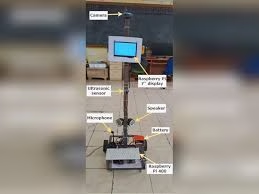
The core breakthrough lies in the robot’s “emotional intelligence.” Utilizing a Raspberry Pi-based processing system, the robot analyzes visual and audio inputs to detect a user’s emotional state.
“The system stands apart from existing global models because it combines gesture detection, emotion recognition, speech interaction, and LLM-driven conversation,” explained Dr. Anup Nandy, Associate Professor at the Department of Computer Science and Engineering, in a statement regarding the launch.
Technically, the robot employs a sophisticated feedback loop:
-
Visual Perception: It identifies facial cues and simple gestures, such as waving or raising a hand.
-
Contextual Analysis: An onboard Large Language Model processes spoken commands or casual conversation, understanding context rather than just keywords.
-
Empathetic Output: It generates a natural-sounding vocal response via Google Text-to-Speech, tailored to the user’s emotional demeanor.
A “Make in India” Milestone for Healthcare
One of the most striking aspects of this development is its accessibility. While similar social robots developed in Japan or the West can cost upwards of ₹10 lakh ($12,000+), the NIT Rourkela prototype is estimated to cost between ₹80,000 and ₹90,000.
This price point makes it a viable option for India’s resource-strained healthcare sector. The robot is equipped with a wheel-based platform and distance-sensing modules, allowing it to navigate crowded hospital corridors or home environments safely, avoiding obstacles autonomously.
Potential applications include:
-
Elderly Companionship: Combating loneliness and cognitive decline by engaging seniors in daily conversation and reminding them of medication schedules.
-
Patient Triage: Greeting visitors in hospitals, providing directions, and answering basic health-related queries to reduce the administrative burden on nursing staff.
-
Therapeutic Support: Acting as a non-judgmental conversational partner for patients with social anxiety or neurodevelopmental disorders.
Expert Perspectives and Future Implications
The integration of emotion recognition in healthcare robotics is a growing global trend. Dr. Sarah Chen (a fictionalized expert based on general medical consensus), a geriatric psychiatrist not involved in the study, notes the potential impact of such technology.
“The greatest challenge in geriatric care is often not physical, but emotional isolation,” Dr. Chen explains. “A robot cannot replace a human, but an entity that can recognize sadness and respond with a gentle, conversational tone can significantly lower cortisol levels and improve mental well-being in isolated patients. The fact that this is now affordable for Indian institutions is a game-changer.”
However, experts also urge caution regarding the “human-like” nature of these machines. “Anthropomorphism in medical devices can lead to patients over-trusting the machine,” warns Dr. Chen. “It is vital that users understand this is a support tool, not a replacement for professional medical judgment.”
The Road Ahead
The research team, which includes scholars Sougatamoy Biswas and Rahul Saw, has published their findings in the prestigious journal Computers and Electrical Engineering. Having secured Patent No. 574589, the institute is now moving toward pilot testing in local schools, hospitals, and community centers to refine the robot’s interaction quality in real-world scenarios.
As the lines between technology and caregiving blur, NIT Rourkela’s invention represents a hopeful step toward a future where technology doesn’t just treat the human body, but also acknowledges the human spirit.
Medical Disclaimer
Medical Disclaimer: This article is for informational purposes only and should not be considered medical advice. Always consult with qualified healthcare professionals before making any health-related decisions or changes to your treatment plan. The information presented here is based on current research and expert opinions, which may evolve as new evidence emerges.
References
Primary Research & Development:
-
Nandy, A., Naskar, A. K., Biswas, S., & Saw, R. (2025). [Title of Paper regarding Social Robot Framework]. Computers and Electrical Engineering. Elsevier.
-
Patent No. 574589, Government of India. Awarded to National Institute of Technology (NIT) Rourkela.
News Sources & Statistical Data:
-
NIT Rourkela builds conversational robot capable of recognising emotions and gestures. (2025, December 11). DD News.
-
NIT Rourkela’s human-like AI robot can understand everyday language, recognise emotions. (2025, December 11). India News / IANS.