 0
0
 0
0
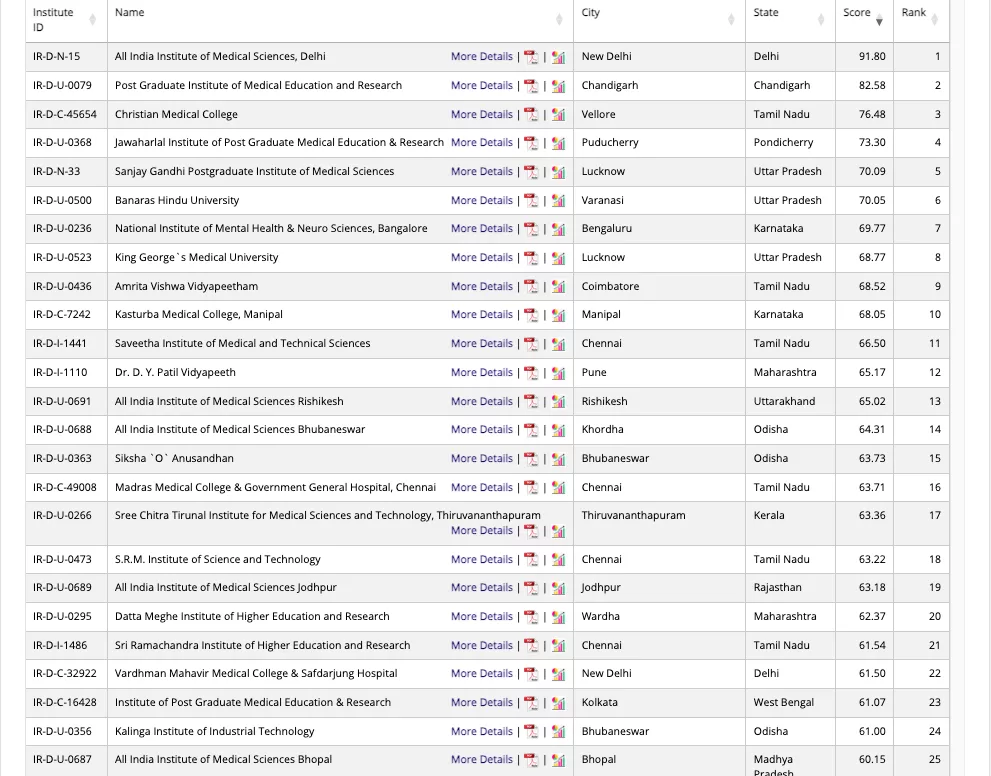
The National Institutional Ranking Framework (NIRF) 2025 medical rankings were released on September 4, 2025, affirming the All India Institute of Medical Sciences (AIIMS), Delhi as the top medical institute in India for the tenth consecutive year. With a commanding score of 91.80 out of 100, AIIMS Delhi continues to set the benchmark for medical education and research quality in the country. This year’s rankings highlight a rigorously assessed list of more than 100 medical institutions evaluated on key parameters including teaching quality, research output, graduation outcomes, outreach and inclusivity, and overall perception among stakeholders.
The prestigious second place has been secured by the Post Graduate Institute of Medical Education and Research (PGIMER), Chandigarh, followed by Christian Medical College (CMC), Vellore in third. Other top-ranking institutions include the Jawaharlal Institute of Post Graduate Medical Education and Research (JIPMER), Puducherry, and Sanjay Gandhi Post Graduate Institute of Medical Sciences, Lucknow completing the top five.
The NIRF rankings, under the Ministry of Education, are widely regarded as among the most authoritative evaluations of academic and research excellence in Indian higher education. They influence decisions by students, parents, and education policymakers alike.
Key Findings and Ranking Details
AIIMS Delhi’s dominance reflects consistent high performance across multifaceted criteria: exceptional teaching and learning resources, robust research activities, superior graduation outcomes, and strong outreach programs that promote inclusiveness and access. The institute’s reputation within the medical community and public perception also contributes significantly to its ranking.
The top 10 medical colleges by NIRF 2025 are:
| Rank | Institution | Location | Score |
|---|---|---|---|
| 1 | All India Institute of Medical Sciences (AIIMS) | Delhi | 91.80 |
| 2 | Post Graduate Institute of Medical Education & Research (PGIMER) | Chandigarh | 82.58 |
| 3 | Christian Medical College (CMC) | Vellore, Tamil Nadu | 76.48 |
| 4 | Jawaharlal Institute of Post Graduate Medical Education & Research (JIPMER) | Puducherry | 73.30 |
| 5 | Sanjay Gandhi Postgraduate Institute of Medical Sciences (SGPGI) | Lucknow | 70.09 |
| 6 | Banaras Hindu University (BHU) | Varanasi | 70.05 |
| 7 | National Institute of Mental Health & Neuro Sciences (NIMHANS) | Bengaluru | 69.77 |
| 8 | King George’s Medical University | Lucknow | 68.77 |
| 9 | Amrita Vishwa Vidyapeetham | Coimbatore | 68.52 |
| 10 | Kasturba Medical College | Manipal | 68.05 |
These results exemplify the geographic diversity in India’s premier medical education landscape, spanning multiple states and regions.
Expert Commentary and Context
Dr. Randeep Guleria, Director of AIIMS Delhi, noted, “These rankings recognize the hard work and dedication of our faculty and students. They also provide a benchmark for us to continually improve and strive for excellence.” His comments underline the importance of such rankings in motivating ongoing institutional development.
Professor K. Srinath Reddy, President of the Public Health Foundation of India, emphasized the need for broader assessment criteria, “While the current parameters are comprehensive, there should be more focus on the social impact of the medical colleges and their contribution to the healthcare system of the country.” This highlights potential future shifts in ranking frameworks that could integrate community service and public health impact more explicitly.
NIRF Ranking Methodology
The NIRF ranking process incorporates five key weighted parameters:
-
Teaching, Learning and Resources (TLR): Evaluates faculty qualifications, student-teacher ratios, and infrastructure.
-
Research and Professional Practice (RP): Assesses research output, patents, projects, and professional engagement.
-
Graduation Outcomes (GO): Measures student performance through graduation rates, placements, and higher studies.
-
Outreach and Inclusivity (OI): Focuses on diversity related to geography, gender, economically disadvantaged groups, and facilities for differently-abled persons.
-
Perception (PR): Captures stakeholder and peer perception of the institution’s reputation.
The comprehensive methodology balances objective data with subjective reputation metrics, aiming to produce a holistic picture of institutional quality. This year saw the inclusion of new indicators aligned with Sustainable Development Goals and National Education Policy priorities.
Public Health and Educational Implications
For prospective medical students and parents, the NIRF rankings provide a data-driven tool to evaluate medical colleges beyond anecdotal reputation, helping guide career-shaping decisions. For policymakers, they highlight areas for investment, quality improvement, and resource allocation.
The rankings reinforce India’s strengths in premier medical education institutions while also suggesting the need to widen quality benchmarks to include social impact and community health contributions—factors critical to the national healthcare ecosystem.
Limitations and Counterpoints
Despite their robust methodology, NIRF rankings have limitations, including their dependence on self-reported data from institutions, potential bias toward research-intensive centers, and relative underemphasis on rural outreach and social medicine. Experts suggest that future rankings could incorporate more granular assessments of community health impact and health equity initiatives.
Conclusion
The 2025 NIRF medical rankings affirm AIIMS Delhi’s outstanding leadership in Indian medical education while showcasing a competitive cohort of institutions excelling in various dimensions. As India continues to expand healthcare access and improve medical education, such rankings will remain vital to fostering excellence balanced with social relevance.
Medical Disclaimer: This article is for informational purposes only and should not be considered medical advice. Always consult with qualified healthcare professionals before making any health-related decisions or changes to your treatment plan. The information presented here is based on current research and expert opinions, which may evolve as new evidence emerges.
References
-
Ministry of Education, Government of India. National Institutional Ranking Framework (NIRF) 2025: Medical Rankings. nirfindia.org. Published September 4, 2025.
- https://www.nirfindia.org/Rankings/2025/MedicalRankingALL.html
- https://www.hindustantimes.com/education/news/nirf-rankings-2025-aiims-new-delhi-emerges-top-medical-college-in-india-check-5-best-medical-colleges-101756965121949.html
- https://www.shiksha.com/medicine-health-sciences/articles/top-20-medical-colleges-in-india-based-on-nirf-ranking-blogId-144323
- https://indianexpress.com/article/education/nirf-rankings-2025-live-updates-education-minister-moe-top-colleges-universities-list-released-neet-jee-cat-clat-10228685/
- https://timesofindia.indiatimes.com/education/news/nirf-2025-medical-rankings-aiims-delhi-tops-the-list-for-the-tenth-year-in-a-row-check-top-10-here/articleshow/123697606.cms
- https://www.nirfindia.org/Rankings/2025/MedicalRanking.html
- https://thedailyguardian.com/news/education/nirf-ranking-2025-out-check-the-new-list-of-best-medical-colleges-652432/
- https://news.careers360.com/nirf-ranking-2025-india-live-engineering-management-medical-law-colleges-universities-iit-nit-jnu-du-nirfindia-org-education-news
- https://www.nirfindia.org/Rankings/2024/MedicalRanking.html
- https://www.hindustantimes.com/education/news/nirf-ranking-2025-live-updates-india-rankings-engineering-management-medical-rank-iit-madras-iisc-du-jnu-nirfindia-org-101756951453473.html