 0
0
 0
0
GENEVA – In a move set to fortify the global defense against a paralyzing childhood disease, the World Health Organization (WHO) announced on February 13, 2026, the prequalification of an additional manufacturer for the novel oral polio vaccine type 2 (nOPV2).
The designation granted to India-based Biological E. Limited (BioE) marks a critical expansion of the global vaccine supply. By meeting stringent international standards for quality, safety, and efficacy, BioE joins Indonesia’s PT Bio Farma as a full-scale producer of the vaccine. This development allows United Nations agencies, including UNICEF, to purchase the vaccine at scale, ensuring a more resilient and diversified supply chain for countries currently battling poliovirus outbreaks.
A Scientific Shield Against Variant Polio
The nOPV2 vaccine is at the heart of the Global Polio Eradication Initiative’s (GPEI) strategy to eliminate circulating vaccine-derived poliovirus type 2 (cVDPV2). While the world was certified free of wild poliovirus type 2 in 1999, “variant” strains can still emerge in under-immunized communities.
Traditional oral vaccines, while effective, contain a weakened virus that can, in rare instances, mutate and regain virulence as it passes through an unprotected population. The “novel” version (nOPV2) was specifically engineered to be more genetically stable.
“Expanding nOPV2 manufacturing is essential to ensuring countries can respond quickly to variant poliovirus outbreaks,” said Mike McGovern, Chair of the Polio Oversight Board of the GPEI. “Biological E’s prequalification status strengthens the global supply and brings us closer to ending these outbreaks for good.”
Data from the field supports this optimism. Since its initial rollout under emergency protocols in 2021, over 2 billion doses of nOPV2 have been administered. Research indicates that nOPV2 is approximately 80% less likely to seed new outbreaks compared to its predecessor, the monovalent oral polio vaccine type 2 (mOPV2).
The Road to Eradication: 2026 Progress
The timing of the WHO announcement follows the 158th session of the WHO Executive Board earlier this month, where Director-General Dr. Tedros Adhanom Ghebreyesus highlighted significant gains.
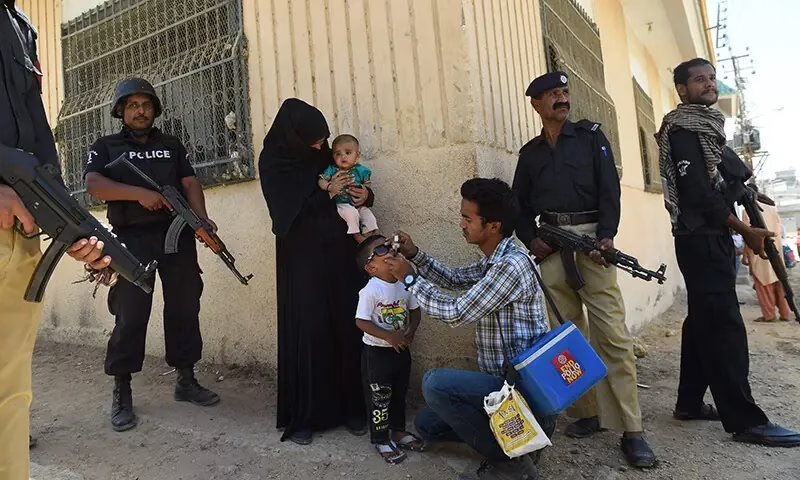
In 2025, the world saw a notable decline in wild polio cases—down to 41 cases from 99 the previous year—concentrated primarily in just 24 districts across Pakistan and Afghanistan. However, the persistence of variant poliovirus in regions like Africa and parts of Southeast Asia remains a “Public Health Emergency of International Concern.”
Manufacturing at Scale
The new prequalification allows Biological E. to manufacture the vaccine end-to-end at its integrated facility in Hyderabad. The company is expected to produce roughly 600 million doses annually.
“With Phase II WHO Prequalification enabling full end-to-end manufacturing, global supply becomes more resilient and responsive,” noted Mahima Datla, Managing Director of Biological E. Limited. “Every delay in outbreak response carries real risk for children and communities.”
What This Means for Public Health and Parents
For the general public, particularly in regions where polio remains a threat, the availability of nOPV2 is a game-changer for several reasons:
-
Rapid Response: A larger stockpile means health authorities can launch “mop-up” vaccination campaigns within days of detecting a virus in wastewater or a clinical case.
-
Safety Profile: The vaccine provides the same high level of intestinal immunity as older versions but with a significantly lower risk of the virus reverting to a form that causes paralysis.
-
Operational Flexibility: The BioE vaccine can be stored for up to six months at standard refrigerator temperatures ($2^\circ\text{C}$ to $8^\circ\text{C}$), making it easier to transport to remote or rural areas with limited deep-freeze capacity.
Limitations and Challenges
Despite the technical superiority of nOPV2, experts warn that a vaccine is only as effective as its delivery. “The seeding risk is not zero,” health officials noted during the Executive Board discussions. In areas where vaccination coverage is extremely low, even a more stable vaccine can eventually mutate if it circulates long enough.
Furthermore, nOPV2 is primarily an outbreak-response tool. For routine, individual protection, the Inactivated Polio Vaccine (IPV)—an injectable, non-live vaccine—remains the global standard for preventing paralysis in children.
The “Final Mile” of Polio
The global community has spent decades and billions of dollars chasing the final cases of polio. While the virus is “just a plane ride away” for any country, the addition of a second massive manufacturing hub for nOPV2 provides the logistical “teeth” needed to bite back at new detections.
As the GPEI extends its strategy through 2029, the focus remains on high-quality surveillance and ensuring that every child, regardless of how “hard to reach” they may be, receives the drops that could save them from a lifetime of paralysis.
Medical Disclaimer: This article is for informational purposes only and should not be considered medical advice. Always consult with qualified healthcare professionals before making any health-related decisions or changes to your treatment plan. The information presented here is based on current research and expert opinions, which may evolve as new evidence emerges.
References
Studies & Official Reports:
-
World Health Organization (2026). WHO prequalifies an additional novel oral polio vaccine, strengthening global outbreak response. Departmental Update, Feb 13, 2026.