 0
0
 0
0
New Delhi — In a potential breakthrough for gastrointestinal health, researchers at the Indian Institute of Technology (IIT) Delhi and the All India Institute of Medical Sciences (AIIMS) have developed a miniaturized, ingestible device capable of collecting pristine microbial samples directly from the small intestine.
The innovation, announced Tuesday, addresses a long-standing blind spot in medical diagnostics: the inability to easily access the upper gastrointestinal (GI) tract without invasive procedures. The research has been published in the prestigious peer-reviewed journal Small.
Opening a “Hidden Universe”
While the human gut microbiome—the trillions of bacteria, fungi, and viruses living in our digestive tract—has become a hotbed of medical research, most current data relies on stool samples. However, medical experts have long noted that stool samples predominantly reflect the environment of the colon (large intestine), failing to capture the unique and dynamic ecosystem of the small intestine where most nutrient absorption occurs.
“To say there is a hidden universe of living microbes in our body is no exaggeration but a scientific reality,” said Prof. Sarvesh Kumar Srivastava, Principal Investigator at the Medical Microdevices and Medicine Laboratory at IIT Delhi, who led the engineering team. “Just as we send rovers to explore outer space, we need miniaturized devices to explore the inner space of the human body.”
How It Works: A “Rover” for the Gut
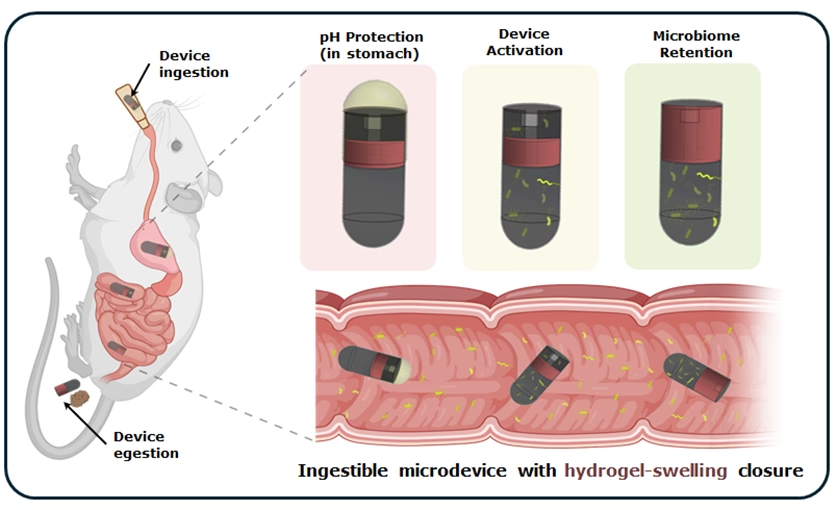
The new device, described as being roughly the size of a grain of rice, utilizes a sophisticated, battery-free design relying on the body’s own chemistry to operate.
According to the study, the device features a specialized 3D-printed shell encased in an enteric coating. This coating is pH-sensitive: it remains sealed shut in the highly acidic environment of the stomach (pH 1–1.5), protecting the sampling chamber from contamination. Once the device passes into the small intestine, where the pH rises to between 3 and 5, the coating dissolves.
This triggers a unique mechanism involving a polyacrylate hydrogel. The hydrogel expands, opening the device to collect a precise sample of the intestinal fluid and microbes. As it continues to expand, it eventually reseals the device, locking the sample inside to protect it from the colon’s environment as it exits the body naturally.
A Diagnostic Game-Changer
The implications for public health are significant, particularly for diagnosing conditions like Small Intestinal Bacterial Overgrowth (SIBO), malabsorption issues, and inexplicable metabolic disorders.
Current methods for sampling the small intestine are limited. “Existing tools are invasive, such as endoscopy, which requires sedation and can be uncomfortable for patients,” explained Dr. Samagra Agarwal, co-senior author from the Department of Gastroenterology at AIIMS New Delhi. “Alternatively, doctors rely on indirect methods like breath tests, which can lack precision.”
“The small intestine plays a crucial role in health and disease,” Dr. Agarwal added. “Understanding the microbes and chemicals released there could be key to early disease detection, monitoring chronic diseases, and developing more targeted treatments.”
Expert Perspectives and Context
The difficulty of sampling the small intestine has long been a hurdle for the global medical community. The International Scientific Association for Probiotics and Prebiotics (ISAPP) has previously highlighted that the vast majority of microbiome studies rely on fecal samples, leaving the biological functions of the upper GI tract “largely unexplored.”
Independent experts in the field of ingestible electronics view such devices as the future of personalized medicine. Dari Shalon, CEO of Envivo Bio and a pioneer in similar sampling technologies, has previously compared the gut to a diverse landscape. In industry commentary regarding the rise of ingestible sampling, Shalon noted that the different parts of the GI tract are “very different ecosystems, much like a desert to a rainforest.”
By enabling “site-specific” sampling, the IIT Delhi-AIIMS device allows researchers to see the “rainforest” of the small intestine without confusing it with the “desert” of the colon.
Road Ahead: From Lab to Clinic
The device has successfully completed validation in animal models (rats), where it demonstrated the ability to collect viable samples without causing tissue injury or inflammation. However, human clinical trials are the necessary next step before the device can become a routine part of healthcare.
The researchers have filed a patent for the technology and are working towards adapting the platform for clinical use in India. If successful, this low-cost, non-invasive tool could replace expensive endoscopic procedures for millions of patients suffering from functional gastrointestinal disorders.
Medical Disclaimer:
This article is for informational purposes only and should not be considered medical advice. Always consult with qualified healthcare professionals before making any health-related decisions or changes to your treatment plan. The information presented here is based on current research and expert opinions, which may evolve as new evidence emerges.
References:
-
Primary Study: Nema, A., Dhar, D., Ramireddy, V.S.R., Priyam, K., Agarwal, S., & Srivastava, S.K. (2025). “A Small Pill-like Ingestible Microdevice for Site-specific Microbiome Sampling in the Upper GI Tract.” Small. DOI: 10.1002/smll.202510289.