 0
0
 0
0
December 8, 2025
GOA, INDIA — In a potential game-changer for rural medicine and global public health, researchers have unveiled a prototype for a handheld, electricity-free device capable of performing a critical step in blood diagnostics that typically requires heavy, expensive laboratory equipment.
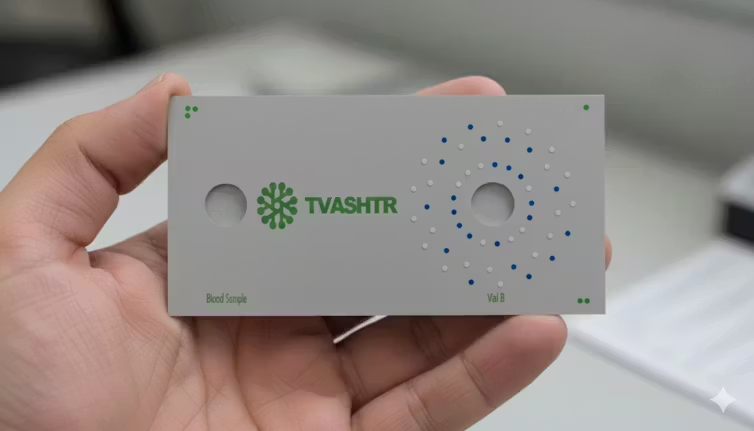
The device, named HemoSift, is the size of a mobile phone and uses simple physics rather than complex machinery to separate blood plasma from red blood cells—a prerequisite for detecting conditions ranging from dengue fever to malnutrition. Developed by a team at the Birla Institute of Technology and Science (BITS) Pilani and the health-tech startup Tvashtr Biotech, the innovation addresses a “quiet bottleneck” that has long plagued healthcare in low-resource settings: the dependence on the centrifuge.
“When a doctor suspects an infection, the test itself is often ready, but the sample preparation is the hurdle,” explains Parth Shinde, lead researcher and founder of Tvashtr Biotech. “We asked a simple question: Why must diagnosis rely on a lab at all?”
The “Centrifuge Barrier”
For patients in high-income nations, a blood test is a banal routine. A nurse draws blood, and a machine called a centrifuge spins it at high speeds to separate the straw-colored plasma (which contains the proteins and markers needed for testing) from the heavier red blood cells.
However, in remote clinics, refugee camps, or even overcrowded emergency rooms during flu season, the centrifuge is a logistical nightmare. It requires reliable electricity, maintenance, and trained technicians—resources often scarce where they are needed most. According to the Lancet Commission on Diagnostics, roughly 47% of the global population lacks access to basic diagnostic services.
“If you cannot separate the plasma quickly, the sample degrades,” notes Dr. Sarah Thompson, a global health pathologist not involved in the study. “We see cases where samples travel for hours to a central lab, only to be rejected because they spoiled in transit. That delay costs lives.”
Physics Over Power
The HemoSift device circumvents this mechanical dependency by utilizing microfluidics and capillary action—the same physical principle that allows plants to draw water from their roots to their leaves.
The device features a specially engineered plastic chip with microscopic channels. When a drop of blood is placed on the device, the channels naturally draw the liquid forward. Due to the specific geometry and surface properties of the channels, the lighter plasma flows ahead while the larger, heavier red blood cells are held back.
According to the development team, the process takes less than five minutes and yields plasma of high enough purity for standard diagnostic assays. Importantly, it requires no batteries, no plugs, and no moving parts.
“It effectively replaces a $2,000 machine weighing several kilograms with a piece of plastic that costs a few dollars and fits in a pocket,” Shinde stated.
From Benchtop to Bedside
The technology has successfully passed “benchtop” testing—controlled laboratory validation—at the nanofabrication facilities of IIT Bombay and is currently undergoing early-phase testing with donated patient blood samples to validate its accuracy against standard centrifuges.
While the device is not yet commercially available, its implications for public health are significant. In countries like India, Brazil, or Indonesia, where mosquito-borne illnesses like dengue and malaria can overwhelm health systems, the ability to test patients on the spot could drastically reduce transmission rates and improve treatment outcomes.
“The goal is not to replace central laboratories, but to extend their reach,” Shinde wrote in a recent report for The Conversation. “It allows a healthcare worker to give a patient not just attention, but an answer.”
Challenges and Future Outlook
Despite the promise, experts caution that the path from prototype to medical staple is long. The device must still undergo rigorous clinical trials to prove it works reliably across different environmental conditions—such as extreme heat or humidity—often found in the field.
“Microfluidic devices can be sensitive,” warns Dr. Thompson. “Ensuring consistent flow rates when the blood viscosity changes—for example, in a dehydrated patient—will be a key technical hurdle they must clear for regulatory approval.”
Furthermore, the device solves only the preparation step. It must still be paired with rapid diagnostic tests (like lateral flow assays used for COVID-19) to provide a complete result. However, by removing the plasma separation barrier, HemoSift opens the door for a new generation of “lab-on-a-chip” tools that were previously impossible to deploy in the field.
As health systems worldwide strive to close the diagnostic gap, innovations like HemoSift offer a glimpse of a future where high-quality healthcare is defined not by proximity to a city, but by the ingenuity of the tools in a doctor’s bag.
Medical Disclaimer:
This article is for informational purposes only and should not be considered medical advice. Always consult with qualified healthcare professionals before making any health-related decisions or changes to your treatment plan. The information presented here is based on current research and expert opinions, which may evolve as new evidence emerges.
References
Primary Source:
-
Shinde, P. (2025, December 5). Why we created a phone-sized device to take blood diagnostics out of the lab into the real world. The Conversation. https://theconversation.com/why-we-created-a-phone-sized-device-to-take-blood-diagnostics-out-of-the-lab-into-the-real-world-271437