 0
0
 0
0
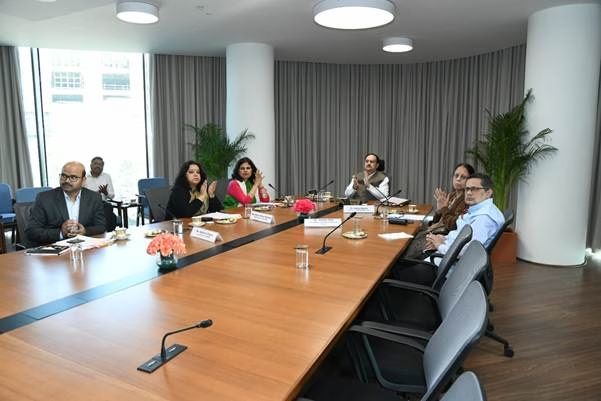
BHUBANESWAR, ODISHA — In a transformative leap for healthcare in Eastern India, the All India Institute of Medical Sciences (AIIMS) Bhubaneswar has officially commissioned a dedicated Liver Transplant Unit and a state-of-the-art Advanced Robotic Surgery System. The facilities were virtually inaugurated on Monday, February 23, 2026, by Union Minister for Health and Family Welfare, Shri Jagat Prakash Nadda, marking a “historic milestone” in the decentralization of high-end medical technology in India.
The launch makes AIIMS Bhubaneswar the first government institution in Odisha to operationalize a comprehensive robotic surgery program. For patients in Odisha, West Bengal, and Assam, the development translates to a significant reduction in “medical migration,” where the critically ill were previously forced to travel to Delhi, Mumbai, or Chennai for life-saving interventions.
Expanding the Frontier of Organ Transplantation
The centerpiece of the inauguration is the Liver Transplant Unit, a specialized ecosystem designed to treat end-stage liver disease (ESLD). The facility includes a dedicated transplant operation theater, an advanced Intensive Care Unit (ICU) tailored for post-operative monitoring, and a specialty clinic for long-term follow-up care.
“This is not just about new equipment; it is about bringing world-class, life-saving treatment within reach of those who need it most,” Minister Nadda stated during the ceremony. He noted that the initiative aligns with the national “Angdaan Jeevan Sanjeevani Abhiyaan,” a movement aimed at sensitizing the public toward organ donation.
The clinical success of the program is already evident. The institute confirmed that two liver transplants have already been successfully performed prior to the formal inauguration. Both recipients are reportedly recovering well, signaling the readiness of the surgical gastroenterology team to handle the complexities of the procedure.
Bridging the Economic Gap
One of the most significant aspects of the new unit is its integration with the Pradhan Mantri Jan Arogya Yojana (PM-JAY) and Rashtriya Arogya Nidhi. By offering these services under government insurance schemes, AIIMS Bhubaneswar is removing the prohibitive financial barriers that often accompany organ transplants, which can cost between ₹15 lakh to ₹25 lakh in private sectors.
The Rise of the Robots: Precision in the OT
The simultaneous launch of the Surgical Robotic System marks a shift toward minimally invasive excellence. Initially, the robotic platform will be utilized across four major specialties:
-
Urology: For prostate and kidney surgeries.
-
Gynaecology: For complex hysterectomies and fibroid removals.
-
Paediatric Surgery: Ensuring precision in delicate procedures for children.
-
Gastrointestinal Surgery: Enhancing the accuracy of tumor resections.
Why Robotic Surgery?
Unlike traditional “open” surgery, robotic-assisted surgery allows surgeons to operate with enhanced 3D visualization and instruments that have a greater range of motion than the human hand.
The benefits for patients include:
-
Reduced Blood Loss: Smaller incisions lead to less trauma to the body.
-
Decreased Pain: Minimally invasive techniques typically require fewer opioids for pain management.
-
Faster Recovery: Patients often see their hospital stays shortened by 30-50%.
-
Higher Precision: Reduced risk of damage to surrounding healthy tissue and nerves.
Expert Perspectives: A Regional Game-Changer
Medical experts across India have lauded the move as a critical step in strengthening the public health infrastructure.
“The establishment of a liver transplant program in a government setup in Eastern India is a massive win for public health,” says Dr. Arvinder Singh Soin, a pioneer in liver transplantation (not affiliated with the AIIMS Bhubaneswar study). “Liver failure is a growing crisis in India, often linked to NASH (Non-Alcoholic Steatohepatitis) and Hepatitis. Having a high-volume center like AIIMS Bhubaneswar reduces the burden on South Indian hubs and makes the ‘Golden Hour’ of organ retrieval more viable across state lines.”
However, experts also point out the challenges ahead. “The hardware is now in place, but the success of a transplant program depends heavily on a robust organ donation culture,” notes Smt. Punya Salila Srivastava, Union Health Secretary. She emphasized that the “Angdaan Jeevan Sanjeevani Abhiyaan” must continue to gain momentum to ensure a steady supply of donor organs.
Public Health Implications and Limitations
While the inauguration is a victory for medical accessibility, health journalists and policy analysts highlight a few points of caution:
-
The Donor Gap: India still faces a significant gap between the number of patients needing transplants and the number of available organs. Public awareness remains the primary bottleneck.
-
Learning Curves: While robotic surgery offers better outcomes, it requires intensive training. AIIMS Bhubaneswar will need to maintain a rigorous training schedule for its surgical staff to ensure the technology’s benefits are fully realized.
-
Maintenance Costs: Advanced robotic systems require high-cost annual maintenance. Sustained government funding will be essential to keep these services “affordable” for the public in the long run.
What This Means for You
For residents of Odisha and neighboring states, this development means that the highest tier of surgical care is now available locally.
Key Takeaways for Readers:
-
Screening: If you or a loved one are managing chronic liver conditions, early consultation at the new AIIMS Liver Specialty Clinic could prevent the progression to end-stage failure.
-
Organ Donation: Consider discussing organ donation with your family. One deceased donor can save up to eight lives, including those awaiting livers at AIIMS Bhubaneswar.
-
Affordability: Check your eligibility for PM-JAY or other state health cards, as these can now be used for advanced robotic and transplant procedures at this facility.
References
-
Press Information Bureau (PIB) Delhi. (2026, Feb 23). Union Health Minister Shri J P Nadda Virtually Inaugurates the Liver Transplant Unit & Robotic Surgery System at AIIMS Bhubaneswar. [Source: Government Release].
Medical Disclaimer: This article is for informational purposes only and should not be considered medical advice. Always consult with qualified healthcare professionals before making any health-related decisions or changes to your treatment plan. The information presented here is based on current research and expert opinions, which may evolve as new evidence emerges.