 0
0
 0
0
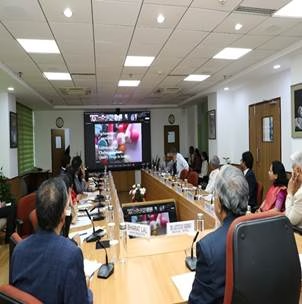
NEW DELHI – In a move to protect the fundamental right to life and health, the National Human Rights Commission (NHRC) of India convened an emergency Open House Discussion (OHD) on February 26, 2026, to address the escalating threat of spurious and substandard medicines. Led by Justice (Dr.) Bidyut Ranjan Sarangi, the Commission warned that regulatory gaps in the pharmaceutical supply chain are no longer just administrative hurdles—they are direct violations of human rights that can lead to large-scale human distress.
The high-level meeting brought together regulators, law enforcement, and medical experts to overhaul India’s drug oversight mechanisms. The central message was clear: in a globalized pharmacy hub like India, the “trust” a patient places in a pill must be backed by a foolproof, transparent system.
The Human Cost of Quality Failure
The discussion opened with poignant reminders of the stakes involved. NHRC Member Smt. Vijaya Bharathi Sayani shared a personal account of a family member who suffered permanent vision loss due to improper treatment involving poor-quality medicines.
“Medicines must heal, not harm,” emphasized NHRC Secretary General Shri Bharat Lal. He noted that while the public often uses the terms interchangeably, there is a critical legal and safety distinction between spurious and substandard drugs that dictates how the state must respond.
Defining the Threat
-
Spurious Drugs (Section 17-B, Drugs and Cosmetics Act): These are intentional frauds. They are counterfeit or fake products often manufactured by criminal entities with no identifiable source. They may contain no active ingredients or even toxic substitutes.
-
Substandard Drugs: These are “out-of-specification” products. They are made by licensed manufacturers but fail to meet required quality standards due to poor raw materials, manufacturing errors, or improper storage.
Recent data from the National Survey on Drugs underscores the gravity of the situation, revealing that approximately 10% of government drug samples were found to be substandard.
A Digital Shield: Tracking and Transparency
To combat the infiltration of fakes into the legitimate supply chain, the NHRC panel proposed a massive technological upgrade. Former Member Shri Rajiv Jain advocated for a “blockchain-based supply chain authentication” system.
By implementing mandatory QR codes and “track-and-trace” technology, every bottle of medicine could be verified from the factory floor to the pharmacy shelf. This would allow patients and providers to scan a product and immediately confirm its authenticity.
Key Proposed Interventions:
-
Centralised Databank: A national, real-time database integrating inputs from state regulators, enforcement agencies, and laboratories to track spurious drug patterns.
-
AI-Based Detection: Using artificial intelligence to spot anomalies in distribution patterns that might indicate the dumping of illegal stock.
-
Special Drug Courts: Establishing dedicated legal forums to ensure the “expeditious trial” of those accused of manufacturing or distributing lethal fakes.
The Regulatory Gap: From “Cough Syrup” Alarms to Reform
The NHRC’s proactive stance follows a series of troubling incidents. In October 2025, the Commission issued notices to the governments of Madhya Pradesh, Rajasthan, and Uttar Pradesh following reports of child fatalities allegedly linked to contaminated cough syrups.
Shri Prashant Reddy T., author of The Truth Pill and a participant in the discussion, highlighted that the issue also extends to “bioequivalence.” He warned that not all generic formulations behave identically to the original drug, necessitating more rigorous quality assurance and transparency in how generics are approved and tested.
Expert Special Rapporteur Dr. Keshav Kumar pointed out that current efforts are hampered by low conviction rates and significant delays in adjudication. He called for the creation of joint Centre-State task forces to ensure that “repeat offenders” cannot simply move their operations across state lines to avoid the law.
What This Means for Consumers
For the average citizen, the NHRC’s deliberations signal a shift toward greater empowerment and safety. The Commission recommended improved public helplines and strengthened whistleblower protections to encourage the reporting of suspicious medicines.
While the government works on systemic changes, medical experts at the forum advised consumers to:
-
Always demand a bill for medicine purchases to maintain a paper trail.
-
Check for tampered packaging or unusual variations in color and texture of tablets.
-
Utilize e-prescription safeguards and purchase from reputable, licensed pharmacies.
A Path Forward: Multi-Sectoral Action
The meeting concluded with a call for institutionalized training for drug inspectors and the benchmarking of “best practices” from states that have successfully reduced the prevalence of substandard drugs.
“In a country as vast as India,” Justice Sarangi noted, “isolated regulatory challenges can translate into large-scale human distress.” The NHRC is now finalizing a set of formal recommendations to be sent to the Union and State governments, aiming to transform the Indian pharmaceutical ecosystem into a bastion of safety and accountability.
References & Sources
Official Government Releases:
-
Press Information Bureau (PIB) Delhi, “NHRC, India, organises an Open House Discussion on ‘Measures to Curb Spurious Medicines in India’,” Posted 26 FEB 2026.
Medical Disclaimer: This article is for informational purposes only and should not be considered medical advice. Always consult with qualified healthcare professionals before making any health-related decisions or changes to your treatment plan. The information presented here is based on current research and expert opinions, which may evolve as new evidence emerges.