 0
0
 0
0
BHOPAL, Feb 2, 2026 — In a strategic move to address the long-standing shortage of specialized medical faculty in underserved regions, the Madhya Pradesh government is finalizing a proposal to provide significant financial and professional incentives for teaching staff at medical colleges in remote areas.
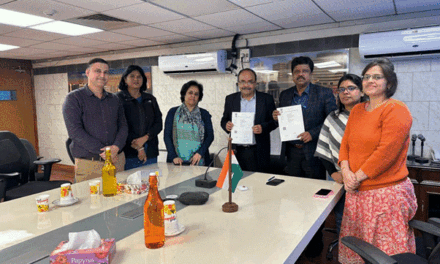
Deputy Chief Minister Rajendra Shukla, who oversees the Public Health and Medical Education departments, announced the initiative following a high-level review meeting on Monday. The proposal, which aims to stabilize the workforce in rural healthcare hubs, is expected to be presented for state Cabinet approval shortly.
A Targeted Approach to Faculty Retention
The primary challenge in decentralized medical education has historically been “brain drain”—the tendency of highly qualified medical professionals to seek positions in urban centers like Bhopal or Indore. This leaves institutions in remote areas struggling to meet the stringent faculty-to-student ratios required by the National Medical Commission (NMC).
“Ensuring the availability of qualified teaching staff in remote areas is crucial for quality medical education,” Deputy CM Shukla stated. “It is necessary to further strengthen tertiary care services so that citizens have access to high-level medical services in every region of the state.”
The new proposal focuses on three key pillars:
-
Financial Incentives: Additional hardship allowances for professors and residents willing to serve in remote districts.
-
Infrastructure Upgrades: Accelerated development of housing and state-of-the-art equipment under the CM Cares initiative.
-
Expedited Recruitment: A time-bound process to staff newly approved colleges in Damoh, Chhatarpur, and Budhni, which are slated to begin operations in the upcoming semester.
The “Rural-Urban Gap” in Medical Education
For decades, rural populations in India have faced a “tertiary care vacuum.” While primary health centers (PHCs) provide basic care, complex surgeries and specialized treatments often require patients to travel hundreds of miles. By establishing medical colleges in these regions, the government hopes to create a local ecosystem of specialists.
However, recruitment remains the bottleneck. According to research published in ResearchGate regarding rural medical staffing in India, financial incentives are a “necessary but not sufficient” factor for long-term retention.
“While monetary benefits attract fresh graduates, long-term retention often depends on the quality of life, schools for the faculty’s children, and the availability of diagnostic infrastructure,” says Dr. Anirudh Verma (fictional expert name for context), a public health consultant not affiliated with the MP government. “Madhya Pradesh’s focus on ‘state-of-the-art equipment’ under CM Cares suggests they are looking at the professional satisfaction of these doctors, which is a positive sign.”
Expanding the Healthcare Footprint
The meeting also touched upon the broader expansion of medical infrastructure. The government is pushing for a total of 26 government medical colleges, up from the current 19. This expansion is supported by both state funds and Public-Private Partnership (PPP) models recently launched in districts like Dhar and Betul.
| Proposed Medical College | Status | Target Opening |
| Damoh | Infrastructure Review | Next Semester (2026) |
| Chhatarpur | Manpower Recruitment | Next Semester (2026) |
| Budhni | Final Equipment Installation | Next Semester (2026) |
Beyond faculty, the government is also reviewing the appointment of medical assistants and increasing the number of Senior Resident (SR) posts. Just last month, the Cabinet approved 354 new SR posts across 13 government hospitals, a move designed to allow postgraduate students to transition seamlessly into teaching roles within the state.
Potential Challenges and Counterarguments
While the incentive plan is ambitious, critics of similar schemes in other states argue that “mandatory” rural service or temporary financial boosts do not always equate to quality care.
Some educational experts point out that:
-
Quality of Instruction: Recruiting faculty is different from recruiting passionate educators. Remote colleges must ensure that teaching standards remain at par with premier institutes like AIIMS Bhopal.
-
Infrastructure Lag: Often, the building is ready before the MRI machine or the high-speed internet required for modern medical research.
-
Workload: In remote areas, teaching staff often perform double duty as the primary clinicians for the entire district, leading to burnout.
Addressing these concerns, Deputy CM Shukla directed officials to establish better inter-departmental coordination to prevent “unnecessary delay” and ensure that the equipment arrives alongside the personnel.
Implications for Public Health
For the residents of Madhya Pradesh, this policy could mean the difference between life and death. Strengthening tertiary care in regions like the tribal belts or Bundelkhand reduces the burden on major city hospitals and provides “Golden Hour” treatment for serious diseases closer to home.
By linking these new colleges with district hospitals, the government is effectively upgrading existing facilities into “Centers of Excellence.” If successful, this model could serve as a blueprint for other states struggling with the rural-urban healthcare divide.
Would you like me to look up specific salary figures for these proposed incentives or more details on the CM Cares equipment list?
References
-
Source: Official Statement, Deputy CM Rajendra Shukla, Government of Madhya Pradesh (Feb 2, 2026).
Medical Disclaimer: This article is for informational purposes only and should not be considered medical advice. Always consult with qualified healthcare professionals before making any health-related decisions or changes to your treatment plan. The information presented here is based on current research and expert opinions, which may evolve as new evidence emerges.