 0
0
 0
0
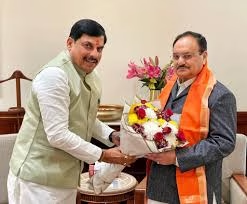
BHOPAL — In a significant move to overhaul its healthcare infrastructure, the Madhya Pradesh government is set to lay the foundation stones for four new medical colleges under a Public-Private Partnership (PPP) model. Chief Minister Dr. Mohan Yadav has formally invited Union Health Minister J.P. Nadda to preside over the ceremony, tentatively scheduled for the last week of December.
The new institutions, to be established in the districts of Panna, Katni, Dhar, and Betul, mark a strategic shift in India’s approach to medical education, aiming to address the chronic shortage of doctors in rural and tribal belts.
The PPP Model: A First for State Healthcare
While several states have explored private participation, Madhya Pradesh is positioning itself as a pioneer in adopting the Design, Build, Finance, Operate, and Transfer (DBFOT) model for district-level medical colleges.
Under this framework:
-
Government Contribution: The state has allocated approximately 25 acres of land per college at a nominal lease rate of ₹1. Additionally, existing district hospitals (with a minimum of 300 beds) will be handed over to private partners to serve as teaching hospitals.
-
Private Partner Role: Private entities will bear the cost of constructing the medical college, hostels, and equipment, and will manage the daily operations.
-
Public Access: According to state officials, the model is designed to ensure affordability. A significant portion of medical seats will be regulated, and patients holding Ayushman Bharat cards or those from Below Poverty Line (BPL) categories are expected to receive free treatment at these facilities.
“I have requested Union Health Minister J.P. Nadda to lay the foundation stones… He has accepted our invitation,” Chief Minister Yadav confirmed following his meeting in New Delhi on Wednesday.
Addressing Critical Healthcare Gaps
The selection of Panna, Katni, Dhar, and Betul is strategically significant. These districts, particularly Dhar and Betul, have substantial tribal populations that have historically faced barriers to accessing tertiary care.
Data from the National Health Systems Resource Centre (NHSRC) highlights the urgency:
-
Maternal & Infant Health: While Madhya Pradesh has seen improvements, its Infant Mortality Rate (IMR) and Maternal Mortality Ratio (MMR) remain higher than the national average.
-
Malnutrition: Districts like Dhar have reported high burdens of childhood wasting, necessitating robust pediatric care and nutritional intervention capabilities that a medical college hospital can provide.
By localizing medical education, the state aims to improve the doctor-patient ratio, which remains a challenge across central India. “Bringing medical colleges to these districts serves a dual purpose: it creates a pipeline of local doctors who are more likely to serve in their home regions and upgrades district hospitals into super-specialty centers,” notes a senior health policy analyst.
Healthcare Governance Under Scrutiny
The announcement comes at a time when the state’s health department is facing intense scrutiny over safety and quality control in existing facilities.
Recent weeks have seen the state grapple with two major health crises:
-
Chhindwara Syrup Tragedy: A localized outbreak of acute kidney failure among children was linked to “Coldrif,” a cough syrup reportedly contaminated with diethylene glycol. The incident claimed the lives of at least 11 children, triggering a statewide ban and a multi-state investigation into pharmaceutical supply chains.
-
Indore Hospital Incidents: The state-run Maharaja Yeshwantrao (MY) Hospital in Indore faced public outcry following reports of rat-bite incidents in its Neonatal Intensive Care Unit (NICU), raising serious questions about hygiene and sanitation protocols in flagship government hospitals.
These incidents underscore the challenge the government faces: while expanding infrastructure via new colleges is vital, maintaining rigorous quality standards in existing public systems remains an immediate priority.
Expert Perspectives and Counterarguments
The shift to a PPP model has elicited mixed reactions from the medical community and civil society.
Proponents argue that the model aligns with NITI Aayog’s guidelines to leverage private capital for public good, potentially fast-tracking infrastructure that would take the government years to build alone.
Critics, however, express caution. Organizations like the Jan Swasthya Abhiyan (JSA) have previously voiced strong opposition to the “privatization” of district hospitals. Their primary concerns include:
-
Equity of Access: Fears that handing over district hospitals to private entities may eventually lead to user fees that exclude the “missing middle”—poor patients who do not possess Ayushman cards.
-
Accountability: Ensuring that private partners adhere to public health goals rather than profit maximization remains a regulatory challenge.
“The government must ensure that the handover of public assets does not compromise the poor’s right to free healthcare. Robust oversight mechanisms are non-negotiable in such partnerships,” warns Dr. Amulya Nidhi, a public health activist associated with JSA.
Looking Ahead
As the foundation stones are laid later this month, the project will be watched closely by health policymakers across India. If successful, the Madhya Pradesh model could serve as a blueprint for other states struggling to balance fiscal constraints with the growing demand for medical education and healthcare services.
Medical Disclaimer: This article is for informational purposes only and should not be considered medical advice. Always consult with qualified healthcare professionals before making any health-related decisions or changes to your treatment plan. The information presented here is based on current research and expert opinions, which may evolve as new evidence emerges.
References
-
News Report: “MP CM invites JP Nadda to lay foundation of four medical colleges.” Lokmat Times, Dec 3, 2025.