 0
0
 0
0
Read Time:6 Minute, 4 Second
1. Introduction
Today we’re exploring the Integrated Disease Surveillance Programme (IDSP)—India’s frontline system for detecting, monitoring, and responding to disease outbreaks. Launched in 2004 (project phase) and integrated under the National Health Mission (NHM) during the 12th Five-Year Plan (2012–17), IDSP focuses on decentralized, laboratory-based, IT-enabled disease surveillance across districts in India (en.wikipedia.org).
Given recurrent outbreaks (e.g., dengue, diarrhea, emerging zoonoses), IDSP is vital for early detection and controlling epidemics through Rapid Response Teams (RRTs) and real-time data analysis. In recent years, the transition to the Integrated Health Information Platform (IHIP) has enhanced its capabilities.
https://youtu.be/_9xpDj7yGkU
2. Historical Background & Evolution
Predecessor: National Surveillance Programme for Communicable Diseases (NSPCD), 1997–2002, with limited success (ceghonline.com, bmcpublichealth.biomedcentral.com).
IDSP Launch: Implemented as a World Bank–assisted project in November 2004 across 9 pilot states. National rollout occurred under NHM from 2012 onward (en.wikipedia.org).
Transformation: Rebranded as a “programme” during XII Plan; IHIP launched in April 2021 to enable daily, case-based, geocoded, real-time surveillance via tablets (ceghonline.com).
Recent Strengthening:
Expansion of ICMR’s VRDL network (150+ labs)
Support via PM‑ABHIM for health infrastructure & labs
Establishment of One Health frameworks and mobile BSL-3 units (health.economictimes.indiatimes.com)
3. Objectives of IDSP
The core objectives are:
Strengthen a decentralized, lab-supported, IT-based surveillance system for epidemic-prone diseases at all levels (nhm.uk.gov.in, haryanahealth.gov.in).
Monitor disease trends and seasonality weekly.
Detect early signals of outbreaks using Rapid Response Teams (RRTs) for swift containment (vajiramandravi.com).
Foster intersectoral coordination including zoonotic surveillance and private sector involvement (haryanahealth.gov.in).
Build human resource capacity via training officers, epidemiologists, microbiologists, laboratory techs, and paramedics (haryanahealth.gov.in).
These objectives align with WHO’s International Health Regulations, ensuring India meets its global surveillance obligations .
4. Organizational Structure
IDSP operates on a three-tiered structure:
A. Central Surveillance Unit (CSU)
Based at NCDC, Delhi
Headed by National Programme Officer
Seven specialized divisions: Finance, IT, Lab, Data, HRD, NCDs, Monitoring (en.wikipedia.org).
B. State Surveillance Units (SSU)
Located within state health departments
Led by State Surveillance Officer + team (epidemiologist, microbio, vet, entomologist, data manager, finance consultant, DEO) (nhm.uk.gov.in, haryanahealth.gov.in).
C. District Surveillance Units (DSU)
Led by District Surveillance Officer + epidemiologist, data manager, DEO (haryanahealth.gov.in).
Sources data from public/private reporting units: PHCs, CHCs, hospitals, labs.
Data flow is weekly (IDSP portal) or daily real-time (IHIP). Reports use three forms:
S: Symptom-based suspected cases
P: Probable cases diagnosed clinically
L: Laboratory-confirmed cases (bmcpublichealth.biomedcentral.com, en.wikipedia.org, vajiramandravi.com).
5. Functions & Activities
A. Surveillance & Reporting
Weekly: All reporting units submit “S”, “P”, and “L” data; Nil reporting is mandatory (vajiramandravi.com).
Daily (IHIP): Case-based syndromic data from ANMs via tablets with geocoding (ceghonline.com).
Media Scanning & Verification Cell (MSVC) monitors print and digital media to detect unreported outbreaks (en.wikipedia.org).
B. Rapid Response
Each district has RRTs consisting of clinicians, epidemiologists, microbiologists, paramedics.
Activated upon early outbreak alerts; conduct field investigation, sample collection, lab confirmation, control measures (haryanahealth.gov.in, cmopaurigarhwal.org.in).
C. Laboratory Support
DSU and SSU labs provide imminent diagnosis for priority diseases.
Enhanced by VRDL network and mobile BSL‑3 units, plus regional NIV platforms (bmcpublichealth.biomedcentral.com, health.economictimes.indiatimes.com).
D. Data Management & Analysis
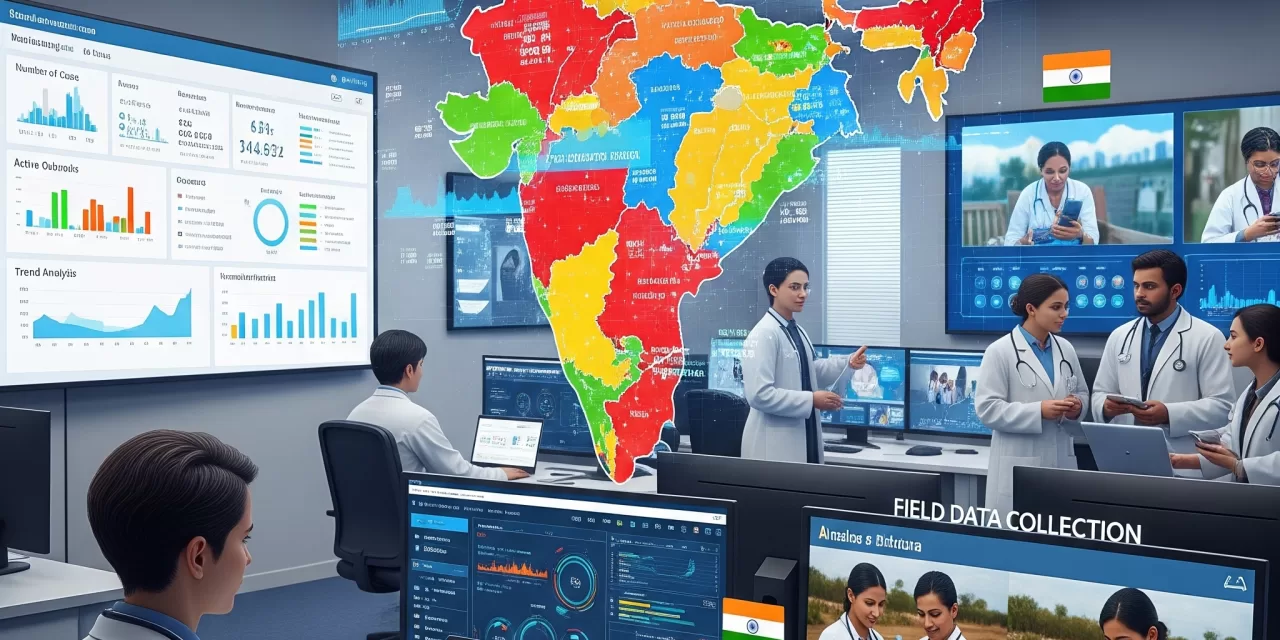
Portal provides dashboards, trend analysis, GIS visualization.
Enables data-driven decision-making at district/state/central levels (haryanahealth.gov.in, ceghonline.com).
Climate‑health integration is enhanced by projects like EpiClim, using IDSP data for forecasting outbreaks relative to weather patterns (arxiv.org).
E. Training & Capacity Building
Three-tiered model: National → State → District.
Master trainers train SSOs, DSOs, RRT members; cascading to MO, ANMs, lab techs, paramedics (haryanahealth.gov.in).
F. Intersectoral Coordination
Zoonotic disease surveillance via coordination with veterinary and environmental sectors (One Health approach) .
Collaboration with the private health sector for comprehensive case capture.
6. Diseases Under Surveillance
IDSP monitors:
13 core syndromes/diseases: acute diarrhoeal disease, dengue, malaria, measles, fever syndromes (ILI/SARI), acute encephalitis, JEV, AFP, rabies, leptospirosis, etc..
State-specific conditions: up to 5 additional diseases per state.
The platform also captures meteorological and remote-sensing data, informing seasonal trend analysis and hotspot identification (en.wikipedia.org).
7. Achievements & Challenges
Achievements
90%+ reporting coverage across India (over 740 districts) (en.wikipedia.org).
Identification of 1,862 outbreaks in a year, with Kerala highest (vajiramandravi.com).
Effective real-time surveillance via IHIP, including GIS mapping & daily alerts (haryanahealth.gov.in).
Stronger lab infrastructure, with VRDL and BSL‑3 support (firsthope.co.in).
Integration with climate–health forecasting tools like EpiClim (arxiv.org).
Challenges
Underreporting and delays at sub-centre/PHC levels (ceghonline.com).
Inconsistent data quality and timeliness in some districts.
Need for universal rollout of IHIP—many states are yet to transition fully (ceghonline.com).
Ensuring sustainable funding, trained workforce, and coordination, especially in zoonotic surveillance frameworks.
8. Exam Relevance
Important for PG students:
Definitions & Structure: What is IDSP, the difference between project and programme phases?
Reporting Formats: Explain S, P, L forms with examples.
RRTs & Lab Network: Composition and role in outbreak response.
IHIP transition: Emphasis on tablet-based real-time case reporting.
Challenges: Highlight data quality, timeliness, and underreporting.
One Health: Emerging zoonoses and intersectoral coordination.
Typical Question Framing:
“Discuss objectives and structure of IDSP.”
“Explain role of IHIP in enhancing IDSP.”
“Enumerate and comment on challenges in disease surveillance in India.”
9. Recent Updates & Future Directions
IHIP rollout continues: enabling daily, case-based geocoded data and analysis in near real-time (firsthope.co.in, ceghonline.com, haryanahealth.gov.in, en.wikipedia.org).
Scaling VRDL and One Health Labs: Regional NIVs and mobile BSL‑3 labs established (health.economictimes.indiatimes.com).
Enhanced IT infrastructure under PM‑ABHIM and ECRP programmes (health.economictimes.indiatimes.com).
Integration with climate surveillance tools like EpiClim for proactive outbreak prediction .
Future focuses: full IHIP adoption, expanded zoonotic surveillance, stronger private‑sector inclusion, and sustained funding.
10. Conclusion
🔍 Take-Home Messages:
IDSP is India’s comprehensive, decentralized, lab-supported, IT-enabled surveillance system for epidemic-prone diseases.
It is structured across Central, State, and District Surveillance Units, with strengthened lab networks, real-time data systems, and trained RRTs.
IHIP marks a major transition—case-based, geocoded surveillance in real time.
While reporting coverage is high, challenges remain in data quality, workforce capacity, and integration.
With bolstered labs, One Health integration, and climate-linked epidemiology, IDSP is now better positioned to handle future challenges.
As MBBS students and future clinicians, understanding IDSP empowers you to actively participate in outbreak detection, reporting, and community-level response. Recognize its critical role—not just in your exams, but in real-world public health.
Suggested Readings & References
Park’s Textbook of Preventive & Social Medicine (27th & 28th ed.)
NCDC, Ministry of Health & Family Welfare – official IDSP/IHIP portal (idsp.nic.in, haryanahealth.gov.in)
BMC Public Health, Maharashtra IDSP assessment (bmcpublichealth.biomedcentral.com)
Clinical Epidemiology & Global Health, IHIP vs IDSP insights (ceghonline.com)
Economic Times HealthWorld – recent programme strengthening
EpiClim (ArXiv, 2025) – climate-disease modeling via IDSP


Happy
0 %

Sad
0 %

Excited
0 %

Sleepy
0 %

Angry
0 %

Surprise
0 %