 0
0
 0
0
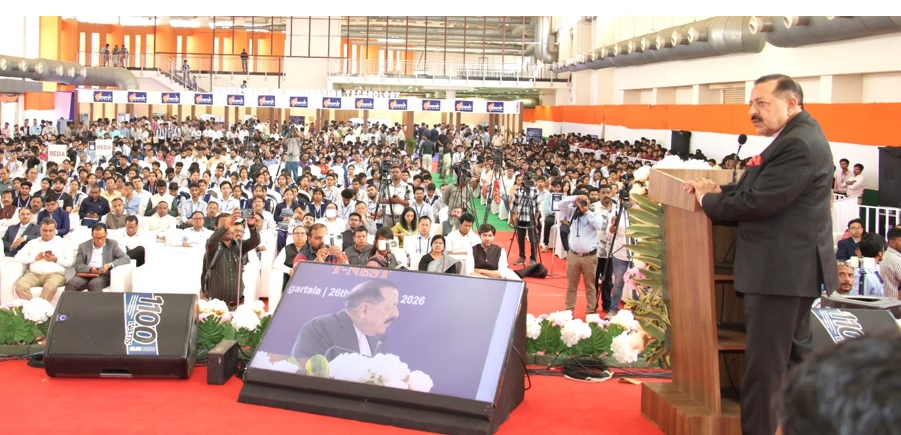
AGARTALA — In a landmark move for regional development and public health infrastructure, Union Minister Dr. Jitendra Singh officially launched India’s first State Innovation Mission (SIM) in Tripura on February 26, 2026. The initiative aims to decentralize the national innovation ecosystem, moving high-tech solutions from metropolitan laboratories directly into the districts and villages of Northeast India.
While the mission focuses on startups and Micro, Small, and Medium Enterprises (MSMEs), its implications for public health are profound. By institutionalizing innovation at the state level, the government seeks to bridge the “equity gap” in healthcare delivery, using deep-tech and artificial intelligence (AI) to reach underserved populations.
Decentralizing the “Engine of Growth”
For decades, the “innovation corridor” in India was largely confined to Tier-I cities like Bengaluru and Hyderabad. The launch of SIM Tripura signals a systemic shift. Dr. Jitendra Singh described the Northeast as the “New Engine” of India’s growth, emphasizing that for the nation to accelerate, states must lead the charge in creative problem-solving.
“Innovation must move beyond laboratories and metropolitan corridors to districts, villages, and every citizen,” Dr. Singh stated during the launch event, which was attended by Tripura Chief Minister Prof. (Dr.) Manik Saha and senior officials from NITI Aayog.
The mission is a natural evolution of the Atal Innovation Mission (AIM). The Union Cabinet recently decided to expand AIM to include 50,000 new Atal Tinkering Labs (ATLs) across the country. These labs serve as the foundational bedrock for “grassroots innovation”—where students and local inventors create low-cost solutions for everyday challenges, including sanitation, water purification, and assistive medical devices.
Health Equity and the “Deep-Tech” Revolution
A critical pillar of SIM Tripura is the integration of Deep-Tech—technologies based on tangible engineering innovation or scientific advances. Dr. Singh highlighted that the government has removed significant barriers for deep-tech startups, backed by a ₹10,000 crore Fund of Funds.
For the healthcare sector, this translates to:
-
Point-of-Care Diagnostics: Developing portable, low-cost testing kits for remote hilly terrains in Tripura.
-
AI in Governance: Using digital tools to streamline vaccine distribution and maternal health tracking.
-
Local Manufacturing: Leveraging Tripura’s abundant natural resources, such as rubber and bamboo, for specialized medical materials and eco-friendly prosthetics.
“Technology must drive equity and inclusion,” Dr. Singh remarked, noting that Tripura has seen a 66% surge in startup recognitions over the last five years. Notably, a significant portion of these are women-led, which experts suggest could lead to a stronger focus on family wellness and community health initiatives.
The MSME Connection: A Social Determinant of Health
Public health experts often point to economic stability as a primary “social determinant of health.” Tripura currently boasts over 3.13 lakh registered MSMEs. By providing these small businesses with the tools to innovate through SIM, the mission indirectly improves public health by:
-
Increasing Employment: Reducing poverty-related health complications.
-
Improving Infrastructure: Encouraging the development of local supply chains for essential goods.
-
Encouraging Nutrition-Tech: Potential startups focusing on food processing and fortified local produce.
“When we empower a local entrepreneur in a small town, we aren’t just creating a business; we are creating a support system for that community’s future,” said a senior official from NITI Aayog during the summit.
Expert Commentary and Balanced Perspectives
While the launch has been met with optimism, some experts urge a cautious approach toward the rapid implementation of AI in state programs.
“The State Innovation Mission is a visionary step for cooperative federalism,” says Dr. Arvinder Malik, a public policy consultant (not involved in the SIM launch). “However, the challenge lies in digital literacy. For innovation to truly be ‘equitable,’ the government must ensure that the end-users—the villagers and local healthcare workers—are trained to use these new technologies effectively. Without a human-centric design, deep-tech can accidentally widen the gap between the tech-savvy and the marginalized.”
Furthermore, while the ₹1 lakh crore Research, Development, and Innovation (RDI) Fund provides substantial financial backing, critics note that the success of SIM will depend on the “ease of doing business” at the local panchayat and district levels, where bureaucratic hurdles often persist.
Looking Ahead: The “Double Engine” Effect
The “double engine” approach—where national vision meets state-level execution—is being put to the test in Tripura. If successful, the SIM model will be replicated across other States and Union Territories.
For the average citizen, this means the next breakthrough in affordable healthcare or sustainable energy might not come from a corporate park in a mega-city, but from a startup in Agartala or a tinkering lab in a rural school.
As India enters what Dr. Singh calls its “innovation decade,” the focus remains clear: ensuring that the benefits of the modern scientific age reach the “unreached” and empower the “underserved.”
Key Statistics at a Glance
| Category | Current Status / Achievement |
| Startup Growth (Tripura) | 66% increase in recognition over 5 years |
| MSME Registrations | 3.13 Lakh+ on Udyam Portal |
| Deep-Tech Support | ₹10,000 Crore Fund of Funds |
| National Expansion | 50,000 new Atal Tinkering Labs planned |
| Total Indian Startups | 2 Lakh+ (generating 21 Lakh+ jobs) |
Medical Disclaimer: This article is for informational purposes only and should not be considered medical advice. Always consult with qualified healthcare professionals before making any health-related decisions or changes to your treatment plan. The information presented here is based on current research and expert opinions, which may evolve as new evidence emerges.
References and Sources
1. Primary Source:
-
Press Information Bureau (PIB) Delhi. “When States Innovate, India Accelerates: Dr Jitendra Singh Launches India’s First State Innovation Mission (SIM) in Tripura.” Posted Feb 26, 2026.