 0
0
 0
0
In a recent decision delivered in mid-September 2025, the Supreme Court of India firmly declined a Public Interest Litigation (PIL) that sought judicial intervention to alter the syllabus for MBBS, MD, and MS medical courses nationwide. The country’s highest court made it clear that the responsibility for setting medical curricula lies with dedicated academic and regulatory authorities—not with the judiciary—calling for expertise-driven decisions in this critical sector.
Key Findings and Developments
Chief Justice of India (CJI) BR Gavai, heading the bench, explicitly stated: “This is not our work. We cannot decide what syllabus should or shouldn’t be. Approach the university or govt.”. With this observation, the court dismissed the PIL but granted liberty for the petitioner to take up the issue with the appropriate governmental or university authorities.
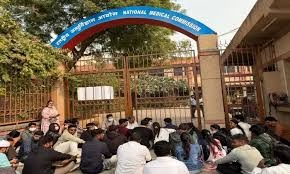
India’s medical curriculum, covering both undergraduate (MBBS) and postgraduate (MD, MS) programs, is developed and periodically updated by the National Medical Commission (NMC). The NMC consists of specialized boards—including the Undergraduate Medical Education Board (UGMEB) and the Postgraduate Medical Education Board (PGMEB)—which collaboratively design, evaluate, and revise syllabi based on evolving standards and societal health needs.
Expert Perspectives
According to Dr. Anita Ramesh, Professor of Medicine at a leading government medical college (not involved in the litigation), “Curriculum formulation in medicine requires evolving knowledge, pedagogical expertise, and sometimes even regional health considerations that only professional bodies and subject-matter experts can balance. Courts intervening could set a challenging precedent removed from these practical realities.”
Education law scholar Dr. Rahul Chatterjee of the National University of Juridical Sciences, Kolkata, agrees, adding, “Worldwide, the role of courts is to ensure due process and legal compliance—not to prescribe content—especially in fields like medicine where scientific advancements are rapid and nuanced.”
Context and Background
The PIL reflects ongoing debates about curriculum content in India’s health education, with calls from various quarters for updating syllabi to keep pace with changes in science, technology, and social context. However, mechanisms are already in place: the NMC routinely updates curricula across disciplines, sometimes following input from universities, associations, patient advocacy groups, and public health agencies.
Judicial restraint in curricular matters is not new—similar stances are adopted internationally to ensure academic autonomy and robust standards. The NMC, grounded in statutory and peer-reviewed processes, develops comprehensive, competency-based curricula that reflect community health needs and global best practices.
Implications for Public Health
For medical students and the broader public, this decision underscores that medical education will continue to be determined not by litigation or political pressure but by boards of experts guided by evidence and best practices. This continuity is crucial for maintaining consistency in physician training and patient care quality nationwide.
Patients and healthcare consumers benefit when curricula remain up to date with evidence-based protocols and emerging health trends; however, the court’s decision recognizes that updating syllabi is best handled methodically by regulatory bodies, not through judicial decree.
Potential Limitations and Counterarguments
Some critics argue that expert bodies can be slow to respond to societal shifts, or may lack adequate stakeholder input—concerns that drive litigants to seek court intervention. Notably, the Supreme Court’s decision did not preclude citizens from petitioning the government or universities directly; it simply clarified the judiciary’s appropriate role.
Internationally, rare exceptions exist where courts have intervened in curricular content over constitutional rights—such as anti-discrimination cases—but these are the exception, not the norm.
Practical Implications for Readers
For students, parents, and educators:
-
Any desired changes or reforms to medical syllabi should be routed through formal petitions to the NMC or affiliated academic boards rather than through legal appeals.
-
Students can expect continued alignment of the Indian medical curriculum with national health priorities and international standards, updated periodically through expert review.
-
Public feedback, scientific advancements, and evolving community needs may still shape curricula via regulatory channels.
Balanced Reporting
While discouraging judicial intervention, the ruling indirectly encourages robust, transparent stakeholder participation before the NMC. Experts recommend regular independent reviews of regulatory decisions to ensure continued responsiveness to both scientific and societal developments.
References
Medical Disclaimer: This article is for informational purposes only and should not be considered medical advice. Always consult with qualified healthcare professionals before making any health-related decisions or changes to your treatment plan. The information presented here is based on current research and expert opinions, which may evolve as new evidence emerges.