 0
0
 0
0
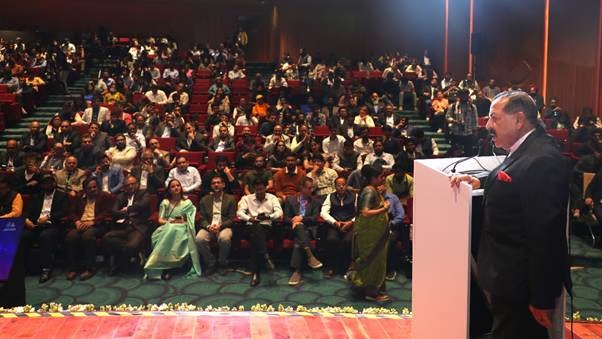
NEW DELHI — In a landmark move toward technological self-reliance, Union Minister Dr. Jitendra Singh has unveiled the latest advancements of BharatGen, India’s first government-owned sovereign Large Language Model (LLM). Speaking at the “BharatGen Models: Vision and Technical Execution 2026” session at Bharat Mandapam, the Minister declared that Artificial Intelligence (AI) has transitioned from a high-tech luxury to an “essential component” of daily life and governance.
The announcement marks a pivotal moment for the Indian healthcare sector. With the launch of specialized models like Ayur Param for Ayurveda and the Param-2 text foundation model—which supports 22 scheduled Indian languages with 17 billion parameters—India is positioning itself to bridge the persistent gap between urban medical expertise and rural healthcare needs.
A Multilingual Shield for Public Health
For a country with 22 official languages and hundreds of dialects, language is often the first barrier to effective healthcare. BharatGen’s “Multilingual AI Stack” is designed to dismantle this hurdle. By integrating speech technologies like Shrutam (speech-to-text) and Sooktam (text-to-speech) in 12 languages, the initiative enables frontline health workers to communicate more effectively with patients in their native tongues.
“Scientific advancement cannot be confined by administrative boundaries,” Dr. Singh noted, emphasizing that BharatGen must respond to real-world linguistic diversity. In the context of digital health, this means a patient in rural Odisha or a clinic in Himachal Pradesh can receive diagnostic support and health literacy materials in their local dialect, rather than struggling with English or Hindi-centric interfaces.
Key Technological Pillars of BharatGen:
-
Param-2 Model: A 17-billion-parameter text foundation model covering all 22 scheduled languages.
-
Ayur Param: A domain-specific model fine-tuned for Ayurveda, bridging traditional wisdom with modern data science.
-
Patram Framework: A document vision-language model for multilingual access to complex Indian medical and legal documents.
From “Pilots” to Population-Scale Impact
The shift from experimental AI pilots to systemic healthcare deployment is already showing measurable results. According to recent government data, AI-enabled tools integrated into the National TB Elimination Programme have contributed to a 27% decline in adverse tuberculosis outcomes.
Furthermore, the e-Sanjeevani telemedicine platform has supported over 282 million consultations, with 12 million of those specifically aided by AI-recommended differential diagnoses. BharatGen is expected to supercharge these existing frameworks by providing a more “sovereign” and “culturally contextual” AI backbone.
“We are moving from a phase of ‘will it work’ to ‘how fast can we scale it,'” said Ankit Modi, a founding member of Qure.ai, speaking on the sidelines of the summit. Experts noted that by using AI to read chest X-rays or screen for diabetic retinopathy at the community level, diagnosis times in states like Goa have been slashed by 50%.
The Sovereign Advantage: Why Ownership Matters
Unlike global AI models developed by private tech giants, BharatGen is a “Whole-of-Government” initiative. Supported by a combined outlay of ₹1,293 crore (under the NM-ICPS and India AI Mission), the project is led by IIT Bombay in a consortium with other premier institutes like IIIT Hyderabad and IIT Madras.
This sovereign status ensures data residency—meaning sensitive health data of Indian citizens remains within national borders—and allows for models to be trained on datasets that reflect Indian demographics, which are often underrepresented in Western-centric AI.
“BharatGen’s distinct feature lies in its sovereign, government-supported character, reflecting a proactive policy approach at an early stage of technological evolution.” — Dr. Jitendra Singh, Union Minister
Balancing Innovation with Accountability
While the enthusiasm at Bharat Mandapam was palpable, the medical community remains cautious. High-stakes applications like AI-assisted surgery or diagnostic triage require rigorous validation to prevent “algorithmic bias”—where a model might misinterpret symptoms in specific ethnic or regional groups due to skewed training data.
Independent observers at the summit highlighted that “scale without design can reproduce inequity.” There is a growing call for transparent, third-party clinical audits of these AI systems to ensure that “human-first” AI does not become a bureaucrat’s shield for denying services or mismanaging care.
Potential Challenges:
-
Data Scarcity: Capturing nuanced dialects for the “last mile” of rural healthcare.
-
Audit Requirements: Ensuring clinical accuracy and safety across diverse healthcare settings.
-
Digital Literacy: Training healthcare providers to use AI as a “clinical accelerator” rather than a replacement for judgment.
What This Means for You
For the average health-conscious consumer, the rise of BharatGen suggests a future where:
-
Telemedicine is more accurate: AI can assist your local doctor by flagging potential risks in your medical history or scans instantly.
-
Traditional Medicine is Validated: Models like Ayur Param help standardize Ayurvedic treatments, making traditional healing more accessible and evidence-based.
-
Language is No Longer a Barrier: Health apps and government portals will likely speak your language—literally—making complex medical advice easier to understand.
As the BharatGen Technology Foundation begins its operations at a national scale, the goal is clear: to build a robust national AI infrastructure that aligns with the vision of a Viksit Bharat (Developed India).
Would you like me to look up specific healthcare apps currently using the BharatGen framework, or provide more details on how Ayur Param integrates traditional Ayurvedic texts?
Medical Disclaimer:
This article is for informational purposes only and should not be considered medical advice. Always consult with qualified healthcare professionals before making any health-related decisions or changes to your treatment plan. The information presented here is based on current research and expert opinions, which may evolve as new evidence emerges.
References
Study & Statistical Citations:
-
Ministry of Science & Technology (2026): “BharatGen Models: Vision and Technical Execution.” PIB Delhi, Feb 17, 2026.