 0
0
 0
0
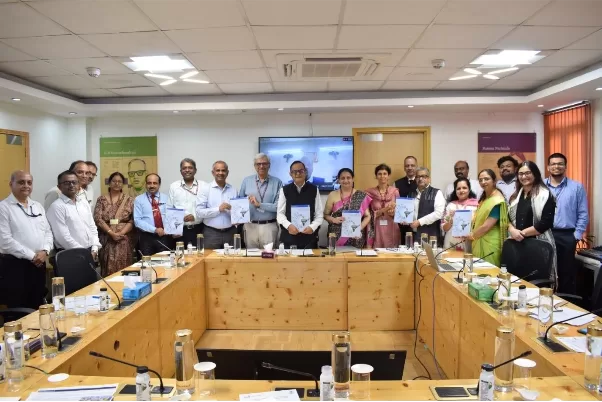
New Delhi, August 27, 2025 — The Government of India’s ambitious National One Health Mission (NOHM) took a major step forward on Tuesday, August 26, with the convening of its third Scientific Steering Committee meeting at Vigyan Bhawan Annexe. Chaired by Prof. Ajay K. Sood, Principal Scientific Adviser to the Government of India, the meeting brought together leaders from 13 ministries and departments to advance an integrated, cross-sectoral approach to human, animal, and environmental health challenges.
This latest session marked a significant expansion of the mission with the inclusion of three new entities: the Ministry of Earth Sciences, the Indian Space Research Organisation (ISRO), and the Department of Fisheries. Their expertise, in areas ranging from climate modeling to satellite monitoring and aquatic health, is expected to enhance preparedness for emerging diseases and environmental threats.
What is the National One Health Mission?
First announced as part of India’s strategy to address complex health risks, NOHM adopts the “One Health” approach, which recognizes that human health is closely linked to the health of animals and the environment. Global experience—from avian influenza and swine flu to the ongoing challenges of COVID-19—has shown how quickly diseases can jump across species and borders.
“No single ministry can address these intersecting threats alone,” Prof. Sood said in his opening remarks. “The One Health Mission is about harnessing the collective expertise of public health, agriculture, animal husbandry, environment, and now even space science to strengthen India’s resilience to 21st-century health challenges.”
Key Outcomes and Discussions
1. State and Union Territory Engagement
Dr. Sangeeta Agarwal, Scientist F from the Office of the PSA, presented progress on state-level partnerships and capacity building.
-
A multi-tiered governance model spanning state, district, and panchayat levels was proposed.
-
Knowledge-sharing networks have been initiated between states — Assam and Uttar Pradesh, and between Goa and Karnataka — to address priority zoonotic diseases such as rabies, leptospirosis, and avian influenza.
-
The first State/UT engagement workshop was held on June 9, 2025, with its report officially released during the meeting. It outlines opportunities and challenges for local implementation.
2. Building a National Learning Network
Plans are underway to launch a unified e-learning module for state and UT officials. The training will cover zoonotic disease surveillance, outbreak response, and environmental monitoring. Additionally, youth engagement through hackathons and ideathons was discussed to crowdsource solutions for regional One Health challenges.
3. Advisory and Review Committee Updates
Four Advisory & Review committees presented their progress:
-
BSL-3/4 Laboratory Network (Lt. Gen. (Retd.) Madhuri Kanitkar): Expanding biosafety capacity for high-risk pathogens.
-
Technology-Enhanced Integrated Surveillance (Dr. N. K. Arora): Developing advanced tools for outbreak detection and field investigation.
-
R&D on Medical Countermeasures (Dr. Renu Swarup): Prioritizing vaccines, therapeutics, and diagnostic platforms.
-
Integration of Databases & Data Sharing (Dr. Vijay Chandru): Establishing protocols for a National Outbreak Data Repository.
4. Frontier Initiatives
The committee discussed several cutting-edge measures, including:
-
Scaling up wastewater surveillance as an early-warning tool for outbreaks such as COVID-19, antimicrobial resistance, and enteric pathogens.
-
Strengthening laboratory networks by linking government, academic, and private research facilities.
-
Fostering inter-ministerial transparency and data sharing to reduce duplication and speed up outbreak response.
Why It Matters
Experts note that India’s vast geography, dense population, and growing interface between humans, livestock, and wildlife make it a global hotspot for zoonotic spillovers. According to the World Health Organization (WHO), over 60% of new emerging infectious diseases originate in animals—often linked to deforestation, industrial farming, and climate change.
“India’s One Health Mission is unique not just for its national scope but also for its attempt to integrate environment, agriculture, and even space technology,” said Dr. Anupama Sharma, Professor of Epidemiology at AIIMS New Delhi (not part of the committee) in a phone interview. “This could serve as a model for countries facing similar health-ecological challenges in the Global South.”
The Indian Council of Medical Research (ICMR) has already piloted One Health projects in states such as Nagaland and Karnataka, where researchers track zoonotic risks at the animal-human interface. Scaling such efforts nationwide could reduce the chances of “silent” outbreaks that escape early detection.
Limitations and Challenges
While the mission has gained momentum, challenges remain:
-
Implementation at the grassroots level: Building local capacity in districts and villages will require sustained investment and training.
-
Data integration hurdles: Ministries and agencies often maintain siloed databases. Creating a seamless national platform will be resource-intensive.
-
Funding and sustained political will: Large-scale projects often face risks of fragmentation once initial attention wanes.
-
Equity concerns: Rural and underserved states may lack the infrastructure to implement sophisticated One Health tools unless specifically supported.
Global Relevance
The discussion comes at a time when organizations like the Quadripartite collaboration (WHO, OIE, FAO, UNEP) are urging countries to adopt cross-sectoral frameworks to tackle zoonotic diseases, antimicrobial resistance, and environmental degradation together. For India, with its G20 commitments to pandemic preparedness, NOHM could evolve into a template for global South-South collaboration.
Looking Ahead
In his closing remarks, Prof. Sood stressed that the strength of the mission lies in its knowledge diversity. The next steps include:
-
Rolling out the unified e-learning module nationally.
-
Accelerating development of the National Outbreak Data Repository.
-
Expanding lab networks beyond central hubs to tier-2 and tier-3 cities.
-
Engaging academic institutions and young innovators in surveillance and response solutions.
“This is not just a health mission—it’s a national resilience mission,” Prof. Sood emphasized. “India is building a framework that is local in execution, national in scope, and global in significance.”
References
- https://www.pib.gov.in/PressReleasePage.aspx?PRID=2161041
Medical Disclaimer
This article is for informational purposes only and should not be considered medical advice. Always consult with qualified healthcare professionals before making any health-related decisions or changes to your treatment plan. The information presented here is based on current research and expert opinions, which may evolve as new evidence emerges.