 0
0
 0
0
NEW DELHI — In a landmark announcement that could redefine the socio-economic fabric of the nation, Finance Minister Nirmala Sitharaman declared before the Rajya Sabha on March 17, 2026, that India has set an ambitious deadline of 2033 to achieve universal health insurance coverage. Speaking during the Question Hour, the Minister emphasized that bridging the “health security gap” is now a top government priority. With the sector already protecting 58 crore lives as of the 2024-25 fiscal year, the roadmap involves aggressive rural expansion, regulatory reforms, and the scaling of existing social safety nets to reach the nearly 90 crore citizens currently living without a formal health cushion.
A Landscape in Transition: By the Numbers
India’s health insurance market is no longer a niche urban product; it has evolved into a powerhouse sector. In the 2024-25 period, total premiums reached a staggering Rs 1,17,505 crore, distributed almost evenly between public insurers (Rs 42,420 crore), private firms (Rs 37,752 crore), and standalone health insurance providers (Rs 37,331 crore).
Data from the Insurance Regulatory and Development Authority of India (IRDAI) reveals a steady climb in penetration. In 2020, only 34% of the population held some form of health coverage. By early 2025, that figure rose to 41%, covering approximately 550 million people. Despite this momentum, the “protection gap” remains significant, with 60% of the population still paying for medical emergencies out of their own pockets—a leading cause of family debt in India.
The engines driving this growth are two-fold:
-
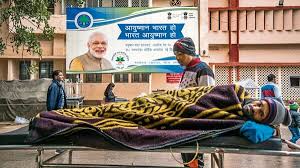
Ayushman Bharat (AB-PMJAY): The world’s largest government-funded healthcare program provides Rs 5 lakh annual coverage to the bottom 40% of the population. As of February 2026, 43.52 crore cards have been issued.
-
Senior Citizen Expansion: A pivotal shift occurred in October 2024, when the government opened AB-PMJAY to all seniors aged 70 and above, regardless of income, shielding 4.5 crore families from the high costs of geriatric care.
Regulatory Teeth and Consumer Protections
To reach the 2033 goal, the government and IRDAI have introduced reforms aimed at making insurance “user-friendly” rather than a “legal maze.” Under new 2024 guidelines, the mandatory waiting period for pre-existing diseases (PED) was slashed from four years to three. More importantly, the “moratorium period”—the timeframe after which an insurer cannot contest a claim—was reduced from eight years to five.
The regulator has also taken a hard line against “fine print” tactics. In the 2023-24 cycle, IRDAI imposed fines of Rs 2 crore each on major players, including Reliance General and HDFC Life, for unfair practices and mis-selling.
“The removal of age caps and the prohibition on denying coverage for severe conditions like cancer or heart disease are game-changers,” says Dr. Sanil Basutkar, a prominent healthcare insurance analyst. “However, while group policies cover 20 crore people, retail (individual) uptake is stagnating at around 5 crore. We need to move from ‘selling’ insurance to ‘buying’ insurance through better consumer trust.”
The “Missing Middle” and Rural Hurdles
The path to 2033 is not without significant roadblocks. While the very poor are covered by government schemes and the wealthy buy private plans, a vast “missing middle”—self-employed individuals, informal workers, and mid-level farmers—remains vulnerable.
Medical inflation in India is currently hovering between 12% and 14%, consistently outstripping the growth of the average policy’s sum insured. In states like West Bengal, out-of-pocket expenses still account for nearly 67% of total healthcare spending.
Comparative Healthcare Metrics (2025-26)
| Metric | India Current | Global Average / WHO Benchmark |
| Per Capita Premium | USD 97 | USD 943 |
| Health Workers | 20.6 per 10,000 | 44.5 per 10,000 |
| Insurance Penetration | 41% | ~60-80% (Developed economies) |
“We have a supply-side problem,” notes a recent report from NITI Aayog. “You can give a person an insurance card, but if there is no empanelled hospital within 50 kilometers, or if that hospital lacks the necessary specialists, the card is just a piece of plastic.”
Public Health Implications: More Than Just Money
Achieving universal coverage by 2033 is projected to save the Indian economy an estimated USD 10 billion annually by preventing “catastrophic health expenditures”—spending that exceeds 10% of a household’s total income.
From a medical perspective, insurance shifts the paradigm from reactive to preventive care. When people aren’t afraid of the bill, they seek help earlier for chronic conditions like hypertension and diabetes. This is critical in a country where Non-Communicable Diseases (NCDs) now account for over 61% of all deaths.
For the average citizen, the 2026 Budget allocation of Rs 9,500 crore to PM-JAY signifies a sustained commitment. The integration of the Digital Ayushman Card with the Unified Health Interface (UHI) also means that claims processing is becoming faster and more transparent, reducing the “paperwork trauma” often associated with hospital discharges.
Expert Analysis: Is 2033 Realistic?
While the Finance Minister’s declaration has been met with optimism, public health experts urge a balanced view.
“The ambition is transformational,” says an industry commentator from a leading health policy think tank. “But we must address the rural-urban divide. Currently, insurance penetration in rural social sectors lags despite mandatory targets set by the regulator. Success hinges on private-public synergy—the private sector must find it viable to operate in Tier-3 cities.”
Furthermore, critics point out that the rise in Foreign Direct Investment (FDI) must be balanced with strict oversight to ensure that the entry of global players doesn’t drive up premium costs for the common man.
What This Means for You
As India marches toward 2033, consumers are encouraged to:
-
Review Eligibility: Check the PM-JAY portal to see if you or your elderly parents qualify for government-backed schemes.
-
Compare Early: With PED waiting periods reduced, it is more beneficial than ever to secure a policy while healthy.
-
Verify Credentials: Use IRDAI-approved portals to compare “Claim Settlement Ratios” before purchasing a plan.
The next decade promises a shift from a “pay-or-suffer” model to a “protected-by-right” system. If the 2033 goal is realized, India will join the ranks of nations that view health not as a privilege of the few, but as a guaranteed security for all.
Medical Disclaimer: This article is for informational purposes only and should not be considered medical advice. Always consult with qualified healthcare professionals before making any health-related decisions or changes to your treatment plan. The information presented here is based on current research and expert opinions, which may evolve as new evidence emerges.
References
-
-
Sitharaman, N. (2026, March 17). Rajya Sabha Question Hour remarks. The Economic Times Health. Source
-