 0
0
 0
0
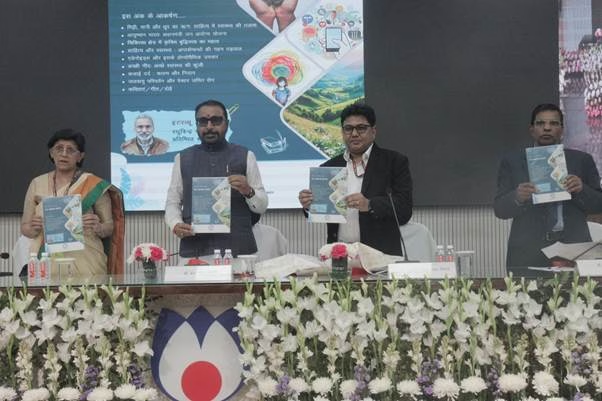
NEW DELHI – In a significant milestone for India’s public health landscape, the National Institute of Health and Family Welfare (NIHFW) celebrated its 49th Annual Day on March 9, 2026. Presiding over the event at the Munirka auditorium, Union Minister of State for Health and Family Welfare, Shri Prataprao Jadhav, outlined an ambitious roadmap for the country’s healthcare future, centered on digital integration, expanded immunization, and a highly skilled medical workforce.
The ceremony served as both a reflection on nearly five decades of institutional excellence and a forward-looking declaration of India’s healthcare priorities. Minister Jadhav emphasized that the government is aggressively scaling the Ayushman Bharat Digital Mission (ABDM) and reinforcing primary care through the widespread establishment of Health and Wellness Centres (HWCs)—recently rebranded as Ayushman Arogya Mandirs.
Bridging the Gap: Digital Infrastructure and Rural Care
As of early 2026, India’s digital health ecosystem has seen unprecedented growth. Minister Jadhav highlighted that the expansion of digital infrastructure is not merely a technological upgrade but a vital necessity for universal health coverage.
“We are making disease surveillance systems more effective and expanding immunization efforts by introducing new vaccines,” Jadhav stated during his keynote address. This digital shift aims to create a seamless link between rural patients and tertiary care, ensuring that a patient’s medical history—secured via the Ayushman Bharat Health Account (ABHA)—is accessible across the country’s healthcare network.
Dr. Sunita Sharma, Director General of Health Services (DGHS), echoed these sentiments, noting that NIHFW has been the backbone of capacity building. “The institute has played a pivotal role in strengthening the capacity of India’s health workforce, ensuring that national health programs are implemented with precision at the grassroots level,” she remarked.
Key Achievements and New Strategic Publications
The Director of NIHFW, Dr. Sunil Vilasrao Gitte, presented the Annual Report, which showcased a year of rigorous research and training. The institute has successfully navigated a post-pandemic landscape by focusing on:
-
Advanced Public Health Training: Upskilling thousands of Community Health Officers (CHOs).
-
Policy Support: Providing data-driven insights for the Ministry of Health and Family Welfare (MoHFW).
-
Research Initiatives: Focusing on maternal health, non-communicable diseases (NCDs), and emerging infectious threats.
To mark the occasion, three significant publications were released:
-
“Dharna”: An annual publication reflecting institutional progress.
-
The HPPI Journal: Focused on Health and Population Perspectives and Issues.
-
“Prospects of Placement Cell”: A guide aimed at bridging the gap between public health graduates and career opportunities in the evolving sector.
Statistical Context: The State of Indian Public Health in 2026
According to recent Ministry reports, the scale of India’s health transformation is reflected in the following data:
-
Infrastructure: Over 1.8 lakh Ayushman Arogya Mandirs are now operational, providing an expanded package of 12 essential health services.
-
Screenings: Nationwide initiatives have resulted in over 39 crore hypertension screenings and 36 crore diabetes screenings, reflecting a shift toward preventive care.
-
Immunization: India has achieved a Full Immunization Coverage (FIC) rate exceeding 98% for the 2025-2026 period.
-
Digital Reach: More than 42 crore Ayushman Cards have been issued, facilitating cashless treatment for the country’s most vulnerable populations.
Expert Perspectives: The Human Element
While the digital push is significant, independent experts emphasize that technology must be matched by “human-centric” training.
“Digital tools like AI-driven surveillance are game-changers for early outbreak detection,” says Dr. Rajesh Kumar, a public health consultant not affiliated with the institute. “However, the real success lies in the ‘last-mile’ delivery. The NIHFW’s focus on training Community Health Officers is what actually translates policy into pulse rates. Without a skilled human hand, the best digital system is just an empty shell.”
Public Health Implications and Challenges
The expansion of disease surveillance is particularly critical as India aims for Measles-Rubella (MR) elimination by late 2026. By integrating laboratory networks and genomic surveillance, the government hopes to detect and contain outbreaks faster than ever before.
However, challenges remain. Critics often point to the “digital divide” in remote areas where internet connectivity can be intermittent. Furthermore, the integration of traditional AYUSH (Ayurveda, Yoga, Unani, Siddha, and Homeopathy) practices—a key focus of the 2026 Union Budget—requires careful standardization to ensure evidence-based outcomes alongside modern medicine.
Moving Forward: What This Means for You
For the average citizen, these developments signal a shift toward a more proactive healthcare experience. The strengthening of local Health and Wellness Centres means that screenings for cancers and chronic diseases are now available closer to home, often free of charge.
The move toward a unified digital health record also means less paperwork for patients and more informed decision-making for doctors. As NIHFW enters its 50th year, its mission remains clear: to ensure that the individuals managing India’s health are as advanced and resilient as the technology they use.
Reference Section
-
Press Information Bureau (PIB): “Union MoS for Health and Family Welfare, Shri Prataprao Jadhav Presides over the 49th Annual Day Celebration of the National Institute of Health and Family Welfare,” Posted March 9, 2026.
Medical Disclaimer: This article is for informational purposes only and should not be considered medical advice. Always consult with qualified healthcare professionals before making any health-related decisions or changes to your treatment plan. The information presented here is based on current research and expert opinions, which may evolve as new evidence emerges.