 0
0
 0
0
February 14, 2026
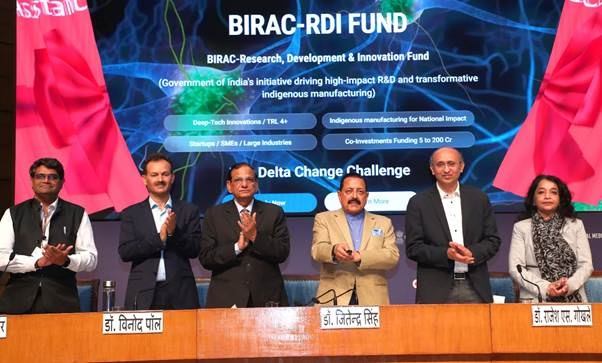
NEW DELHI — In a move set to redefine the landscape of Indian healthcare and industrial manufacturing, Union Minister Dr. Jitendra Singh announced on Friday the first national call for the BIRAC–RDI Fund. The initiative, which will deploy ₹2,000 crore over the next five years, is the inaugural pulse of the government’s massive ₹1 lakh crore Research, Development, and Innovation (RDI) framework. The fund aims to transform high-risk laboratory breakthroughs into scalable medical and industrial products, signaling India’s transition from a technology follower to a global biotechnology leader.
From Startup to Scale-Up: The New Biotech Horizon
The announcement, made in New Delhi before a gallery of scientists, industry leaders, and NITI Aayog officials, marks a “decisive shift” in India’s scientific trajectory. According to Dr. Singh, India is no longer a “late starter” in the biotech race.
“Over the past decade, India has moved from policy hesitation to policy acceleration,” Dr. Singh stated. The numbers support this claim: India’s biotech startup ecosystem has exploded from a mere 50 firms in 2014 to over 11,000 in 2026. This “quantum jump” is the foundation for what the government predicts will be a $300 billion bioeconomy by 2030.
Bridging the “Valley of Death”
For years, promising medical innovations in India have often stalled in the transition from a successful lab experiment to a mass-produced product—a phase often called the “Valley of Death” in the scientific community. The BIRAC–RDI Fund is specifically designed to bridge this gap.
Managed by the Biotechnology Industry Research Assistance Council (BIRAC), the fund will support technologies moving from Technology Readiness Level 4 (TRL-4)—where a proof-of-concept is validated in a lab—to TRL-9, where a product is fully proven in a real-world environment and ready for the market.
Dr. Rajesh S. Gokhale, Secretary of the Department of Biotechnology, emphasized that this fund is unique because it provides “patient capital.”
“The RDI Fund has been structured to support long-gestation, high-risk research. We are moving from research outputs to scalable industrial outcomes in biopharma, bioenergy, and the blue economy,” Dr. Gokhale said.
What This Means for Public Health
While the fund targets industrial growth, its most significant impact will likely be felt in the doctor’s office and the pharmacy. By funding “high-impact” innovations, the initiative focuses on:
-
Next-Generation Biopharmaceuticals: Accelerating the development of affordable biosimilars and novel drugs for chronic diseases.
-
Space Medicine: As India ventures further into space exploration, the fund is already supporting domestic kits for plant and life science research in zero-gravity environments, which could yield insights into bone density loss and aging.
-
Bio-Industrial Manufacturing: Creating greener, more efficient ways to produce medicines and essential chemicals, reducing India’s dependence on imported raw materials.
Expert Perspective
Independent experts suggest that this level of funding is a game-changer for indigenous healthcare. “The challenge in India hasn’t been a lack of brilliant scientists, but a lack of infrastructure to take a discovery through the expensive clinical trial and manufacturing phases,” says Dr. Arvinder Singh, a consultant in health policy (not involved in the fund’s administration). “If managed transparently, this fund could lead to cheaper diagnostic tools and therapies tailored specifically for the Indian genetic profile.”
Strategic Growth and Global Standing
The Biotechnology sector is being positioned as the driver of India’s next industrial revolution, much like Information Technology (IT) was in the 1990s.
| Metric | 2014 | 2024 | 2030 (Target) | 2047 (Target) |
| Bioeconomy Value | $8 Billion | $165.7 Billion | $300 Billion | $1 Trillion |
| Biotech Startups | ~50 | ~10,000+ | 20,000+ (Est.) | N/A |
Dr. Jitendra Kumar, Managing Director of BIRAC, noted that the infrastructure is already in place to absorb this capital. With over 100 bio-incubation centers and 10 lakh square feet of specialized space already established, the fund acts as the fuel for an engine that is already built.
Limitations and the Road Ahead
Despite the optimism, industry analysts point to potential hurdles. High-risk research, by definition, has a high failure rate. Critics often worry about the “red tape” involved in government-managed equity and debt instruments.
Furthermore, while ₹2,000 crore is a significant sum, the global biotech market is hyper-competitive. Staying ahead will require not just initial funding, but a sustained regulatory environment that fast-tracks approvals without compromising safety standards.
Conclusion: A Call to Innovators
The national call for applications is officially open to startups, SMEs, and industry partners. Proposals can be submitted via the official portal until March 31, 2026.
For the average citizen, this initiative represents a promise: that the next breakthrough in cancer treatment, vaccine technology, or sustainable living might not just be discovered in an Indian lab, but also manufactured in an Indian factory, making it more accessible and affordable for all.
References
- https://www.pib.gov.in/PressReleasePage.aspx?PRID=2227506®=3&lang=1
Medical Disclaimer: This article is for informational purposes only and should not be considered medical advice. Always consult with qualified healthcare professionals before making any health-related decisions or changes to your treatment plan. The information presented here is based on current research and expert opinions, which may evolve as new evidence emerges.