 0
0
 0
0
February 27, 2026
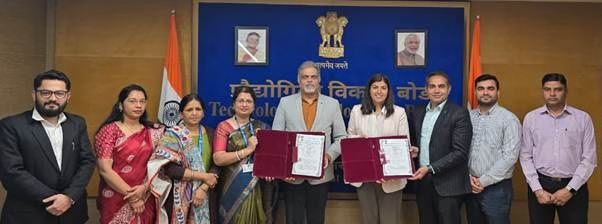
NEW DELHI — In a move set to redefine the landscape of affordable precision medicine, the Technology Development Board (TDB) of India’s Department of Science & Technology announced on Thursday its financial backing for a homegrown immunotherapy platform. The project, led by Gurgaon-based East Ocyon Bio Private Limited, aims to develop “off-the-shelf” CAR-NK cell therapies—a next-generation treatment designed to combat both treatment-resistant solid tumors and Leishmaniasis, a neglected tropical disease that remains a significant public health challenge in rural India.
The initiative marks a critical shift toward “Aatmanirbhar Bharat” (Self-Reliant India) in the high-stakes world of biotherapeutics. By moving away from expensive, patient-specific treatments toward mass-produced, donor-derived cells, the project seeks to make cutting-edge cancer care accessible to a broader population while simultaneously tackling infectious diseases that often lack innovative funding.
The Evolution of Immunotherapy: From CAR-T to CAR-NK
For the past decade, CAR-T cell therapy has been the “poster child” of personalized medicine. It involves harvesting a patient’s own T-cells, genetically engineering them to recognize cancer, and re-infusing them. However, CAR-T therapy is notoriously expensive, logistically complex, and carries risks of severe side effects like cytokine release syndrome (CRS), where the immune system overreacts dangerously.
Enter CAR-NK (Chimeric Antigen Receptor–Natural Killer) cells. Unlike T-cells, which are the “specialized snipers” of the immune system, Natural Killer (NK) cells are the “front-line infantry.” They can recognize and kill abnormal cells without prior sensitization.
“The transition to CAR-NK platforms represents a pragmatic evolution,” says Dr. Aranya Kapoor, an independent oncologist not involved in the project. “Because NK cells do not require a perfect genetic match between donor and patient, we can create ‘off-the-shelf’ batches. This eliminates the weeks of waiting time required for CAR-T, which is often a luxury many advanced cancer patients don’t have.”
Key Advantages of the CAR-NK Platform:
-
Immediate Availability: Pre-manufactured and cryopreserved for “on-demand” use.
-
Enhanced Safety: Lower risk of Graft-versus-Host Disease (GvHD) and reduced neurotoxicity.
-
Dual-Action Killing: NK cells use both the engineered receptor and their natural instincts to find and destroy tumors, even those that try to “hide” from the immune system.
Targeting “Difficult-to-Treat” Tumors
The lead innovation from East Ocyon Bio focuses on a protein called PD-L1. Many solid tumors—such as those found in the lungs, breast, and colon—express PD-L1 to “turn off” the immune system, effectively acting as a biological invisibility cloak.
The new therapy engineers NK cells to target this PD-L1 protein directly. By using a gamma-retroviral platform, researchers ensure these “hunter cells” remain active and persistent within the body long enough to dismantle the tumor’s defenses.
“Supporting frontier technologies like this is about more than just innovation; it’s about sovereignty in healthcare,” stated Sh. Rajesh Kumar Pathak, Secretary of the TDB. “This will significantly reduce our reliance on imported, multi-million dollar therapies.”
A World First: Immunotherapy for Leishmaniasis
Perhaps the most groundbreaking aspect of this project is its application to Leishmaniasis (commonly known in India as Kala-azar). Caused by a parasite transmitted by sandflies, the disease can be fatal if left untreated and often leaves survivors with permanent scarring or organ damage.
Traditional treatments for Leishmaniasis can be toxic and are increasingly facing drug resistance. By applying CAR-NK technology to an infectious disease, the project explores a “host-directed” therapy. Instead of just attacking the parasite, the engineered cells help the patient’s immune system clear the infection more effectively.
This represents a rare instance where high-tech oncology research is “cross-pollinated” to solve a disease of poverty, providing a potential lifeline for thousands in regions like Bihar and West Bengal.
Scaling the Future: Challenges and Reality
While the promise is immense, the road to the bedside involves rigorous clinical trials. “The transition from a laboratory success to a mass-produced clinical product is steep,” cautions Dr. Kapoor. “We must ensure that these ‘off-the-shelf’ cells maintain their potency after being frozen and shipped across a country with diverse climatic conditions.”
East Ocyon Bio founders, Dr. Renu and Dr. Dinesh Kundu, noted that the TDB’s support is the bridge needed to cross this “valley of death” between innovation and patient access. The project will utilize Good Manufacturing Practices (GMP) to ensure that the cells are safe, sterile, and effective for large-scale human use.
What This Means for Patients
For the average consumer, this development signals a future where “precision medicine” isn’t just for the wealthy.
-
Lower Costs: Mass production reduces the per-dose cost significantly compared to personalized CAR-T.
-
Faster Treatment: Patients can receive infusion days after diagnosis rather than waiting weeks for cell processing.
-
New Hope for Solid Tumors: While previous immunotherapies worked best on blood cancers (like leukemia), this platform specifically targets the “harder” solid tumors.
As India moves toward the clinical trial phase of this indigenous platform, the eyes of the global medical community are on Gurgaon. If successful, India could become a global hub for the next generation of affordable, life-saving biotherapeutics.
Medical Disclaimer
Medical Disclaimer: This article is for informational purposes only and should not be considered medical advice. Always consult with qualified healthcare professionals before making any health-related decisions or changes to your treatment plan. The information presented here is based on current research and expert opinions, which may evolve as new evidence emerges.
Reference Section
Primary Source:
-
Press Information Bureau (PIB) Delhi. (2026, February 26). TDB-DST supports Indigenous CAR-NK Cell Therapy Platform for Oncology and Leishmaniasis. Government of India.