 0
0
 0
0
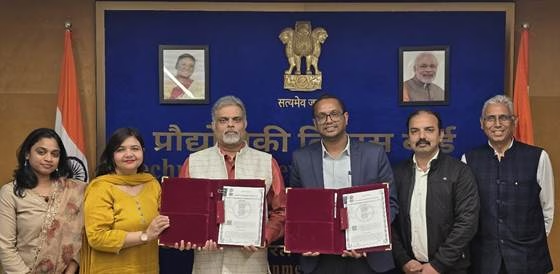
NEW DELHI — In a significant move toward medical self-reliance, the Government of India’s Technology Development Board (TDB) has announced a strategic partnership with Ayukriyam Innovations Pvt. Ltd. to commercialize Autoscope, an indigenous, AI-driven Whole Slide Imaging (WSI) system. Announced on February 26, 2026, this collaboration aims to modernize India’s diagnostic infrastructure, moving away from labor-intensive manual microscopy toward high-throughput, automated digital pathology.
The project, born out of the Molecular Imaging & Diagnostics Lab at the Indian Institute of Technology (IIT) Delhi, represents a shift toward “deep-tech” solutions designed specifically for resource-constrained environments. By integrating advanced robotics with artificial intelligence, Autoscope seeks to bridge the gap between high-end urban laboratories and rural healthcare centers.
The End of the “Manual Era” in Diagnostics
For over a century, the gold standard for diagnosing infectious diseases and cancers has remained largely unchanged: a pathologist peers through a manual microscope at a glass slide. While effective, this method is slow, prone to human fatigue, and requires highly specialized personnel who are often concentrated in major metropolitan hubs.
Autoscope changes this workflow by digitizing the entire process. The system automatically scans biological samples—such as blood smears or tissue biopsies—and converts them into high-resolution digital “whole slides.”
Key Features of the Autoscope Platform:
-
Fully Automated Imaging: Eliminates the need for manual focus and slide movement.
-
AI-Driven Analytics: Algorithms pre-screen slides to identify pathogens or cellular abnormalities.
-
High Throughput: Capable of processing large batches of slides significantly faster than manual methods.
-
Portability and Deployment: Designed to maintain precision even in settings with limited infrastructure.
“Indigenous development of advanced diagnostic platforms integrating imaging and artificial intelligence is vital for strengthening India’s healthcare infrastructure,” stated Shri Rajesh Kumar Pathak, Secretary of the TDB. He emphasized that the goal is to reduce India’s heavy reliance on expensive, imported diagnostic machinery while fostering the Aatmanirbhar Bharat (Self-Reliant India) mission.
Bridging the Diagnostic Gap
The implications for public health, particularly in a country as geographically diverse as India, are profound. According to the World Health Organization (WHO), early and accurate diagnosis is the cornerstone of managing infectious diseases like Tuberculosis and Malaria, which still pose significant burdens in the region.
In many rural districts, a lack of on-site pathologists leads to “diagnostic delays,” where samples must be shipped to distant cities, stalling treatment for days or weeks. Autoscope’s digital nature allows for telepathology—the ability for a technician in a village to scan a slide and a specialist in a city to review the digital file instantly.
“AI doesn’t replace the doctor; it acts as a high-speed assistant,” says Dr. Ananya Sharma, a consultant pathologist not involved in the project. “In a high-volume setting, AI can flag ‘suspicious’ slides, allowing the pathologist to focus their expertise where it is most needed, thereby reducing human error caused by exhaustion.”
Technical Context: What is Whole Slide Imaging (WSI)?
To understand the leap Autoscope represents, one must look at the evolution of pathology. Traditional microscopy captures only a small “field of view” at one time. WSI technology, however, captures the entire slide at multiple magnifications.
Analogy: If manual microscopy is like looking at a city through a straw, Whole Slide Imaging is like having a high-definition, zoomable Google Map of the entire city.
By applying AI to these “maps,” the Autoscope system can recognize patterns—such as the specific morphology of a parasite or a cluster of malignant cells—that might be missed by the naked eye during a routine screening.
Challenges and the Path to Market
Despite the promise of AI in healthcare, the transition faces hurdles. Historically, the adoption of digital pathology has been slowed by the high cost of equipment and the massive data storage required for high-resolution images. Furthermore, AI models must be rigorously validated across diverse patient populations to ensure they do not exhibit “algorithmic bias.”
The TDB’s financial assistance is specifically earmarked to address these “valley of death” challenges—the gap between a laboratory prototype and a mass-produced medical device. The funding will support:
-
Manufacturing Excellence: Establishing a dedicated facility for local production.
-
Field Evaluations: Rigorous testing in real-world clinical environments to ensure accuracy across various conditions.
-
Market Readiness: Ensuring the device meets stringent regulatory standards for medical hardware.
Impact on the Patient
For the average consumer, this technological leap translates to three “As”: Accuracy, Affordability, and Accessibility.
When diagnostics are produced locally and automated, the cost per test typically drops. For a patient in a remote area, it could mean receiving a life-saving diagnosis in hours rather than weeks. As Ayukriyam Innovations moves toward full-scale production, the landscape of Indian diagnostics appears poised for a digital-first future.
The promoters of Ayukriyam expressed that the TDB support is a “catalyst” that will significantly accelerate their ability to bring these lab-grown innovations to the bedside of the patients who need them most.
Statistical Context: The Diagnostic Market
-
Import Dependency: Estimates suggest India currently imports nearly 70-80% of its high-end medical devices.
-
Market Growth: The Indian diagnostic market is projected to grow at a CAGR of roughly 14%, driven by rising healthcare awareness and technological integration.
-
Pathologist Shortage: There is a significant disparity in the pathologist-to-patient ratio in rural vs. urban India, a gap AI-driven systems like Autoscope are designed to mitigate.
Medical Disclaimer
Medical Disclaimer: This article is for informational purposes only and should not be considered medical advice. Always consult with qualified healthcare professionals before making any health-related decisions or changes to your treatment plan. The information presented here is based on current research and expert opinions, which may evolve as new evidence emerges.
References
1. Primary Source:
-
Press Information Bureau (PIB) Delhi. “TDB supports Ayukriyam Innovations Pvt. Ltd. for Development of ‘Autoscope’ – An AI-Driven Whole Slide Imaging Diagnostic System.” (Feb 26, 2026).