 0
0
 0
0
A team of Indian researchers has unveiled a groundbreaking method to synthesize specialized nanoparticles—dubbed “nano-cups”—that promise to revolutionize photothermal therapy (PTT) for cancer treatment. This innovative approach, developed by scientists at the Institute of Nano Science and Technology (INST), Mohali, in collaboration with the Advanced Centre for Treatment, Research & Education in Cancer (ACTREC), Tata Memorial Centre, and the Indian Institute of Technology Bombay (IITB), offers a simplified, safer, and more efficient route to producing these potent cancer-fighting agents1246.
A Leap Beyond Conventional Methods
Traditionally, fabricating nanoparticles with semi-shell (SS) or nano-cup morphology has required complex, multi-step processes involving harsh chemicals like hydrofluoric acid, high temperatures, and toxic precursors. These methods are labor-intensive, costly, and pose significant safety and environmental risks124.
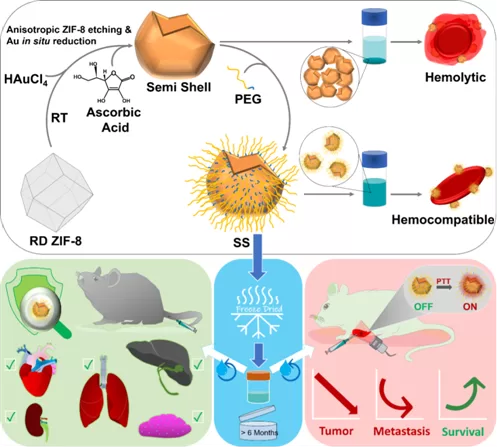
The new technique, published in Communications Chemistry, eliminates these barriers by introducing a one-step colloidal synthesis performed at room temperature. The process employs a biocompatible metal-organic framework (MOF), specifically ZIF-8, as a sacrificial template. Ascorbic acid (Vitamin C) is used as a mild reducing agent, allowing gold nanoparticles to grow in place of the etched ZIF-8, forming the unique nano-cup structure without the need for specialized equipment or hazardous reagents1246.
Enhanced Performance and Safety
These PEGylated semi-shell nano-cups are partly covered with polyethylene glycol (PEG), which significantly improves their stability, cryo-preservability, and compatibility with blood. This ensures a longer shelf life and safer intravenous administration. The nanoparticles exhibit strong absorption and scattering of near-infrared (NIR) light, making them highly effective for photothermal therapy—a treatment that uses light to generate heat and selectively destroy cancer cells1246.
Extensive laboratory and animal studies demonstrated that these nano-cups can effectively ablate metastatic breast tumors, significantly improving survival rates and reducing tumor recurrence in preclinical mouse models. The approach offers superior stability, ease of administration, and enhanced photothermal performance compared to existing technologies1246.
Future Directions
The research team plans to explore combined chemo-photothermal therapies for even more targeted cancer treatments and to investigate the use of these semi-shells in advanced diagnostic applications, such as Surface-Enhanced Raman Spectroscopy (SERS) biosensing, leveraging their unique optical properties1246.
“This innovation marks a significant step forward in cancer nanomedicine, offering a safer, more scalable, and highly effective platform for targeted cancer therapy,” said a spokesperson for the collaborating institutes14.
Disclaimer:
The findings described are based on preclinical research and have not yet undergone human clinical trials. While results in laboratory and animal models are promising, further studies are required to confirm safety and efficacy in humans. Readers should not interpret this as an endorsement of any specific treatment or as a substitute for professional medical advice1246.
- https://www.pib.gov.in/PressReleseDetail.aspx?PRID=2136980
- https://orissadiary.com/a-simplified-method-to-synthesize-nano-cups-that-can-blaze-the-cancer-with-heat/
- https://pmc.ncbi.nlm.nih.gov/articles/PMC6572460/
- https://www.devdiscourse.com/article/satire/3461277-revolutionary-one-step-nanoparticle-synthesis-boosts-photothermal-cancer-therapy
- https://pdf.ipinnovative.com/pdf/10669
- https://dst.gov.in/simplified-method-synthesize-nano-cups-can-blaze-cancer-heat
- https://x.com/PIB_India/status/1934952242119139834