 0
0
 0
0
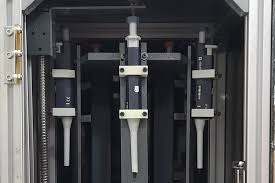
A team of Indian researchers from IIT Madras and Panjab University has developed an innovative, portable device named the “Smart MDD (Malathion Detection Device)” capable of detecting very low levels of pesticide residues, particularly organophosphate Malathion, in water, food, and environmental samples in real time. This breakthrough technology promises to enhance public health monitoring and environmental safety by providing rapid, accurate detection of toxic pesticide contamination, which is crucial given the known health risks posed by these chemicals.
Key Developments and Technology
The Smart MDD employs a colorimetric detection system utilizing gold nanoparticles tailored with an aptamer molecule that specifically recognizes Malathion. When the pesticide is present, a unique interaction triggers a color change from red to blue, which the device’s automated optical system quantitatively measures, eliminating the need for manual processing and expert handling. The sensitivity of this device is remarkable, with a detection limit around 250 picomolar, demonstrating precision comparable to sophisticated laboratory spectrophotometers, yet in a field-deployable, user-friendly format.
The research, supported by India’s Department of Science and Technology under its Technology Development and Transfer Programme, directly addresses limitations of conventional pesticide residue detection methods, which are typically costly, time-intensive, and require specialized personnel and infrastructure. The Smart MDD is designed for on-site use by farmers, food safety inspectors, and environmental regulators to rapidly check irrigation water, food produce, soil, and aquatic systems for pesticide contamination, facilitating compliance with safety standards and early intervention to protect human health and ecosystems.
Health and Environmental Context
Pesticides such as Malathion, while important in pest control for agriculture, are known to pose significant health hazards upon exposure. Acute effects can include skin irritations, respiratory issues, nausea, and neurological symptoms, whereas chronic exposure has been linked to long-term conditions such as cancers, reproductive disorders, metabolic disturbances, and neurodegenerative diseases including Parkinson’s disease. These health risks underscore the urgent need for effective monitoring tools that can detect toxic residues before they reach harmful levels in foods and water sources.
Current detection methods, often laboratory-based, face challenges including high costs, delayed results, and technical complexity. Advancements in biosensor technologies are rapidly evolving, with this new device representing a significant step forward by combining high sensitivity and ease of use in a portable format, potentially revolutionizing how pesticide exposure risks are monitored and managed in real-world settings.
Expert Commentary and Future Implications
Prof. Sujatha Narayanan Unni of IIT Madras, a lead researcher in the project, highlighted the immense potential impact of this technology: “It can help farmers, food safety agencies, and environmental regulators rapidly monitor pesticide contamination on-site. This will ensure safety standards are met, significantly reducing public health risks and aiding in tracking pesticide runoff in water bodies, a major environmental concern”.
Dr. Rohit Kumar Sharma from Panjab University emphasized plans to extend the platform for detecting a broader suite of pesticides, enhancing its role in sustainable agricultural management and environmental monitoring. This expansion could lead to comprehensive tools that safeguard food safety and environmental health on a larger scale.
Implications for Public Health and Daily Life
For consumers and the general public, the availability of this device may lead to faster identification of contamination risks in food and water, allowing for prompt action such as avoiding consumption of tainted produce or unsafe water sources. For agricultural communities and regulatory bodies, it enables proactive monitoring to prevent pesticide overuse and environmental damage, which aligns with public health goals of reducing pesticide-related illnesses and protecting ecosystems.
Limitations and Considerations
Though laboratory tests demonstrate strong performance, the device must undergo extensive validation with real-world samples from fruits, vegetables, and agricultural water sources to ensure reliability outside controlled conditions. Further research will be necessary to confirm specificity across varied environmental matrices, potential interference by other chemicals, and user adaptability in diverse settings.
Moreover, as the device currently targets Malathion specifically, additional development is required to expand detection capabilities to other pesticide classes relevant to local and global agricultural practices.
Conclusion
The development of the Smart MDD device by Indian researchers is a promising advancement in the pursuit of safer food and water through innovative, accessible pesticide monitoring. By enabling rapid, on-site detection of toxic pesticide residues, this tool supports early intervention and better regulatory compliance, ultimately contributing to improved public health and environmental stewardship. Ongoing validation and expansion of detection ranges will determine its broader applicability and impact.
Medical Disclaimer: This article is for informational purposes only and should not be considered medical advice. Always consult with qualified healthcare professionals before making any health-related decisions or changes to your treatment plan. The information presented here is based on current research and expert opinions, which may evolve as new evidence emerges.
References