 0
0
 0
0
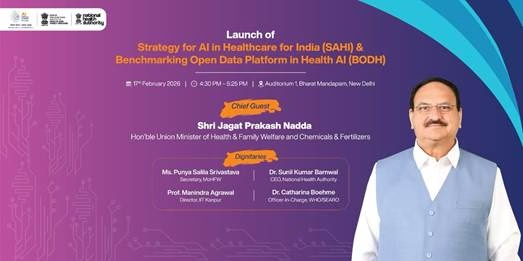
NEW DELHI – In a move set to redefine the digital health landscape of the Global South, Union Health Minister Shri J.P. Nadda is scheduled to launch two landmark initiatives, SAHI and BODH, at the India AI Summit tomorrow at Bharat Mandapam. These frameworks aim to transition India from fragmented digital adoption to a unified, ethical, and evidence-based Artificial Intelligence (AI) ecosystem, directly impacting how over 1.4 billion citizens receive medical care.
The launch comes amid a global surge in “agentic AI”—systems capable of making complex clinical decisions—prompting the Indian government to establish rigorous guardrails for patient safety and data privacy.
The Twin Pillars: SAHI and BODH
The Ministry of Health and Family Welfare (MoHFW) has designed these initiatives to address the two greatest hurdles in medical technology: ethical governance and performance validation.
1. SAHI: The Strategic Compass
The Strategy for Artificial Intelligence in Healthcare for India (SAHI) serves as the national guidance framework. Think of it as a “constitutional manual” for AI in hospitals. It provides a roadmap for:
-
Governance and Ethics: Ensuring AI doesn’t replace the human touch but enhances it.
-
Data Stewardship: Managing how patient data is handled to prevent misuse.
-
Inclusive Adoption: Ensuring that AI tools work as effectively in a rural clinic in Chhattisgarh as they do in a multi-specialty hospital in Mumbai.
2. BODH: The Testing Ground
Developed by IIT Kanpur in collaboration with the National Health Authority (NHA), the Benchmarking Open Data Platform for Health AI (BODH) is a technical breakthrough. It allows developers to test their AI models against real-world Indian health data without ever “seeing” or “touching” the private patient records.
By using “privacy-preserving” technology, BODH ensures that an AI diagnostic tool is accurate across diverse populations before it is allowed to interact with a single patient.
Expert Insights: Trust Over Tech
While the technology is impressive, experts emphasize that the real victory lies in building trust.
“The challenge in India isn’t just building AI; it’s ensuring that the AI understands the nuances of the Indian physiology and socio-economic context,” says Dr. Sunil Kumar Barnwal, CEO of the National Health Authority. “BODH provides the ‘quality assurance’ stamp that has been missing in the health-tech sector.”
Independent observers agree. Dr. Arvind Kumar, a veteran public health policy researcher (not involved in the project), noted: “We are moving away from ‘black box’ AI where no one knows how a machine reached a diagnosis. SAHI mandates transparency, which is the only way clinicians will ever fully embrace these tools.”
From Theory to the Frontline: What This Means for You
For the average citizen, these initiatives might feel like high-level policy, but their practical implications are immediate:
-
Faster, Accurate Diagnostics: AI models validated through BODH can help doctors spot early signs of tuberculosis or diabetic retinopathy in seconds, often in areas where specialists are scarce.
-
Reduced Medical Errors: SAHI’s framework for “Clinical Decision Support Systems” acts like a co-pilot for doctors, flagging potential drug interactions or missed symptoms.
-
Data Privacy: With the implementation of the Digital Personal Data Protection Act (2023), these platforms ensure your medical history remains yours, even as it helps train the next generation of life-saving software.
Navigating the Challenges: The Road Ahead
Despite the optimism, the transition is not without hurdles. Critics and bioethicists point to three primary concerns:
-
Algorithmic Bias: If the data used to train AI comes mostly from urban centers, the tools might be less accurate for rural populations with different dietary habits and genetic profiles.
-
The “Human” Factor: There is a risk that overworked healthcare staff might over-rely on AI recommendations without critical oversight.
-
Infrastructure Gaps: While the Ayushman Bharat Digital Mission (ABDM) provides the “digital rails,” many primary health centers still struggle with basic internet connectivity.
To counter these, the SAHI framework includes specific mandates for bias audits and requires AI tools to provide “explainable” results—meaning the AI must explain why it gave a certain recommendation in plain language.
Statistical Context: The AI Surge
The scale of this mission is unprecedented. According to recent health ministry briefings:
-
40% of Indian clinicians already use some form of AI in their practice, a 3x jump from 2024.
-
The eSanjeevani platform has already facilitated hundreds of millions of consultations, many now supported by AI-enabled clinical decision tools.
-
India aims to save billions in healthcare costs by 2050 through AI-driven preventive care and operational efficiency.
Conclusion: A Responsible Future
As Bharat Mandapam hosts global tech leaders this week, the message from India is clear: Innovation is vital, but responsibility is non-negotiable. SAHI and BODH represent a significant leap toward a future where “AI for all” isn’t just a slogan, but a safe, regulated reality.
Medical Disclaimer
Medical Disclaimer: This article is for informational purposes only and should not be considered medical advice. Always consult with qualified healthcare professionals before making any health-related decisions or changes to your treatment plan. The information presented here is based on current research and expert opinions, which may evolve as new evidence emerges.
References
Official Sources:
-
PIB Delhi. (2026, Feb 16). Union Health Minister Shri JP Nadda to Launch two Landmark Initiatives: SAHI and BODH at the India AI Summit. [Release ID: 2228733].