 0
0
 0
0
Read Time:6 Minute, 5 Second
Number of people developing TB
The total of 10.7 million (95% UI: 9.9–11.5 million) in 2024 was a small (1%) reduction from 10.8 million (95% UI: 10.0–11.6 million) in 2023. It remained above the level of 10.3 million (95% UI: 9.6– 11.0 million) in 2020. The 30 high TB burden countries4 accounted for 87% of all estimated incident cases worldwide, with eight of these countries accounting for two thirds (67%) of the global total: India (25%), Indonesia (10%), the Philippines (6.8%), China (6.5%), Pakistan (6.3%), Nigeria (4.8%), the Democratic Republic of the Congo (3.9%) and Bangladesh (3.6%). The top five countries accounted for 55% of the global total.
1. India’s Global Position
- India accounts for 25% of the global TB burden — the highest share of any country in the world.
- Together with Indonesia, the Philippines, China, Pakistan, Nigeria, the Democratic Republic of the Congo, and Bangladesh, these eight countries account for 67% of global TB cases.
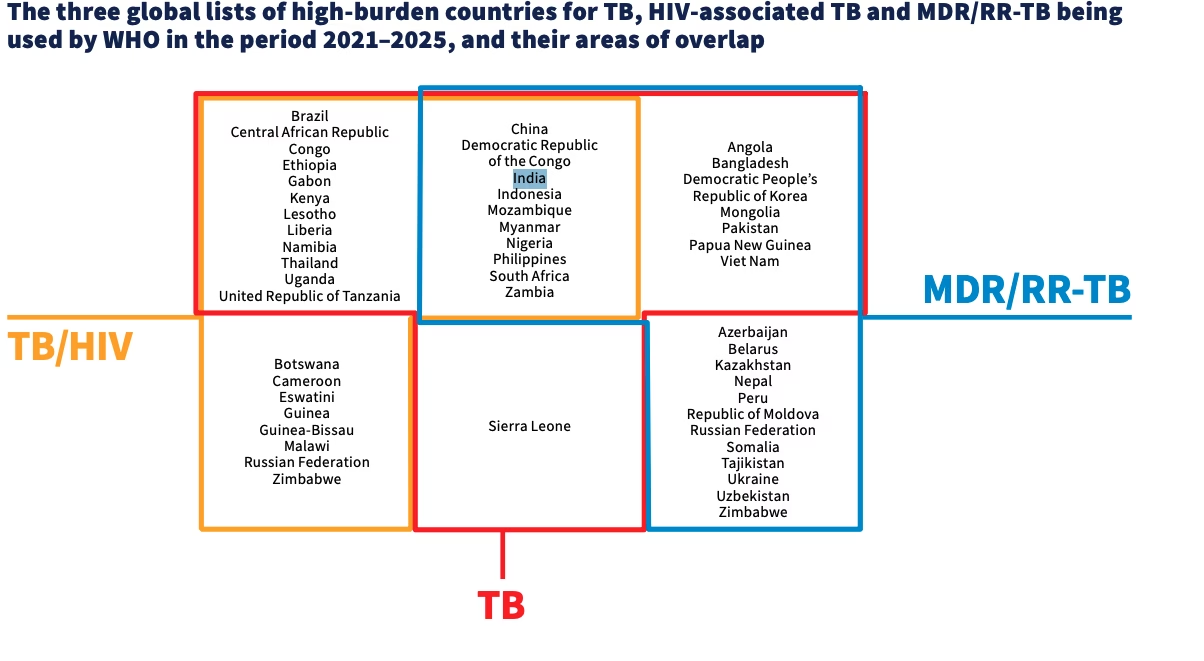
- India remains among the 30 High TB Burden Countries (HBCs) for 2021–2025, and also appears in the HIV-associated TB and MDR/RR-TB lists.
2. Burden of Disease in India (2024 data)
- Incidence category: 187 (160–218) new cases per 100,000 population per year (Category 3 – endemic).
- India contributes roughly 2.68 million (2.5–2.8 million) incident TB cases annually (estimated).
- TB incidence in India has stabilized compared to 2023 but remains a major contributor to the global total.
3. Case Detection and Notification
- In 2024, the gap between estimated TB incidence and diagnosed cases remains significant but improving.
- India notified over 96% of estimated incident TB cases, placing it among the best-performing high-burden countries for case detection (alongside Bangladesh, Brazil, Ethiopia, Kenya, Mozambique, Uganda, and Zambia).
- Despite progress, India still contributed to 8.8% of the global “missing” TB cases — people who developed TB but were not officially diagnosed or reported.
4. Drug-Resistant TB (MDR/RR-TB)
- India is the largest contributor to the global MDR/RR-TB burden, accounting for 32% of global MDR/RR-TB cases in 2024.
- Estimated proportion of MDR/RR-TB among new TB cases: ~3.2%, a decrease from 4.7% (95% UI: 3.5–6.0%) in 2015 worldwide.
- Among previously treated cases, MDR/RR-TB prevalence is ~16%, This was down from 19% (95% UI: 10–28%) in 2015., indicating ongoing transmission and treatment challenges.
- India, China, the Philippines, and the Russian Federation together make up over 50% of global MDR/RR-TB cases.
- ines (7.1%) and the Russian Federation (6.7%) (Fig. 8). The highest proportions of people with TB who had MDR/RR-TB (>50% of previously treated cases in 2023) were found in Eastern Europe and Central Asia.
5. TB Mortality in India
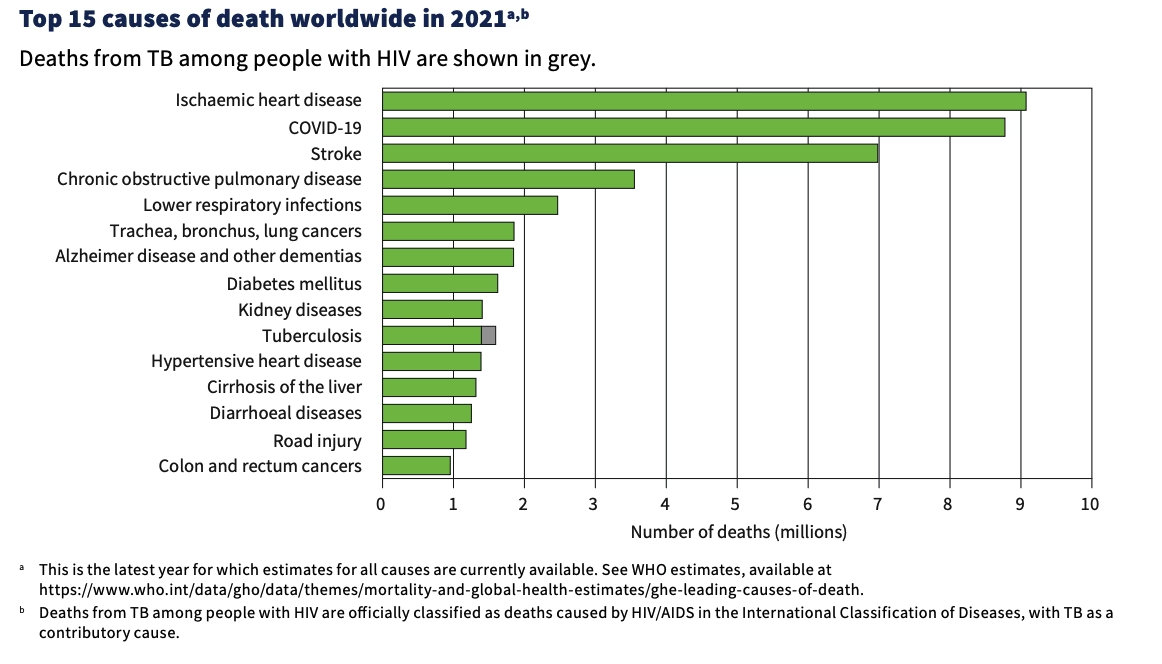
- Globally in 2024, TB caused an estimated 1.23 million, deaths (95% UI: 1.13–1.33 million), including 1.08 million among HIV-negative people (95% UI: 0.99–1.18 million) and 150 000 among people with HIV (95% UI: 120 000– 183 000).1 This total was down from 1.27 million (95% UI: 1.17–1.38 million) in 2023, 1.42 million (95% UI: 1.29–1.55 million) in 2019 (pre-pandemic) and a 42% reduction from 2.13 million (95% UI: 1.91–2.35 million) in 2010. The case fatality rate was 11.5%.
- India remains among the countries with the highest number of TB deaths , accounting for 28% of deaths globally, though mortality continues to decline.
- Updated cause-of-death data from India’s Sample Registration System (SRS) 2020 and 2022 were incorporated into WHO’s dynamic modeling for TB incidence and mortality in 2025.
- Despite the decline, TB remains one of the leading causes of death from infectious disease in India.
6. TB and HIV Co-infection
- India continues to report HIV-TB co-infection but at relatively low levels compared with African countries.
- High ART (antiretroviral therapy) coverage among HIV-TB co-infected patients (around 90% globally in 2024) contributes to better outcomes.
- Deaths from TB among people with HIV have been declining for many years and by 2024 had fallen 76% compared with 2010 worldwide.
7. Treatment Success and Outcomes
- Treatment success rate (drug-susceptible TB) in India is around 90 %, consistent with the global average.
- Expansion of rapid diagnostics and shorter, all-oral MDR-TB regimens has improved outcomes since 2023.
- Five countries accounted for about 60% of the gap between the estimated global number of people who developed MDR/RR-TB in 2024 (incident cases of MDR/ RR-TB) and the global number of people enrolled on treatment in 2024. Listed in order of their share of the global gap, these countries were India (33%), the Philippines (9.3%), Indonesia (7.3%), China (6.1%) and Pakistan (4.1%).
8. TB Funding and Health System Context
- India, as part of the BRICS group (Brazil, Russia, India, China, South Africa), funds nearly all TB activities domestically, with 97 % of TB spending coming from national resources.
- This domestic funding has insulated India’s TB program from global donor funding cuts in 2025 that affected many low-income countries.
- The National TB Elimination Programme (NTEP) continues to drive screening, notification, and treatment expansion through both public and private sectors.
- Of the 30 high TB burden countries, estimates of the percentage of the population facing catastrophic health expenditures are particularly high (≥15% of the population) for Angola, Bangladesh, China, India, Nigeria, Sierra Leone and Uganda.
9. Data Systems and Research
- India maintains one of the most robust TB surveillance systems globally.
- National TB Inventory Study (2019–2021) and National Drug Resistance Surveys (2016, 2024) contribute to WHO’s global modeling.
- India’s surveillance incorporates mortality data (SRS), inventory studies, and prevalence data for comprehensive disease modeling.
10. Progress Toward End TB Strategy Goals
- Among the 30 high TB burden countries, most made progress in service coverage between 2000 and 2019. The largest gains in absolute terms (+30 index points or more) were in China, India, Myanmar, Thailand and Viet Nam.
- End TB Milestone (2025) targets:
- 50% reduction in incidence and 75% reduction in deaths (relative to 2015).
- India has not yet met these milestones but shows steady progress in incidence reduction and improved detection.
- Key achievements:
- Enhanced access to rapid diagnostics (GeneXpert, Truenat).
- Shorter all-oral MDR-TB regimens introduced.
- Integration of TB-HIV services and nutrition support (Nikshay Poshan Yojana).
11. Future Outlook
- WHO notes India’s central role in global TB control, emphasizing:
- Continued investment in TB research and vaccines.
- Strengthened surveillance and cause-of-death reporting.
- Sustained domestic funding despite shrinking donor aid.
- India’s dynamic model updates (2025) will guide new global TB burden estimates for 2026–2030.
🔍 Summary Table – India (WHO TB Report 2025)
| Indicator | Value / Rank (2024) |
|---|---|
| Global share of TB cases | 25% (highest worldwide) |
| Incidence rate | 100–299 per 100,000 |
| Estimated incident cases | ~2.7 million |
| Estimated MDR/RR-TB share | 32% of global MDR/RR-TB cases |
| Treatment success (DS-TB) | ≈90% |
| Funding source | ~97% domestic |
| HIV-TB coinfection | Low (<5%) |
| TB deaths | High but declining |
| Reporting coverage | >80% of estimated cases |


Happy
0 %

Sad
0 %

Excited
100 %

Sleepy
0 %

Angry
0 %

Surprise
0 %