 0
0
 0
0
KASAULI, HIMACHAL PRADESH – February 21, 2026
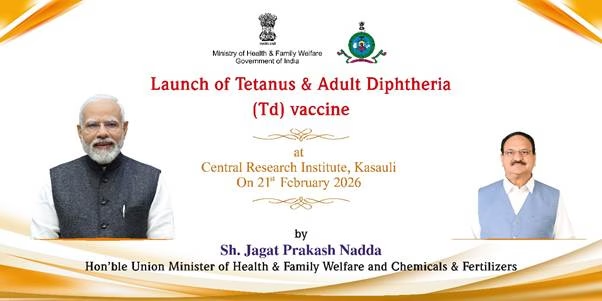
In a landmark move for India’s public health infrastructure, Union Minister for Health and Family Welfare, Shri J.P. Nadda, is set to launch the Tetanus and adult Diphtheria (Td) vaccine today at the historic Central Research Institute (CRI) in Kasauli. The launch marks the official replacement of the decades-old Tetanus Toxoid (TT) vaccine with the Td vaccine across all age groups in India’s Universal Immunization Programme (UIP).
The transition—recommended by the National Technical Advisory Group on Immunization (NTAGI) and the World Health Organization (WHO)—aims to address a critical gap in adult immunity: the resurgence of diphtheria due to waning protection from childhood vaccinations.
Why the Shift? Moving Beyond Tetanus
For over forty years, the TT vaccine has been the standard for injury-associated prophylaxis and maternal care in India. While highly successful in eliminating maternal and neonatal tetanus, the TT vaccine offers no protection against diphtheria.
Diphtheria is a severe respiratory infection caused by Corynebacterium diphtheriae. It often presents as a thick, gray coating in the throat that can lead to:
-
Breathing obstructions
-
Heart failure
-
Permanent paralysis
-
Death (Case fatality rates can reach 10% in adults over 40)
Scientific data indicates that while childhood DTP (Diphtheria-Tetanus-Pertussis) vaccines provide robust early protection, diphtheria immunity declines significantly by adolescence. “We are seeing a shift in the age profile of diphtheria cases,” says a public health expert from the National Institute of Epidemiology (not involved in the CRI project). “Nearly 70-80% of recent outbreaks in India have occurred in individuals over the age of five, underscoring the need for adult booster doses that the old TT shot simply didn’t provide.”
The Science of Td: Dual Protection
The new Td vaccine is a “combination” vaccine. It contains the same amount of tetanus toxoid as the previous TT vaccine but adds a reduced dose of diphtheria toxoid (indicated by the lowercase ‘d’).
Key Components of the Td Vaccine:
-
Purified Tetanus Toxoid: Maintains the high level of protection against “lockjaw.”
-
Reduced Diphtheria Toxoid: Specifically formulated for adults and adolescents to minimize side effects while boosting immunity.
-
Adjuvant (Aluminum Phosphate): A substance that enhances the body’s immune response to the vaccine.
-
Preservative (Thiomersal): Ensures the multi-dose vials remain safe for use in the field.
CRI Kasauli, which has been at the forefront of vaccine production since 1905, undertook the rigorous developmental studies required for this rollout. The institute successfully secured marketing authorization after meeting stringent clinical trial waivers and quality benchmarks set by the Central Drugs Laboratory.
Public Health Implications and Rollout
The launch is not just a policy shift but a massive logistical undertaking. CRI Kasauli has committed to supplying 55 lakh (5.5 million) doses to the Universal Immunization Programme by April 2026.
| Feature | Tetanus Toxoid (TT) | Tetanus & adult Diphtheria (Td) |
| Protects Against | Tetanus only | Tetanus AND Diphtheria |
| Target Audience | All age groups | All age groups (including pregnant women) |
| UIP Status | Phased out | New Standard (2026) |
| Dosage in UIP | 10 and 16 years; Pregnancy | 10 and 16 years; Pregnancy |
For pregnant women, the Td vaccine is now the recommended choice. This dual-action approach ensures the mother is protected from both diseases during delivery while passing critical antibodies to the newborn, maintaining the hard-won gains in neonatal health.
Expert Perspectives and Limitations
While the medical community has widely hailed the move, some experts emphasize that vaccination is only one part of the puzzle. Dr. Rajesh Kumar, a former immunization consultant, notes that “Vaccine hesitancy in adult populations is often higher than in pediatrics. Success will depend on clear communication that the Td shot is just as safe as the TT shot they are used to.”
Common side effects of the Td vaccine are mild and similar to the TT vaccine, including:
-
Soreness or redness at the injection site
-
Mild fever or fatigue
-
Headaches
Healthcare providers are also reminded that while Td protects against two diseases, it does not include protection against Pertussis (whooping cough), which is found in the Tdap vaccine. Patients with a history of severe allergic reactions to previous vaccines or Guillain-Barré syndrome should consult their physician before administration.
The Road Ahead
The Ministry of Health and Family Welfare plans to progressively increase production at CRI Kasauli to ensure a sustained domestic supply. By 2027, the goal is to have Td fully integrated into every primary health center across the country, effectively retiring the monovalent TT vaccine.
This transition reflects a maturing public health strategy in India—one that recognizes that protection must evolve as the epidemiology of disease changes.
Medical Disclaimer: This article is for informational purposes only and should not be considered medical advice. Always consult with qualified healthcare professionals before making any health-related decisions or changes to your treatment plan. The information presented here is based on current research and expert opinions, which may evolve as new evidence emerges.
References
-
Ministry of Health and Family Welfare (2026). “Launch of Tetanus and Adult Diphtheria (Td) Vaccine at CRI Kasauli.” Press Information Bureau (PIB), Feb 20, 2026.