 0
0
 0
0
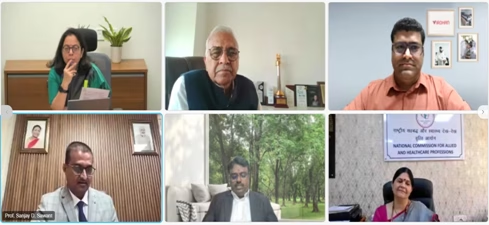
NEW DELHI – In a strategic move to fortify the nation’s medical infrastructure, the Government of India has unveiled an ambitious roadmap to scale up the allied health workforce by 100,000 professionals over the next five years. The initiative, discussed during a high-level Post-Budget Webinar on March 9, 2026, aims to address a long-standing imbalance in the patient-to-caregiver ratio and modernize the delivery of diagnostic and rehabilitative services across the country.
The session, titled “Scale-up Allied Health Professionals,” brought together a coalition of policymakers, medical educators, and industry leaders to translate the Union Budget’s “Para 53” announcement into a functional reality. The surge in personnel is designed to meet the escalating demands of an aging population and a rising tide of non-communicable diseases (NCDs) such as diabetes and cardiovascular disorders.
Redefining the “Backbone” of Healthcare
While doctors and nurses often command the spotlight, Allied Health Professionals (AHPs)—including physiotherapists, radiographers, medical lab technicians, and speech therapists—form the operational backbone of modern medicine.
Dr. Vinod Kotwal, Additional Secretary at the Ministry of Health and Family Welfare (MoHFW), noted that the demand for these specialists is no longer a luxury but a necessity. “Demographic transitions and the rapid adoption of advanced medical technologies in diagnostics and emergency care require a workforce that is not just larger, but more technically proficient,” Dr. Kotwal stated during the session.
Priority Disciplines for Expansion:
The government has identified several key areas for immediate capacity building:
-
Diagnostics & Imaging: Radiology, Medical Laboratory Sciences, and Imaging Technology.
-
Therapeutic Services: Physiotherapy, Occupational Therapy, and Dialysis Therapy.
-
Critical Support: Anaesthesia and OT Technology, Emergency Medical Technology.
-
Behavioral & Specialized Care: Applied Psychology, Palliative Care, and Optometry.
Closing the Quality Gap: Standardization Under NCAHP
One of the primary challenges identified by the panel is the current disparity between public and private training institutes. India currently houses over 500 government institutes with approximately 48,000 seats, dwarfed by 3,800 private institutions offering over 360,000 seats.
The quality of training, infrastructure, and faculty varies significantly across these entities. To combat this, the government is leaning heavily on the National Commission for Allied and Healthcare Professions (NCAHP) Act, 2021.
“The operationalization of the NCAHP marks a transformative shift,” noted Dr. Yagna Unmesh Shukla, Chairperson of the NCAHP. “We are now focused on ensuring uniform standards across all institutes. Whether a student is in a rural government college or an urban private facility, the level of competency must be standardized to ensure patient safety.”
From Medical Colleges to “Comprehensive Ecosystems”
A significant takeaway from the webinar was the proposal to transform existing district medical colleges into “hubs” for allied health sciences. By leveraging the existing infrastructure of medical colleges—many of which already possess the laboratories and clinical environments required for AHP training—the government aims to rapidly expand seat capacity without the lag time of new construction.
Key strategies discussed include:
-
Simulation-Based Learning: Strengthening laboratories and simulation facilities to provide hands-on experience before clinical placement.
-
Faculty Exchange Programs: Promoting knowledge sharing between established universities and newer medical colleges to mitigate faculty shortages.
-
Industry-Academia Collaboration: Aligning curricula with the needs of private healthcare providers like NATHEALTH to ensure graduates are “job-ready.”
Public Health Implications: What This Means for Patients
For the average citizen, a robust allied health workforce translates to faster diagnostic turnaround times, better post-operative rehabilitation, and improved emergency response.
“When we talk about ‘Universal Health Coverage,’ we aren’t just talking about doctors,” says Shri Siddhartha Bhattacharya, Director General of NATHEALTH. “We are talking about the technician who runs your MRI, the therapist who helps a stroke victim walk again, and the paramedic who stabilizes a patient in the golden hour. Scaling this workforce is a direct investment in saving lives.”
Experts believe that by professionalizing these roles, the healthcare system can shift from a reactive model to a more sustainable, preventive, and rehabilitative one. This is particularly crucial for rural India, where access to specialized diagnostic and rehabilitative care remains a significant hurdle.
Challenges and Counterarguments
Despite the optimistic outlook, some experts warn that “scaling up” must not come at the cost of “watering down.” Professional associations have previously raised concerns regarding the proliferation of short-term diploma courses that may not provide the depth of knowledge required for complex clinical environments.
The panel acknowledged these concerns, emphasizing that the expansion would include a mix of diploma, undergraduate, and postgraduate programs, all strictly adhering to NCAHP norms. Another hurdle remains the “prestige gap”—convincing the youth that allied health is a respectable and rewarding career path on par with traditional medicine or engineering.
Looking Ahead
The insights from this session will serve as the blueprint for an implementation roadmap. As the government prepares to roll out these 100,000 positions, the focus remains on creating a “comprehensive ecosystem” where allied health professionals are recognized as essential, autonomous contributors to the patient care journey.
For the youth of India, this marks the opening of a massive new door in the professional world. For the healthcare consumer, it promises a future where quality care is defined by a team of experts, not just a single clinician.
Reference Section
- https://www.pib.gov.in/PressReleasePage.aspx?PRID=2236913®=3&lang=1
Medical Disclaimer: This article is for informational purposes only and should not be considered medical advice. Always consult with qualified healthcare professionals before making any health-related decisions or changes to your treatment plan. The information presented here is based on current research and expert opinions, which may evolve as new evidence emerges.