 0
0
 0
0
Ahmedabad, India – December 29, 2025
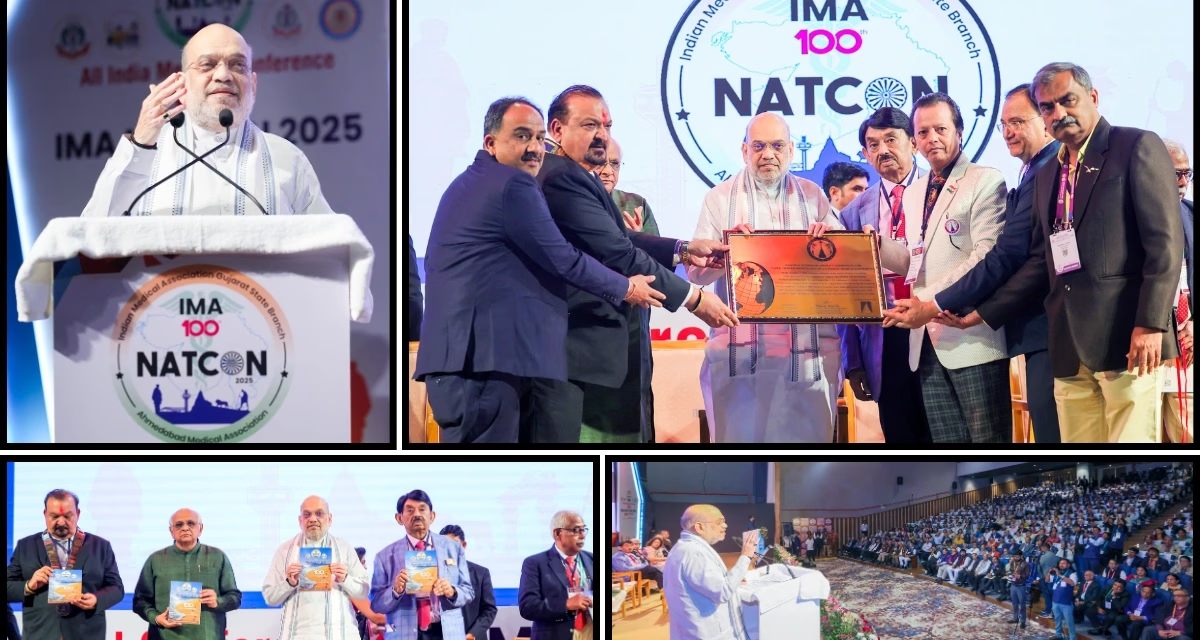
In a landmark address marking the centenary year of the Indian Medical Association (IMA), Union Home Minister Amit Shah declared on Sunday that India is successfully transitioning from an “illness-centric” to a “wellness-centric” healthcare model. Speaking to a gathering of over 5,000 medical professionals at the swearing-in ceremony of newly elected IMA office-bearers, Shah underscored the government’s commitment to building a holistic ecosystem rooted in preventive care, digital innovation, and universal accessibility.
The ceremony, which saw Dr. Anil J. Nayak assume office as the National President of the IMA, served as a platform for the government to reflect on a decade of healthcare reforms while urging the medical fraternity to lead the nation’s “Viksit Bharat” (Developed India) vision.
A Strategic Shift: From Treatment to Prevention
“The focus of healthcare must gradually shift from illness to wellness,” Shah remarked, highlighting that a healthy population is the bedrock of national progress. He pointed to a suite of flagship initiatives—including the Swachhata Mission (Clean India), Fit India Movement, and International Yoga Day—as the primary drivers behind this behavioral shift.
According to government data, these preventive measures are not merely lifestyle campaigns but public health interventions with measurable outcomes. For instance, recent reports from the Ministry of Health indicate that the Swachh Bharat Mission has contributed to a significant decline in waterborne diseases, while the Mission Indradhanush vaccination drive has successfully reached over 5.46 crore children and 1.32 crore pregnant women as of late 2025.
Scaling the Infrastructure: The ₹1.65 Lakh Crore Investment
To support this “people-centric” vision, the Union government has dramatically ramped up financial commitments. Shah revealed that ₹1.65 lakh crore has been allocated to strengthen healthcare facilities across the country.
“Our health budget has risen from ₹37,000 crore in 2013–14 to ₹1.28 lakh crore today,” Shah noted. This 245% increase has facilitated:
-
The Expansion of Medical Education: The number of medical colleges has doubled to 808 in the 2025-26 cycle, up from 387 in 2014.
-
Tertiary Care Access: 22 new All India Institute of Medical Sciences (AIIMS) institutions have been approved to decentralize super-speciality care.
-
Universal Coverage: The Ayushman Bharat Yojana continues to provide a safety net for millions, with the Home Minister urging doctors to further promote the use of affordable generic medicines to reduce out-of-pocket expenditure (OOPE).
The Digital Frontier: Telemedicine and ABHA
A key pillar of the new model is the Ayushman Bharat Digital Mission (ABM). Shah highlighted the role of the ABHA (Ayushman Bharat Health Account) in creating a seamless digital health history for citizens. As of December 2025, more than 84 crore ABHA accounts have been created, enabling patients to access their records anywhere in the country.
Shah also called for the active participation of doctors in expanding telemedicine and video counseling services. The national platform, eSanjeevani, has already crossed 43 crore teleconsultations, a feat that Gujarat Chief Minister Bhupendra Patel attributed to the adoption of advanced technologies and modern infrastructure.
“Telemedicine is not just a convenience; it is a necessity for reaching our remote and underserved communities,” Shah stated.
Expert Perspectives and Ethical Evolution
While the government focuses on infrastructure, the IMA leadership is looking toward the “human” side of medicine. Dr. Anil J. Nayak, the incoming National President, emphasized that the association would work closely with the government to meet the evolving expectations of the medical fraternity.
However, independent experts suggest that rapid expansion must be balanced with quality control. “While the increase in medical seats is a welcome move to address the doctor-to-population ratio—which now stands at 1:811 in India, surpassing the WHO standard of 1:1000—we must ensure that the quality of training in new institutions remains world-class,” says Dr. Arvinder Soin, a leading transplant surgeon and healthcare commentator (not involved in the IMA ceremony).
Shah also touched upon a sensitive topic: Medical Ethics. He urged the IMA to redefine ethical standards in the age of AI and advanced diagnostics, calling on medical colleges to instill strong values in the next generation of doctors.
Limitations and the Road Ahead
Despite the optimistic outlook, challenges remain. Critics often point to the “implementation gap” in rural areas where, despite infrastructure growth, the shortage of specialized nursing and paramedical staff persists. Furthermore, while the share of Government Health Expenditure as a percentage of GDP has risen to 1.84%, it still trails the 2.5% target set by the National Health Policy 2017.
Additionally, the transition to a digital-first model faces hurdles in regions with low digital literacy. Ensuring that the ABHA system remains inclusive for those without smartphones remains a critical public health priority for 2026.
Practical Implications for Readers
For the average citizen, this “People-Centric Model” means:
-
Lower Costs: Increased availability of generic medicines and insurance coverage under Ayushman Bharat aims to protect families from “catastrophic health expenditure.”
-
Ease of Access: Telemedicine through eSanjeevani allows for specialist consultations without the need for travel.
-
Preventive Focus: A greater emphasis on routine screenings and wellness programs through local Health and Wellness Centres.
As the IMA enters its second century, the partnership between the state and the medical community appears focused on one goal: ensuring that “wellness” is not a luxury, but a right for every Indian citizen.
Medical Disclaimer: This article is for informational purposes only and should not be considered medical advice. Always consult with qualified healthcare professionals before making any health-related decisions or changes to your treatment plan. The information presented here is based on current research and expert opinions, which may evolve as new evidence emerges.
References
https://english.bharatexpress.com/india/india-building-a-people-centric-healthcare-model-says-hm-amit-shah-246732/amp