 0
0
 0
0
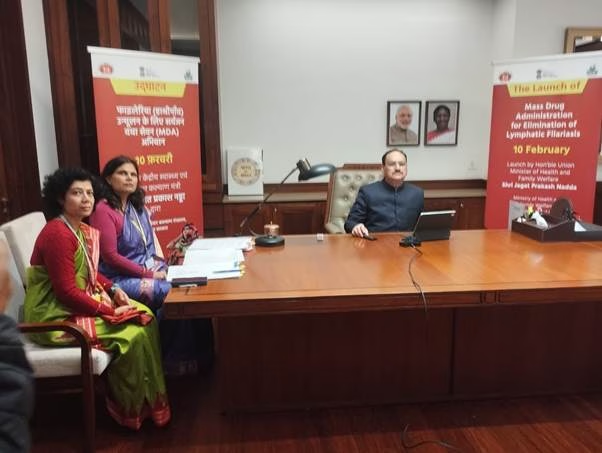
NEW DELHI – In a decisive move to rid the nation of one of its most debilitating tropical diseases, Union Health Minister Shri J.P. Nadda officially launched the 2026 Annual Nationwide Mass Drug Administration (MDA) campaign for Lymphatic Filariasis (LF) on Tuesday.
Addressing state health ministers and senior officials from 12 endemic states via video conference, Nadda reaffirmed India’s ambitious goal: eliminating LF as a public health problem by 2027. This target places India three years ahead of the global Sustainable Development Goal (SDG) deadline of 2030, signaling a high-priority shift in the nation’s public health infrastructure.
“Eliminating Lymphatic Filariasis is not merely a health objective; it is a critical social and economic imperative,” Nadda stated during the launch. “This disease severely impacts the livelihood, economic productivity, and social well-being of our citizens, often leading to long-term hardship and social stigma for entire families.”
The Silent Burden: Understanding Lymphatic Filariasis
Lymphatic Filariasis, commonly known as elephantiasis (or Haatipaon in Hindi), is a vector-borne disease caused by microscopic, thread-like worms. These parasites are transmitted to humans through the bite of infected mosquitoes—specifically the female Culex mosquito, which thrives in stagnant and polluted water.
Once inside the human body, the larvae migrate to the lymphatic system, where they grow into adult worms. The resulting damage to the lymphatic system leads to:
-
Lymphoedema: Severe swelling, usually in the legs or arms.
-
Hydrocele: Scrotal swelling in men.
-
Acute Attacks: Painful episodes of fever and local inflammation.
According to government data as of 2024, India currently manages over 6.20 lakh cases of lymphoedema and 1.21 lakh cases of hydrocele, highlighting the massive scale of the morbidity involved.
A Strategic Shift: The 2026 Roadmap
The 2026 campaign marks a significant operational change. Moving away from the previous biannual model, the National LF Programme has transitioned to a unified annual MDA campaign. This shift is designed to overcome logistical hurdles such as monsoon disruptions and to allow more dedicated time for critical surveillance activities.
The Numbers Behind the Push
The current campaign targets 719 blocks across 124 districts in 12 identified states. To “eliminate” the disease, health authorities must consistently bring the microfilaria prevalence rate (the percentage of the population with parasite larvae in their blood) to below 1% in all endemic areas.
| Metric | 2014 Data | 2025/2026 Progress |
| MDA Population Coverage | 75% | 85% – 96% |
| Districts Stopping MDA (Cleared TAS-1) | 15% (39 districts) | 41% (143 districts) |
| Medical College Engagement | 1% | 96% |
“The transition to a single, intensified window allows for stronger supervision and higher coverage,” noted Smt. Punya Salila Srivastava, Secretary of the Ministry of Health and Family Welfare.
Overcoming the “Last Mile” Challenges
Despite the progress, health officials face a persistent enemy: medication hesitancy. Because LF can remain asymptomatic for years while the parasite damages the body internally, many healthy-looking individuals see no reason to take the preventive drugs.
“The challenge is ensuring Directly Observed Treatment (DOT),” says Dr. Anita Verma (a pseudonym for a public health expert not involved in the government launch). “People fear side effects, but the risk of permanent disability from the disease is far higher. Community engagement and trust-building are the only ways to cross that finish line.”
To address this, the government is utilizing Ayushman Arogya Mandirs (AAMs) for early screening and treatment. Furthermore, hydrocele surgeries are now covered under Ayushman Bharat (AB-PMJAY), providing financial protection for those needing surgical intervention.
Expert Perspective: Why Now?
Independent infectious disease specialists emphasize that India’s success is vital for global elimination.
“India carries a significant portion of the global LF burden,” says Dr. Rajesh Kumar, an epidemiologist. “By moving to a ‘whole-of-government’ approach—involving departments like Rural Development and Education—the program moves from a clinical exercise to a social movement. This is how you sustain high drug compliance.”
The campaign relies on a multi-drug regimen (typically including DEC, Albendazole, and sometimes Ivermectin) that effectively kills the microfilariae in the blood, preventing mosquitoes from picking up the parasite and passing it to others.
What This Means for You
For residents in endemic districts, the message from health authorities is clear: Prevention is the only cure.
-
Take the Medication: When health workers visit your home, consume the anti-filarial drugs in their presence.
-
Vector Control: Minimize stagnant water around your home to reduce mosquito breeding.
-
Spread Awareness: Encourage neighbors to participate, as the community is only protected if the vast majority takes the medication.
As the 2026 campaign rolls out, the focus remains on reaching the most vulnerable populations, ensuring that by 2027, the “shadow of the elephant” no longer looms over the health and economy of India.
References
-
Ministry of Health and Family Welfare (MoHFW). (2026, February 10). Union Health Minister Launches Annual Nationwide Mass Drug Administration Campaign for Lymphatic Filariasis Elimination. PIB Delhi.
Medical Disclaimer: This article is for informational purposes only and should not be considered medical advice. Always consult with qualified healthcare professionals before making any health-related decisions or changes to your treatment plan. The information presented here is based on current research and expert opinions, which may evolve as new evidence emerges.