 0
0
 0
0
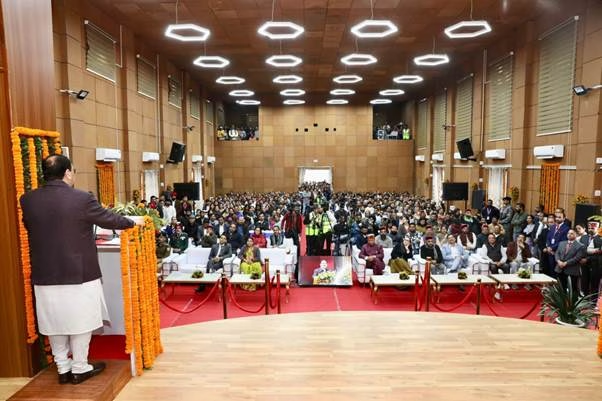
KASAULI, HIMACHAL PRADESH — In a landmark move for India’s public health infrastructure, Union Health Minister Shri Jagat Prakash Nadda officially launched the indigenously manufactured Tetanus and Adult Diphtheria (Td) vaccine at the Central Research Institute (CRI) on Saturday.
The launch marks a critical transition in the nation’s Universal Immunization Programme (UIP), moving away from the traditional Tetanus Toxoid (TT) vaccine to a dual-protection formula. This shift is designed to sustain India’s hard-won elimination of maternal and neonatal tetanus while simultaneously addressing a rising need for diphtheria immunity among adults and adolescents.
A Milestone in Self-Reliance
Addressing a gathering of scientists and health experts, Minister Nadda described the development as a “momentous and historic occasion.” The CRI, a premier public sector institution, is slated to supply 5.5 million (55 lakh) doses to the UIP by April 2026.
“This indigenous Td vaccine reflects our commitment to Atmanirbhar Bharat (Self-Reliant India) in the health sector,” Nadda stated. “By manufacturing this internally, we are not just saving costs; we are safeguarding our national health security.”
The Minister highlighted that while historical vaccine development—such as those for Japanese Encephalitis or Tuberculosis—often took decades or even a century, India’s modern regulatory and scientific framework has accelerated. He pointed to the COVID-19 pandemic, where India developed two indigenous vaccines within nine months, as proof of this evolved capability.
Why the Switch? Understanding Td vs. TT
For decades, the Tetanus Toxoid (TT) vaccine was the standard for pregnant women and injury-related prophylaxis in India. However, global health trends and epidemiological data suggested a gap in protection.
The Scientific Rationale
The World Health Organization (WHO) first recommended the transition from TT to Td in 2006. The rationale is simple: while tetanus cases have plummeted, diphtheria—a serious bacterial infection affecting the nose and throat—has seen sporadic outbreaks in older age groups whose childhood immunity has waned.
“The Td vaccine provides the same level of protection against tetanus as the TT vaccine, but with the added benefit of a low-dose diphtheria component,” explains Dr. Arvinder Singh, a public health consultant not involved in the CRI project. “It essentially ‘boosts’ the immune system against two threats instead of one, without increasing the risk of adverse effects.”
India’s National Technical Advisory Group on Immunization (NTAGI) recommended this replacement across all age groups, including pregnant women, to ensure that the population remains protected against respiratory diphtheria, which can be fatal if left untreated.
Statistical Impact: 99% Vaccine Coverage
The Minister also utilized the platform to announce a significant milestone in domestic health: India has achieved nearly 99% vaccine coverage.
The Scale of the Universal Immunization Programme (UIP)
The UIP is the world’s largest immunization initiative, and the numbers behind it are staggering:
-
Annual Cohort: Approximately 25 million (2.5 crore) pregnant women and 25 million children.
-
Total Doses: Children receive 27 doses of various vaccines by the age of 16.
-
Tracking: The digital U-WIN platform now tracks every beneficiary from pregnancy registration through adolescence.
“The transformation of our public health landscape is evident in the data,” Nadda noted, citing that institutional deliveries have risen from 79% to 89%, further ensuring that newborns receive their birth doses of essential vaccines in a controlled environment.
The Role of the Central Research Institute (CRI)
The CRI Kasauli holds the distinction of being the first government institute to manufacture vaccines under Good Manufacturing Practices (GMP) standards.
To reach this launch, the institute navigated a rigorous regulatory path:
-
Developmental Studies: Completed internal R&D to stabilize the dual-antigen formula.
-
Regulatory Waivers: Based on the established safety profiles of Td vaccines globally, the institute secured necessary waivers for certain clinical trial phases to expedite availability.
-
Marketing Authorization: Secured the license for commercial manufacture and sale following clearance from the Central Drugs Laboratory (CDL).
Public Health Implications and Limitations
While the launch is a victory for public sector manufacturing, experts note that the success of the Td vaccine depends on public uptake and awareness.
“The challenge with adult vaccination is often ‘vaccine fatigue’ or a lack of perceived risk,” says Sarah Williams, an infectious disease researcher. “While the 99% coverage figure is impressive for childhood vaccines, maintaining that momentum for adult boosters like Td requires persistent community engagement.”
Furthermore, while the CRI will supply 5.5 million doses by 2026, the total annual requirement for India is significantly higher. Scaling up production progressively in the coming years will be vital to prevent any supply-side gaps in the UIP.
Looking Ahead: A Global Pharmacy
The Minister concluded by reminding the audience of India’s role as the “pharmacy of the world.” Under the Vaccine Maitri initiative, India supplied vaccines to nearly 100 countries during the pandemic.
With the Td vaccine now part of the domestic arsenal, India strengthens its position not just as a consumer of global health standards, but as a primary innovator and provider of life-saving biologicals.
Reference Section
- https://www.pib.gov.in/PressReleasePage.aspx?PRID=2231147®=3&lang=1
Medical Disclaimer: This article is for informational purposes only and should not be considered medical advice. Always consult with qualified healthcare professionals before making any health-related decisions or changes to your treatment plan. The information presented here is based on current research and expert opinions, which may evolve as new evidence emerges.