 0
0
 0
0
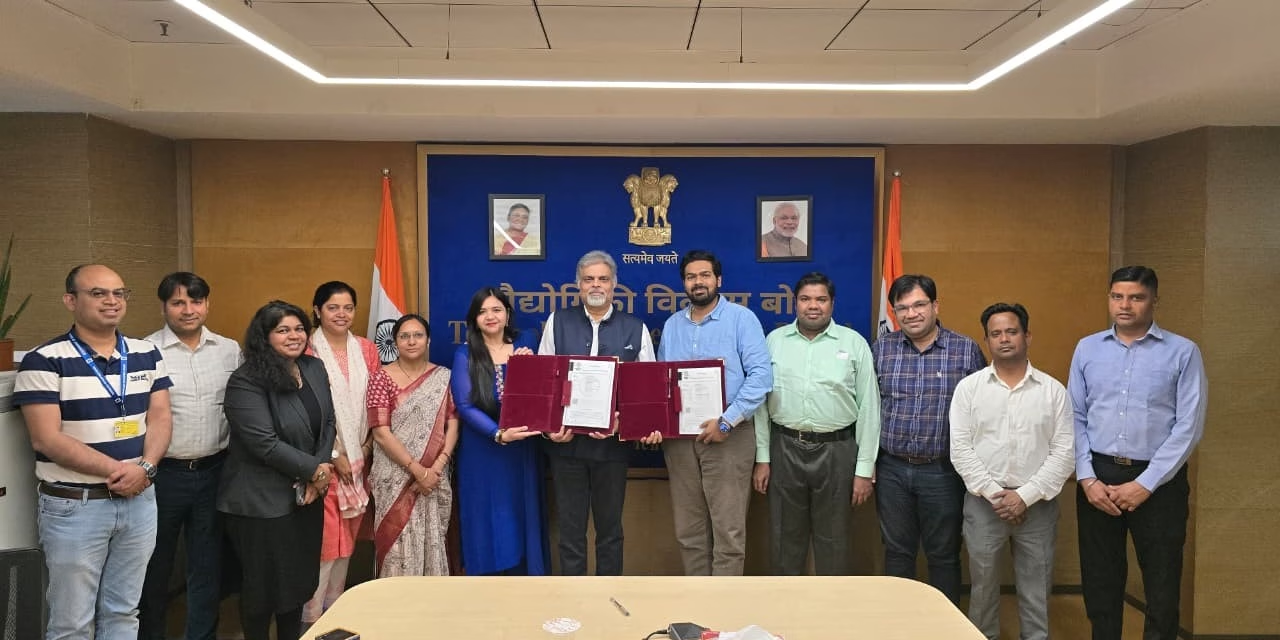
CHENNAI — In a significant move toward medical self-reliance, the Technology Development Board (TDB) of India’s Department of Science & Technology (DST) announced on March 17, 2026, a strategic financial partnership with Acrannolife Genomics Private Limited. The investment aims to establish a high-tech manufacturing facility in Chennai, dedicated to the domestic production of two groundbreaking in-vitro diagnostic (IVD) kits: Trunome GrafAssure and TBFYND.
This initiative marks a pivotal shift in India’s healthcare landscape, moving from a dependence on expensive, imported molecular diagnostics toward locally manufactured, high-precision genomic tools. By scaling up production at the TANSIDCO Industrial Estate, the project seeks to make advanced monitoring for organ transplant recipients and rapid tuberculosis (TB) testing more accessible and affordable for millions of patients across the country.
The Science of “Early Warning”: Revolutionizing Transplant Care
For patients who have undergone solid-organ transplants—such as kidney or liver surgeries—the primary threat to survival is organ rejection. Traditionally, doctors have relied on biopsies (invasive tissue sampling) or rising creatinine levels to detect rejection. However, by the time these markers spike, significant tissue damage has often already occurred.
Acrannolife’s flagship product, Trunome GrafAssure, utilizes cell-free DNA (cfDNA) technology. When a transplanted organ is under stress or being attacked by the recipient’s immune system, it sheds tiny fragments of DNA into the bloodstream.
“The ability to detect these DNA fragments through a simple blood draw allows clinicians to see signs of rejection or infection weeks before clinical symptoms appear,” explains Dr. Ananya Sharma, a transplant immunologist not affiliated with the project. “In the world of transplantation, time is tissue. Early intervention can mean the difference between saving a graft and needing a secondary transplant.”
According to data from the National Organ and Tissue Transplant Organisation (NOTTO), India performs thousands of transplants annually, yet post-operative monitoring remains a logistical and financial challenge for many. The indigenization of this liquid biopsy technology could reduce costs significantly compared to international alternatives like those manufactured in the U.S. or Europe.
Tackling the TB Crisis with LAMP Technology
While transplant care addresses a specialized niche, the second kit, TBFYND, targets one of India’s most enduring public health crises. Tuberculosis remains a leading cause of mortality in the region, with the World Health Organization (WHO) reporting that India accounts for over 25% of the global TB burden.
TBFYND utilizes Loop-mediated Isothermal Amplification (LAMP) technology. Unlike traditional PCR (Polymerase Chain Reaction) tests that require expensive thermal cyclers and stable electricity, LAMP technology can amplify DNA at a constant temperature. This makes it ideal for rapid, point-of-care testing in resource-limited settings.
“The goal of TB elimination by 2025-2026 requires hyper-local, rapid diagnostics,” says Shri Rajesh Kumar Pathak, Secretary of the TDB. “By supporting indigenous manufacturing, we aren’t just funding a company; we are strengthening the backbone of our public health infrastructure.”
Economic and Public Health Implications
The TDB’s support is part of the broader “Atmanirbhar Bharat” (Self-Reliant India) mission. Currently, a substantial portion of India’s high-end diagnostic market is dominated by global conglomerates. This often leads to higher prices and supply chain vulnerabilities, as seen during the COVID-19 pandemic.
Key Objectives of the New Facility:
-
Scalability: Transitioning from lab-scale production to industrial-grade manufacturing.
-
Cost Reduction: Minimizing import duties and international logistics costs to lower the price per test.
-
Data Sovereignty: Utilizing proprietary software platforms to process genomic data locally, ensuring secure and reliable diagnostic workflows.
Promoters at Acrannolife Genomics emphasized that this facility will act as a “dedicated platform,” meaning it can eventually be adapted to manufacture other molecular diagnostics, further insulating the Indian market from global price fluctuations.
Challenges and Limitations
Despite the optimism, experts urge a balanced view. While cfDNA technology is highly sensitive, it is not a “magic bullet.” High levels of donor-derived cfDNA can sometimes be triggered by infections rather than rejection, requiring skilled clinical interpretation.
Furthermore, the success of TBFYND will depend on its integration into the National Tuberculosis Elimination Program (NTEP). “A diagnostic tool is only as good as the healthcare system’s ability to act on the result,” notes Dr. Sharma. “We must ensure that as we scale the making of these kits, we also scale the training of healthcare workers to use them correctly.”
What This Means for Patients
For the average consumer, this development suggests a future where high-end “genomic medicine” is no longer restricted to elite private hospitals.
-
For Transplant Recipients: Expect more frequent, less invasive monitoring that can be done at local diagnostic centers rather than specialized transplant hubs.
-
For TB Screening: Faster results mean treatment can start immediately, reducing the window of transmission within families and communities.
As the manufacturing facility at TANSIDCO becomes operational, the healthcare sector will be watching closely to see if these indigenous solutions can meet the rigorous quality standards required for global diagnostic benchmarks.
References & Sources
-
Primary Source: Press Information Bureau (PIB) Delhi, “TDB-DST supports Acrannolife Genomics Private Limited,” Published 17 MAR 2026.
Medical Disclaimer: This article is for informational purposes only and should not be considered medical advice. Always consult with qualified healthcare professionals before making any health-related decisions or changes to your treatment plan. The information presented here is based on current research and expert opinions, which may evolve as new evidence emerges.