 0
0
 0
0
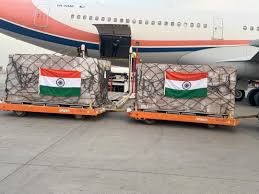
NEW DELHI/KABUL — In a significant humanitarian intervention aimed at shoring up Afghanistan’s collapsing public health infrastructure, India delivered a major consignment of 63,734 doses of influenza and meningitis vaccines to Kabul on Thursday, December 4, 2025.
The delivery, facilitated by the Ministry of External Affairs (MEA), marks a critical escalation in India’s medical assistance to the war-torn nation, arriving just as the harsh Afghan winter threatens to trigger severe respiratory outbreaks among vulnerable populations. This shipment follows closely on the heels of a massive 73-tonne aid package sent just last week, underscoring New Delhi’s commitment to the Afghan people despite the complex geopolitical landscape.
A Lifeline for Public Health
The consignment was handed over to officials at the Indira Gandhi Hospital in Kabul, a facility historically supported by Indian aid. According to MEA spokesperson Randhir Jaiswal, the delivery is a reaffirmation of India’s “steadfast support” for Afghanistan’s public health needs.
“Augmenting Afghanistan’s healthcare efforts, India has delivered 63,734 doses of Influenza and Meningitis vaccines to Kabul,” the MEA stated. “India’s unwavering support to the Afghan people continues.”
This latest tranche of aid is particularly strategic. Unlike generic medical supplies, this shipment targets two specific, high-mortality threats that loom large over Afghanistan’s current demographic crisis: seasonal influenza and bacterial meningitis.
The Medical Imperative: Why These Vaccines?
Health experts argue that the timing and specificity of this donation are critical. Afghanistan’s healthcare system remains in a precarious state, with the World Health Organization (WHO) estimating that nearly 23 million people—half the population—require urgent humanitarian assistance in 2025.
1. The Influenza Threat:
With the onset of winter, Afghanistan faces a “triple threat” of respiratory pathogens: COVID-19, seasonal influenza, and respiratory syncytial virus (RSV). For a population suffering from widespread malnutrition and displacement, a standard flu season can become a mass casualty event.
“In a compromised health setting like Afghanistan, seasonal influenza is not just a nuisance; it is a killer,” explains Dr. Sarah Vane, a public health specialist in infectious diseases (independent of this mission). “The vaccines provided will likely be prioritized for frontline healthcare workers, the elderly, and immunocompromised children to prevent the healthcare system from being overwhelmed.”
2. The Meningitis Risk:
Meningitis, an inflammation of the protective membranes covering the brain and spinal cord, poses a severe risk in crowded living conditions. Afghanistan has seen massive internal displacement due to recent earthquakes in the northern provinces of Balkh and Samangan.
“Bacterial meningitis is swift and deadly, often claiming lives within 24 to 48 hours of symptom onset,” notes recent data from the WHO Eastern Mediterranean Regional Office. “In refugee camps and temporary shelters where hygiene is compromised, the risk of transmission skyrockets. Vaccination is the only effective firewall.”
A Pattern of Consistent Aid
Thursday’s delivery is part of a calibrated surge in Indian humanitarian assistance. It complements a delivery on November 28 of 73 tonnes of life-saving medicines and essential supplements. Furthermore, it represents a massive scale-up from a pilot delivery in May 2025, which saw 11,000 doses of the same vaccines sent to Kabul.
The aid comes in the wake of a high-level meeting in New Delhi on November 20 between India’s External Affairs Minister S. Jaishankar and Alhaj Nooruddin Azizi, the acting Minister for Industry and Commerce in the Taliban administration. While India has not officially recognized the Taliban government, it has maintained a “people-centric” policy, separating humanitarian needs from political recognition.
Challenges and Limitations
While the aid is vital, public health officials caution that logistics remain a significant hurdle. Ensuring the “cold chain”—the temperature-controlled supply chain required to keep vaccines effective—is maintained from Kabul to remote, snow-bound provinces is a logistical nightmare.
“Delivering vaccines to Kabul is step one,” says a former UN logistics coordinator for the region. “Step two is getting them to the remote villages in Badakhshan or the earthquake-hit zones in Herat before they spoil. That requires local infrastructure that is currently hanging by a thread.”
Additionally, 63,000 doses, while significant, cover only a fraction of the population in a country of over 40 million. Sustained international support is required to achieve herd immunity or broad protection against these pathogens.
Implications for Public Health
For the average Afghan citizen, this aid offers a glimmer of hope during a bleak winter. The availability of meningitis vaccines specifically protects children from permanent disability, including hearing loss and brain damage, which are common sequelae of the disease.
As India continues to position itself as a “first responder” in the region—having also sent food aid to earthquake victims in November—the focus remains on stabilizing a healthcare system teetering on the edge of collapse.
Medical Disclaimer:
This article is for informational purposes only and should not be considered medical advice. Always consult with qualified healthcare professionals before making any health-related decisions or changes to your treatment plan. The information presented here is based on current research and expert opinions, which may evolve as new evidence emerges.
References
-
Primary Source: Ministry of External Affairs, Government of India. Press Statement on Humanitarian Assistance to Afghanistan. December 4, 2025.