 0
0
 0
0
January 23, 2026
NEW DELHI — In a landmark move for global public health, India has become the second country in the world to successfully integrate Mobile Stroke Units (MSUs) into its national emergency medical services. The initiative, spearheaded by the Indian Council of Medical Research (ICMR), marks a paradigm shift in how neurological emergencies are managed in rural and difficult terrains. By bringing the hospital to the patient’s doorstep, health officials have reported a dramatic reduction in stroke-related deaths and long-term disability, specifically within the challenging landscapes of Northeast India.
The “Golden Hour”: Bringing the Hospital to the Doorstep
For decades, the “Golden Hour”—the first 60 to 90 minutes after the onset of stroke symptoms—has been the most significant barrier to saving lives in rural India. In the Northeast, where mountainous terrain and limited infrastructure often turn a 20-mile journey into a five-hour ordeal, the Golden Hour was frequently lost before a patient even reached a primary health center.
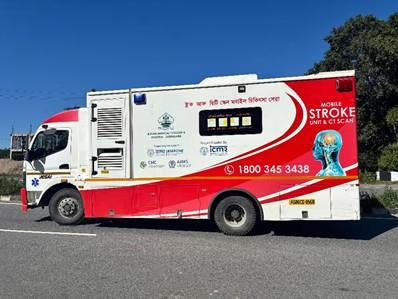
On Thursday, Dr. Rajiv Bahl, Secretary of the Department of Health Research and Director General of the ICMR, announced that India has moved beyond the pilot phase of a specialized “Stroke Care Pathways” study. As part of this transition, the ICMR has officially handed over two state-of-the-art Mobile Stroke Units to the Government of Assam to ensure the continuity of life-saving care.
“Mobile Stroke Units were first developed in Germany and later evaluated in major global cities,” Dr. Bahl stated during the handover ceremony in New Delhi. “India is now the second country globally to report the successful integration of an MSU with emergency medical services for treating rural acute ischemic stroke patients.”
A Hospital on Wheels: How the MSU Works
An MSU is essentially a specialized emergency room and diagnostic suite condensed into a high-tech ambulance. To the untrained eye, it looks like a standard emergency vehicle, but its interior houses the critical technology required to treat a “brain attack.”
Each unit is equipped with:
-
A Portable CT Scanner: To immediately distinguish between an ischemic stroke (caused by a clot) and a hemorrhagic stroke (caused by a bleed).
-
Point-of-Care Laboratory: For rapid blood testing to ensure the patient can safely receive medication.
-
Tele-Neurology Systems: High-speed communication links that allow paramedics to consult with expert neurologists in real-time.
-
Thrombolytic “Clot-Busting” Drugs: Medications like Alteplase or Tenecteplase that can dissolve a clot and restore blood flow to the brain.
“The beauty of this model is that the diagnosis happens in the patient’s driveway,” says Dr. Vikram Seth, a neurologist not involved in the ICMR study but who has followed the pilot’s progress. “In a stroke, two million neurons die every minute. By the time a rural patient reaches a city hospital, the window for these life-saving drugs has often closed. The MSU effectively pauses the clock.”
Impact by the Numbers: A 24-Hour Wait Cut to Two
The results of the ICMR-funded initiative in Assam have been described by medical professionals as “revolutionary.” Before the deployment of these units, the average time for a stroke patient in remote parts of the Northeast to receive treatment was nearly 24 hours.
With the integration of MSUs, that window has been slashed to just 2 hours. The clinical outcomes reported by the Ministry of Health reflect this efficiency:
-
Mortality: Deaths have been reduced by approximately one-third.
-
Disability: The rate of long-term, severe disability has been reduced eight-fold.
-
Accessibility: The units successfully navigated “difficult terrain” that previously rendered specialized care impossible.
P. Ashok Babu, Secretary and Commissioner of Health for Assam, emphasized that this is not just a pilot project anymore. “The handover strengthens Assam’s emergency response system and ensures this service remains under state ownership. It provides a strong foundation for expansion to other districts.”
Addressing the High Burden in the Northeast
The choice of Assam for this initiative was strategic. The Northeast region of India carries a disproportionately high burden of stroke, fueled by high rates of hypertension and tobacco use, coupled with geographical barriers.
To support the MSUs, the ICMR established a tiered network of care:
-
Neurologist-led units at Assam Medical College & Hospital, Dibrugarh.
-
Physician-led units at Tezpur Medical College Hospital and Baptist Christian Hospital, Tezpur.
This “hub-and-spoke” model ensures that while the MSU starts treatment in the field, the patient is seamlessly transitioned to a facility capable of long-term recovery and rehabilitation.
Challenges and the Path Forward
While the success in Assam is a significant milestone, experts caution that scaling this technology nationwide presents hurdles.
“The cost of a single Mobile Stroke Unit, equipped with a CT scanner and specialized staff, is substantial,” notes Dr. Ananya Sharma, a public health researcher. “Maintenance of sensitive medical equipment on bumpy rural roads is a logistical challenge. Furthermore, the success of an MSU depends entirely on public awareness—people must recognize the signs of a stroke and call for help immediately for the unit to be effective.”
There is also the matter of staffing. Operating an MSU requires a specialized team, including a CT technician and nurses trained in emergency neurology. As India looks to expand this program, investment in specialized training for paramedics will be as crucial as the vehicles themselves.
What This Means for the Public
For the average citizen, this development signals a shift in the philosophy of Indian healthcare: from “patient-to-hospital” to “hospital-to-patient.”
Medical professionals urge the public to remember the BE FAST acronym to identify a stroke, as the MSU can only help if it is dispatched quickly:
-
Balance: Sudden loss of coordination.
-
Eyes: Sudden vision loss or doubling.
-
Face: One side of the face drooping.
-
Arms: Weakness in one arm.
-
Speech: Slurred or strange speech.
-
Time: Time to call emergency services immediately.
As India joins Germany at the forefront of mobile neurological care, the “Assam Model” serves as a blueprint for other developing nations grappling with rural healthcare delivery. By proving that high-tech interventions can work in low-resource, difficult-to-reach environments, the ICMR has opened a new chapter in the fight against one of the world’s leading causes of disability.
References
- https://tennews.in/india-2nd-country-globally-to-integrate-mobile-stroke-units-with-emergency-medical-services-icmr/
Medical Disclaimer: This article is for informational purposes only and should not be considered medical advice. Always consult with qualified healthcare professionals before making any health-related decisions or changes to your treatment plan. The information presented here is based on current research and expert opinions, which may evolve as new evidence emerges.