 0
0
 0
0
February 24, 2026
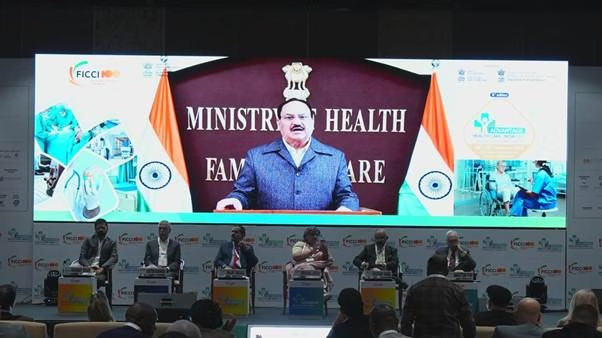
NEW DELHI — In a landmark virtual address marking the opening of the 8th edition of ‘Advantage Health Care – India 2026’, Union Minister for Health and Family Welfare Shri Jagat Prakash Nadda declared that India is undergoing a “comprehensive transformation” to align its healthcare infrastructure with global standards. Addressing an international delegation of healthcare providers, policymakers, and industry leaders, Nadda highlighted the nation’s emergence as a premier destination for Medical Value Travel (MVT), underpinned by clinical excellence, digital integration, and a unique blend of modern and traditional medicine.
The event, organized by the Federation of Indian Chambers of Commerce & Industry (FICCI), serves as a strategic platform to showcase India’s specialized medical capabilities to the world. As global healthcare costs rise and wait times for elective surgeries lengthen in many Western nations, India is positioning itself as a resilient, high-quality, and cost-effective alternative for complex medical interventions.
A Shift Toward Global Alignment and Resiliency
The core of the Minister’s message focused on the structural reforms initiated under the leadership of Prime Minister Shri Narendra Modi. These reforms are not merely aimed at increasing volume but at ensuring that the Indian healthcare ecosystem is “globally aligned.”
For the average patient, “globally aligned” means that a cardiac bypass or an oncology treatment received in New Delhi or Bengaluru meets the same rigorous safety and efficacy protocols as those in London or New York. The Minister noted that the presence of international delegates reflects a growing global “credibility” in India’s medical outcomes.
Key Pillars of the 2026 Healthcare Vision:
-
Clinical Excellence: Focus on advanced specialties including cardiology, oncology, organ transplantation, and neurosciences.
-
Digital Integration: Utilizing the Ayushman Bharat Digital Mission (ABDM) to ensure seamless data portability and tele-consultations for international patients.
-
Infrastructure Modernization: Expansion of JCI (Joint Commission International) and NABH (National Accreditation Board for Hospitals) accredited facilities.
The Economic and Social Impact of Medical Value Travel
Medical Value Travel is often simplified as “medical tourism,” but the Union Health Minister redefined it as a “catalyst for international cooperation.” According to recent data from the Ministry of Tourism and the Ministry of Health, India has seen a steady 15-20% year-on-year growth in international patients seeking treatment.
“Medical travel is not only an economic opportunity but also a channel of cooperation that builds confidence and strengthens people-to-people ties,” Shri Nadda stated. This perspective shifts the focus from a purely transactional model to one of “patient-centric care,” where the emphasis is on the long-term recovery and follow-up of the individual, regardless of their country of origin.
Holistic Care: The Integration of Ayush
Supporting the Union Health Minister, Shri Prataprao Jadhav, Minister of State for Health and Family Welfare & Ayush, emphasized that India’s “secret weapon” in global healthcare is its integrated approach.
India is unique in its formal integration of traditional systems—Ayurveda, Yoga, Unani, Siddha, and Homeopathy (Ayush)—with modern allopathic medicine.
“This integrated model reflects a vision that values innovation alongside tradition and treatment alongside prevention,” Shri Jadhav noted.
For patients suffering from chronic pain or recovering from major surgery, this means access to a “holistic” recovery plan that might include modern physiotherapy alongside traditional Ayurvedic rejuvenation, a combination that is increasingly supported by clinical trials for improving post-operative quality of life.
Expert Perspectives: Infrastructure vs. Accessibility
While the government highlights its successes, independent health experts suggest that the road to becoming a global hub requires a delicate balance between international service and domestic needs.
“The growth of Medical Value Travel in India is a testament to our world-class surgical talent,” says Dr. Arvinder Soin, a pioneer in liver transplantation (not affiliated with the FICCI event). “However, the challenge for 2026 and beyond is ensuring that the ‘Advanced Specialty Care’ mentioned by the Minister remains accessible to the Indian citizenry while we open our doors to the world. Digital health will be the bridge that allows us to manage both effectively.”
Statistical Context: India’s Competitive Edge
| Service | Estimated Cost (India) | Estimated Cost (USA) | Savings |
| Heart Bypass | $5,000 – $8,000 | $100,000+ | ~90% |
| Knee Replacement | $4,000 – $6,000 | $30,000+ | ~80% |
| Liver Transplant | $25,000 – $30,000 | $300,000+ | ~90% |
| Source: Industry benchmarks and previous Medical Value Travel reports. |
Implications for the Public and Potential Limitations
For the general public, the “Advantage Health Care” initiative suggests that the quality of local hospitals is rising to meet international standards. When a hospital prepares for international medical travelers, it must adhere to strict nurse-to-patient ratios and hygiene protocols that benefit every patient in the ward.
However, some public health advocates caution against “brain drain” within the domestic system, where the best medical professionals might gravitate toward MVT-focused private hospitals. The government’s response, as outlined by Shri Nadda, is a “comprehensive reform” that includes strengthening regulatory coordination and inter-ministerial cooperation to ensure the entire ecosystem grows together.
Looking Ahead: A Future-Ready System
The 8th edition of ‘Advantage Health Care – India 2026’ concluded its opening session with an exhibition of the latest in diagnostic services and pharmaceutical strength. The message was clear: India is no longer just a “pharmacy of the world,” but is rapidly becoming the “hospital of the world.”
As the event continues through the week, stakeholders will focus on streamlining “Medical Visas” and establishing “One-Stop Portals” for international patients, ensuring that the journey from a patient’s home to an Indian operating theater is as seamless as the surgery itself.
Medical Disclaimer: This article is for informational purposes only and should not be considered medical advice. Always consult with qualified healthcare professionals before making any health-related decisions or changes to your treatment plan. The information presented here is based on current research and expert opinions, which may evolve as new evidence emerges.
References
1. Primary Source: * Press Information Bureau (PIB) Delhi. “Union Health Minister Shri Jagat Prakash Nadda Virtually Addresses 8th Edition of ‘Advantage Health Care – India 2026’.” Posted 23 Feb 2026.