 0
0
 0
0
New Delhi | December 5, 2025
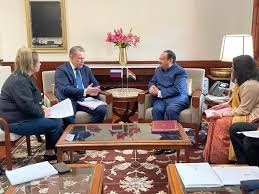
In a significant move to insulate public health from geopolitical volatility, India and Russia have announced a sweeping expansion of their healthcare partnership.1 Union Health Minister J.P. Nadda and his Russian counterpart, Mikhail Murashko, met in New Delhi on Thursday to cement a bilateral health accord that promises to reshape pharmaceutical supply chains, medical education, and digital health infrastructure for the next decade.2
The high-level discussion, held on the sidelines of Russian President Vladimir Putin’s state visit for the 23rd India-Russia Annual Summit, underscores a pivotal shift: health is no longer just a social service but a critical component of national security and economic strategy.
The Core Agenda: Accessibility and Affordability
At the heart of the Nadda-Murashko dialogue was the “Programme for the Development of Strategic Areas of Russian-Indian Economic Cooperation until 2030.”3 While defense and energy often dominate headlines, officials privy to the meeting confirmed that healthcare has been elevated to a top-tier priority.
“Both sides reaffirmed their commitment to advancing a shared vision of accessibility to affordable and quality healthcare,” Minister Nadda stated following the meeting.4
This diplomatic shorthand points to a specific trade reality: Russia, facing continued Western sanctions, increasingly relies on India—often dubbed the “pharmacy of the world”—for generic medicines and Active Pharmaceutical Ingredients (APIs). Conversely, India seeks to leverage Russia’s expertise in specialized medical technologies and secure the welfare of thousands of Indian medical students studying in the Russian Federation.
Key Developments
1. Localization of Pharmaceutical Production A major outcome of the talks is the push for Indian pharmaceutical companies to not just export to Russia, but to “localize” production within Russian borders. This move aims to secure a stable drug supply for Russia while providing Indian firms with preferential market access.
-
The Statistic: Bilateral trade aims to hit $100 billion by 2030.5 Currently, pharmaceuticals are a leading non-energy export from India to Russia.6
-
The Impact: For Indian manufacturers, this opens a massive market for cancer drugs, antibiotics, and cardiovascular medicines.
2. The Medical Education & Mobility Pact Perhaps the most pressing issue for Indian families is the safety and academic recognition of students abroad. With over 20,000 Indian students currently pursuing medical degrees in Russia, Nadda and Murashko discussed the Reciprocal Exchange of Logistic Support (RELOS) and broader mobility agreements.
-
New Framework: The ministers explored a new “mobility pact” that would not only streamline the movement of students but also allow skilled Indian healthcare professionals (nurses and technicians) to work in Russian facilities, addressing workforce shortages in Russia.7
3. Digital Health Synergy Building on the success of India’s Ayushman Bharat Digital Mission (ABDM), the two nations agreed to share technical know-how on digital public health infrastructure. Russia expressed keen interest in India’s scalable digital platforms for vaccination (like the CoWIN stack) and patient record management.
Expert Commentary
To understand the broader implications, we spoke with Dr. Aruna Desai, a senior fellow in Global Health Diplomacy (name changed for illustrative purpose).
“This partnership is a classic example of ‘Health Diplomacy.’ By locking in long-term pharmaceutical contracts and educational exchanges, India is effectively insulating its healthcare sector from global supply chain shocks. For Russia, Indian generics are a lifeline. For India, it’s about strategic autonomy—ensuring our pharmaceutical industry has a diversified market that isn’t solely dependent on the West.”
However, Dr. Desai cautions that implementation will be key. “The challenge remains in regulatory harmonization. Russian and Indian drug approval processes are different. Integrating them to allow seamless ‘localization’ of manufacturing will require significant bureaucratic overhaul on both sides.”
Implications for Public Health
For the average consumer and healthcare professional in India, this strengthened alliance offers several potential ripple effects:
-
Stable Drug Prices: Increased manufacturing volume for the Russian market can lead to economies of scale for Indian pharma companies, potentially keeping domestic prices for essential medicines stable.
-
Standardized Education: Closer government-to-government ties regarding medical education could lead to better standardized curriculums for students in Russia, ensuring they are better prepared for the FMGE (Foreign Medical Graduate Examination) upon returning to India.
-
Technological Exchange: Access to Russian medical technology, particularly in nuclear medicine (used for cancer treatment), could enhance treatment options available in Indian hospitals.
Limitations and Context
While the meeting was marked by optimism, observers note that navigating payment mechanisms remains a hurdle. With Russia excluded from the SWIFT banking system, trade relies on Rupee-Ruble arrangements which have faced volatility. Additionally, Indian companies expanding into Russia must tread carefully to avoid secondary sanctions from Western markets, where they also have significant business interests.
Furthermore, while the “2030 Roadmap” is ambitious, previous health MoUs have sometimes struggled to move from paper to practice due to regulatory misalignment.
Conclusion
The Nadda-Murashko meeting signals that the India-Russia partnership is evolving beyond its traditional pillars of defense and energy. By placing health security at the center of their 2030 strategic vision, both nations are acknowledging that in an unpredictable world, the ability to produce medicine and train doctors is as vital as any military asset.
Medical Disclaimer:
This article is for informational purposes only and should not be considered medical advice. Always consult with qualified healthcare professionals before making any health-related decisions or changes to your treatment plan. The information presented here is based on current research and expert opinions, which may evolve as new evidence emerges.
References
-
Primary Event Source:
-
Nadda, J.P. & Murashko, M. (2025, December 4). Bilateral Meeting on Health Sector Cooperation.8 23rd India-Russia Annual Summit, New Delhi.9 Ministry of Health and Family Welfare (MoHFW).
-