 0
0
 0
0
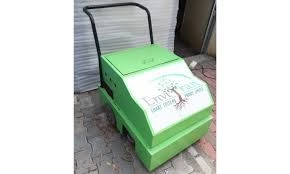
Chennai, November 28, 2025 – Researchers at the Indian Institute of Technology Madras (IIT Madras) have developed an innovative, walk-behind Road Dust Collector (RDC) designed to tackle one of India’s most pervasive air pollution sources: street dust. This battery-powered device promises to reduce harmful particulate matter like PM2.5 resuspended from roads, protecting public health while safeguarding sanitation workers from dust exposure. The technology transfer to Envitran Smart Systems marks a step toward scalable deployment in crowded urban areas.
Technology Breakthrough
The RDC operates like a lightweight lawnmower, featuring a self-adjusting brush that maintains contact with uneven or sloped surfaces for effective cleaning. Its core innovation lies in a cyclone separator system that captures both coarse and fine dust particles, directing them into separate bins to prevent re-suspension into the air. Fine dust collected can even be repurposed for products like earthen pots, adding a sustainable twist.
Prof. S. M. Shiva Nagendra, from IIT Madras’s Department of Civil Engineering and lead developer, emphasized the device’s practicality: “Our goal was to develop a technology that improves air quality while also making the lives of manual sweepers safer and easier. This device is designed to make a real difference on the ground.” Powered by a small, energy-efficient fan, the compact unit navigates narrow lanes inaccessible to large machines, addressing gaps in traditional broom-based sweeping.
Road Dust: A Hidden Pollutant Menace
Road dust ranks among top contributors to airborne PM2.5 and PM10 in Indian cities. Studies show it accounts for 35-66% of PM10 levels and 16-38% of PM2.5, often surpassing vehicle emissions in places like Delhi and Kolkata. Resuspended by traffic and wind, these particles—especially PM2.5 under 2.5 micrometers—penetrate deep into lungs, lodging in alveoli and triggering inflammation.
In India, annual PM2.5 exposure averages 63.4 µg/m³, far exceeding WHO guidelines, with rural and low-income areas hit hardest. A pooled analysis of 35 studies linked PM2.5 exposure to a 7.6% increased risk of respiratory diseases overall, rising to 10.4% in children for symptoms like wheezing, cough, and lower respiratory infections. Sanitation workers face amplified risks from prolonged exposure during manual sweeping.
Health Impacts in Sharp Focus
PM2.5 from road dust correlates with aggravated asthma, chronic obstructive pulmonary disease (COPD), pneumonia, and cardiovascular issues. In children, risks climb 8.2% for wheezing and 15.3% for lower respiratory illnesses per exposure increment; even levels below India’s 40 µg/m³ standard heighten illness odds. Nationally, PM2.5 contributes to millions of deaths yearly—3.8 million under local standards—with respiratory diseases claiming 24-30% of pollution-linked fatalities.
Dr. Kalpana Balakrishnan, a public health expert at Sri Ramachandra Institute (not involved in the research), noted: “Road dust is an underappreciated vector for PM2.5, exacerbating India’s air quality crisis. Technologies like this RDC could meaningfully cut resuspension, potentially averting thousands of respiratory cases in high-density cities.” Long-term, reduced exposure might ease burdens on healthcare systems strained by pollution-driven COPD and infections.
Public Health and Worker Protection Implications
For urban residents, deploying RDCs citywide could lower ambient PM2.5, aiding compliance with National Clean Air Programme goals. Healthier air translates to fewer emergency visits for asthma or bronchitis, particularly benefiting children and the elderly. Workers, currently inhaling dust clouds from brooms, gain from mechanized collection that minimizes inhalation risks and physical strain.
Cost savings appeal to municipalities: the low-maintenance design undercuts expensive mechanized sweepers. Environmentally, it curbs dust recirculation, supporting circular economy via dust reuse. Early adopters like Chennai could model reductions seen in pilot tests, where similar cyclone tech cut resuspended PM by up to 70%.
Challenges and Future Outlook
While promising, scalability hinges on widespread adoption amid funding constraints for local bodies. Critics note that road dust is just one PM source—vehicles and industry dominate elsewhere—requiring holistic strategies. Maintenance training for operators and integration with existing waste systems pose logistical hurdles, though IIT Madras’s licensing to Envitran aims to streamline commercialization.
Ongoing refinements, like enhanced battery life, could boost viability. Independent trials will quantify real-world PM reductions, building on lab validations. Balanced against limitations, the RDC represents targeted innovation in India’s fight for breathable air.
Medical Disclaimer: This article is for informational purposes only and should not be considered medical advice. Always consult with qualified healthcare professionals before making any health-related decisions or changes to your treatment plan. The information presented here is based on current research and expert opinions, which may evolve as new evidence emerges.
References