 0
0
 0
0
At the Madhya Pradesh Regional AI Impact Conference 2026 in Bhopal on January 15, researchers from the Indian Institute of Technology (IIT) Indore showcased a groundbreaking human-like AI replica capable of simulating breathing, blinking, and disease progression to aid preventive diagnosis. This innovation, part of the Charak DT platform developed by Drishti CPS—a technology hub at IIT Indore funded by India’s Department of Science and Technology under the National Mission on Interdisciplinary Cyber-Physical Systems (NM-ICPS)—marks a leap in personalized healthcare. Vaibhav Jain from Drishti CPS emphasized its potential: “We are making a digital twin of the human body which aims to provide preventive diagnosis of diseases… This patient replica looks like a real human which can breathe and blink eyes like a human.”
Key Features and Technology
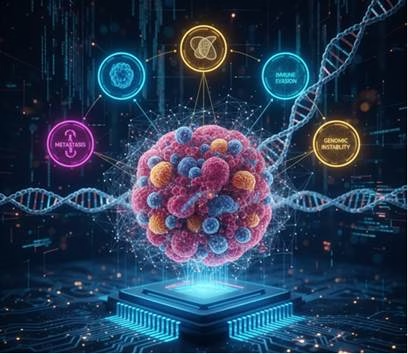
The Charak DT platform creates a virtual “digital twin” of the human body, trained on diverse physiological parameters to detect disease patterns when thresholds are breached. Currently focused on the lungs, it simulates organ responses to interventions like medications, allowing safe experimentation without patient risk. Future expansions target the cardiovascular system, eyes, heart, and more, integrating real-time data for holistic modeling from primary to tertiary care.
This pathy-agnostic system draws inspiration from ancient Ayurvedic principles in the Charaka Samhita, emphasizing individual-centric care: “Every individual is different… and thus should be considered as a separate entity.” Drishti CPS has funded 89 startups and collaborates with AIIMS Bhopal, Delhi, and Raipur for clinical validation, ensuring real-world applicability. The replica’s AI models analyze organ functions to predict outcomes, supporting surgical planning, drug optimization, and telemedicine.
Background on Digital Twins in Healthcare
Digital twins—virtual replicas mirroring physical assets—originated in manufacturing but have transformed healthcare by enabling predictive simulations. In India, where specialist shortages and rural access gaps persist, they address chronic disease burdens like diabetes and cardiovascular issues, which account for substantial healthcare loads. Global reviews highlight their role in reducing hospital readmissions by up to 25% for chronic conditions through scenario testing.
IIT Indore’s effort builds on pilots like those at IIT-Chennai for cardiothoracic surgery, where twins simulate treatments to resolve conflicting specialist opinions. Supported by NM-ICPS, Charak DT fosters commercialization via developer collaborations, promoting scalable, sustainable tech. Unlike static models, it evolves with patient data for personalized profiles at individual, family, and community levels.
Public Health Implications
For India’s 1.4 billion population, Charak DT promises democratized care: rural telemedicine, optimized resources, and reduced costs via fewer redundant tests. It supports predictive analytics for epidemics, personalized medicine for chronic illnesses, and in-silico trials slashing drug development timelines. Patients gain from outcome predictions, empowering informed decisions—like adjusting lifestyles based on virtual lung stress tests—while providers streamline workflows.
In public health, it aids last-mile delivery, bridging urban-rural divides and aligning with Ayushman Bharat Digital Mission for data interoperability. Globally, such tech could enhance equity, but India’s context amplifies impact amid rising non-communicable diseases (63% of deaths). Practical takeaway: Individuals might use twin insights via apps for early warnings, prompting timely check-ups rather than crises.
Limitations and Challenges
Despite promise, digital twins face hurdles: data privacy risks demand robust governance, as emphasized in scoping reviews calling for ethical frameworks. In India, infrastructure gaps, high costs, and equity issues could limit access beyond metros. Current Charak DT lung focus means broader rollout awaits validation; over-reliance might erode clinical judgment if not integrated carefully.
Accuracy hinges on quality training data, with biases potentially skewing predictions for diverse demographics. Regulatory clarity lags, though NM-ICPS support aids progress. Experts urge multidisciplinary collaboration: “Compliance with ethical guidelines… is critical.” No large-scale trials yet prove efficacy, positioning this as innovative but early-stage.
This development positions India at the forefront of AI-health fusion, blending tradition with tech for preventive paradigms. As Charak DT scales, it could redefine disease detection, but balanced adoption ensures benefits outweigh risks.
Medical Disclaimer: This article is for informational purposes only and should not be considered medical advice. Always consult with qualified healthcare professionals before making any health-related decisions or changes to your treatment plan. The information presented here is based on current research and expert opinions, which may evolve as new evidence emerges.
References:
-
Economic Times Health. “IIT Indore develops human-like AI powered replica…” Jan 16, 2026. https://health.economictimes.indiatimes.com/news/industry/iit-indore-develops-human-like-ai-powered-replica-to-detect-disease-in-human-body/126565671