 0
0
 0
0
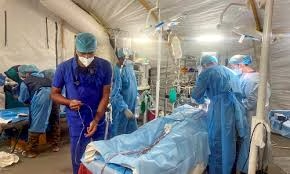
COLOMBO/NEW DELHI — In a critical humanitarian intervention amidst the devastation left by Cyclone Ditwah, a field hospital established by the Indian Army in Sri Lanka’s Mahiyanganaya region has become a lifeline for thousands. As of December 7, the facility has provided urgent medical care to over 2,200 patients, conducting dozens of surgeries in an area where local healthcare infrastructure has been severely crippled by flooding and landslides.
The medical mission, part of India’s broader “Operation Sagar Bandhu” (Operation Friend of the Sea), underscores the critical role of rapid medical deployment in disaster zones. With the death toll from the cyclone surpassing 600 and hundreds still missing, the field hospital’s presence has prevented a secondary health crisis in the hard-hit central highlands.
A Hospital Rising from the Mud
Established on December 5 near Kandy, the field hospital was operational within hours of the Indian Army medical team’s arrival. The facility is equipped with surgical suites, trauma care units, and critical life-support systems.
According to the Ministry of External Affairs (MEA), the medical team has successfully conducted 67 minor procedures and at least five major emergency surgeries in just 72 hours. “The focus has been on stabilization,” said an MEA spokesperson. “From treating crush injuries caused by landslides to managing acute waterborne infections, the team is addressing the immediate medical fallout of the storm.”
The location, Mahiyanganaya, was strategically chosen due to its proximity to communities cut off by washed-out roads. To facilitate access, Indian engineers simultaneously deployed three Bailey bridges, restoring vital supply lines that allow ambulances to reach remote villages.
The Medical Challenge: Beyond Trauma
While the initial wave of patients presented with trauma—fractures, lacerations, and head injuries sustained during the landslides—the medical focus is shifting toward preventing disease outbreaks.
Dr. Aruna De Silva, a public health epidemiologist in Colombo who is not involved in the Indian mission, emphasized the precarious nature of the current phase. “After the immediate trauma of a cyclone, the ‘second wave’ of mortality often comes from infection,” Dr. De Silva explained. “With water sources contaminated, the risk of leptospirosis, cholera, and vector-borne diseases like dengue skyrockets. A field hospital that provides not just surgery but also prophylactic care and clean water is the difference between a disaster and a catastrophe.”
The Indian team has reportedly set up isolation wards to handle potential infectious cases, a standard protocol in flood-relief operations.
Diplomacy Through Care
The operation aligns with India’s “Neighbourhood First” policy, but for the patients on the ground, the geopolitics is secondary to survival. Lieutenant General Lasantha Rodrigo, Commander of the Sri Lanka Army, visited the facility on Saturday, visibly moved by the speed of the response. He noted that the Indian team’s ability to perform complex surgeries in a field setting relieved immense pressure on the surviving local hospitals, which are currently overwhelmed.
“Operation Sagar Bandhu is not just about supplies; it is about shared capabilities,” said an Indian High Commission official. “When a neighbour bleeds, we are there to stitch the wound.”
Public Health Implications
For health-conscious readers and policymakers, the Mahiyanganaya mission highlights a crucial lesson in disaster management: the necessity of modular, mobile healthcare units. Traditional hospitals are often immobile and vulnerable to the very disasters they are meant to address. The success of this field hospital suggests that rapid-deployment medical units should be a standard component of regional disaster preparedness pacts.
Limitations and Challenges
Despite the success, challenges remain. The sheer scale of displacement—over 400,000 people affected—means that a single field hospital, however efficient, cannot cover all needs. Logistics remain difficult; heavy rains continue to batter the island, grounding helicopter sorties and complicating the resupply of medical consumables. Furthermore, as the acute phase passes, the long-term mental health impact of the disaster on survivors will require sustained attention that emergency field units are rarely equipped to provide.
Conclusion
As skies begin to clear over Mahiyanganaya, the Indian field hospital stands as a testament to the resilience of medical cooperation. For the 2,200 patients treated so far, it has been a sanctuary in the storm. For the region, it is a reminder that in the face of climate-driven disasters, health security is a shared responsibility.
Medical Disclaimer:
This article is for informational purposes only and should not be considered medical advice. Always consult with qualified healthcare professionals before making any health-related decisions or changes to your treatment plan. The information presented here is based on current research and expert opinions, which may evolve as new evidence emerges.
References:
-
Ministry of External Affairs, Government of India. (2025, December 7). Operation Sagar Bandhu: Update on Humanitarian Assistance to Sri Lanka. New Delhi.