 0
0
 0
0
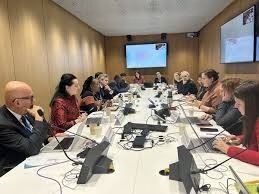
GENEVA — On January 20, 2026, a high-level delegation of international parliamentarians met with the World Health Organization (WHO) at its headquarters to forge a new path for global women’s health. The dialogue, convened by the Konrad-Adenauer-Stiftung (KAS) and the UNITE Parliamentarians Network for Global Health, aimed to transform abstract medical research into enforceable national laws.
The meeting comes at a critical juncture for global health. Thirty years after the landmark Beijing Declaration, experts warn that progress on women’s rights and health outcomes has stalled or turned “uneven.” From the rising burden of noncommunicable diseases (NCDs) like cancer to the complexities of sexual and reproductive health and rights (SRHR), the message from Geneva was clear: health cannot be treated in isolation from the laws that govern a nation.
Moving Beyond “Fragmented” Healthcare
For decades, women’s healthcare has often been siloed into specific categories, such as maternal health or fertility. However, the WHO is now pushing for a “life-course approach”—a strategy that views health as a continuous journey from birth to old age.
Dr. Alia El-Yassir, WHO Director for Gender, Equity, and Diversity, emphasized that health outcomes are rarely just about biology. Instead, they are dictated by social norms and structural barriers. “Women’s health outcomes are shaped by gender inequalities that persist across the life course,” Dr. El-Yassir noted during the summit.
The parliamentarians in attendance—representing nations as diverse as Germany, Mexico, South Africa, and Sri Lanka—acknowledged that a woman’s ability to stay healthy is often tied to her economic status, her education, and the legal protections she is afforded.
Key Focus Areas of the Dialogue:
-
Integrated Care: Moving away from “one-off” medical interventions toward comprehensive health systems.
-
SRHR: Addressing sexual and reproductive health as a fundamental right, even in the face of humanitarian crises.
-
NCDs: Tackling the “silent killers,” specifically cervical and breast cancers, through better screening and domestic investment.
The Cancer Crisis: A Political Challenge
One of the most pressing technical sessions focused on the skyrocketing rates of noncommunicable diseases. Cancer is no longer just a medical issue; it is a “health system sustainability” issue.
Dr. Prebo Barango, Lead for the Cervical Cancer Elimination Initiative, presented data on how integrated prevention can save lives. Cervical cancer, for instance, is almost entirely preventable through HPV vaccination and regular screening. Yet, the gap between high-income and low-income nations remains vast.
“Health is inseparable from broader social and economic policies,” the parliamentarians noted in a collective statement. They shared stories from their home countries illustrating how cancer doesn’t just affect the patient—it creates a “caregiver burden” that can pull entire families into poverty.
The WHO Global Platform for Access to Childhood Cancer Medicine was also highlighted as a vital tool. Led by Santiago Milan, this initiative seeks to ensure that a child’s survival rate depends on their diagnosis, not their geography.
Why Parliamentary Engagement Matters
You might wonder why a group of politicians is meeting with doctors in Geneva. The reason is simple: the budget.
Dr. Jeremy Farrar, WHO Assistant Director-General, explained that the WHO is undergoing a significant restructuring to better support national governments. However, the WHO can only provide the evidence; the parliamentarians must provide the funding and the legal framework.
“Parliaments play a pivotal role in shaping health policy, legislation, and budgetary decisions,” Dr. Farrar said. By bringing lawmakers to the table, the WHO hopes to ensure that when a new medical breakthrough occurs, the laws are already in place to get that treatment to the people who need it most.
What This Means for Your Health
For the average citizen, this high-level dialogue signals a shift in how healthcare may be delivered in the coming years.
-
More Holistic Visits: You may see your primary care provider addressing more than just immediate symptoms, looking instead at long-term prevention across your “life course.”
-
Increased Screening Access: As nations commit to the Cervical Cancer Elimination Initiative, expect more localized and affordable screening programs.
-
Digital Health and Literacy: A major focus of the dialogue was reducing stigma and improving health literacy, meaning more resources may become available to help you navigate your own health decisions.
Potential Challenges and Counterarguments
While the dialogue was productive, significant hurdles remain. Skeptics often point to the “implementation gap”—the space between passing a law and actually building a clinic. Additionally, global multilateralism is currently under strain. Political shifts in various regions can lead to “health nationalism,” where countries pull back from international cooperation, potentially defunding the very initiatives discussed in Geneva.
Furthermore, integrating gender-responsive care requires deep cultural shifts that legislation alone cannot always fix. Critics argue that without addressing the underlying economic disparities that prevent women from seeking care, even the best-funded health programs may fall short.
Looking Ahead: The 2026 Global Summit
The Geneva dialogue serves as a preamble to the upcoming UNITE Global Summit 2026, scheduled for March 6-7 in Manila, Philippines. That summit is expected to produce concrete legislative roadmaps for the participating nations.
As Dr. Pascale Allotey, Director of WHO’s Department of Sexual, Reproductive, Maternal, Child, Adolescent Health and Ageing, concluded: “Health needs evolve from birth to older age. Our laws must evolve with them.”
Reference Section
-
World Health Organization (2026). Report on the AS–UNITE Parliamentary Dialogue: Women’s Health and Multilateralism. Geneva, Switzerland.
Medical Disclaimer: This article is for informational purposes only and should not be considered medical advice. Always consult with qualified healthcare professionals before making any health-related decisions or changes to your treatment plan. The information presented here is based on current research and expert opinions, which may evolve as new evidence emerges.