 0
0
 0
0
March 7, 2026
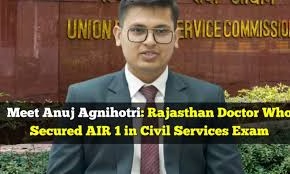
JODHPUR — When the Union Public Service Commission (UPSC) released the final merit list for the 2025 Civil Services Examination (CSE) on March 6, 2026, the results signaled a symbolic shift in India’s professional landscape. Dr. Anuj Agnihotri, a 2023 MBBS graduate from the All India Institute of Medical Sciences (AIIMS), Jodhpur, secured All India Rank (AIR) 1. His transition from the clinical wards of a premier tertiary care center to the “Steel Frame” of Indian administration has reignited a national conversation regarding the increasing trend of medical professionals trading their stethoscopes for administrative authority.
Dr. Agnihotri, hailing from Rahata village in Rajasthan, cleared the grueling three-stage examination on his third attempt. Having previously secured a position in a different service, his ascent to the top spot underscores a growing pattern: doctors are not only appearing for the UPSC in higher numbers but are consistently dominating the top deciles of the results. Out of the 958 candidates recommended for appointment this year to the IAS, IFS, and IPS, a significant percentage share Dr. Agnihotri’s medical background.
The “Success Gap”: Why Doctors Excel in UPSC
Statistical analysis of UPSC performance data reveals that “Medical Science” as an optional subject consistently yields one of the highest success rates. Historical data indicates that while thousands of candidates opt for humanities, the success rate for Medical Science often hovers around 16% to 20%, significantly higher than many traditional subjects.
Experts suggest this is not coincidental. The rigorous nature of an MBBS—characterized by five and a half years of high-volume memorization, clinical precision, and 24-hour shifts—prepares candidates for the stamina required by the UPSC.
“Medical training inherently builds a scientific mindset and an extraordinary capacity for disciplined study,” says an education analyst at ClearIAS. “Doctors are trained to synthesize complex biological data into a diagnosis. The UPSC Mains requires a similar ability to synthesize socio-economic data into policy solutions.”
The Motivation: From Individual Healing to Systemic Reform
For many, the jump from medicine to bureaucracy is driven by a desire to address the “root causes” of illness that a prescription pad cannot reach.
Dr. Rajiv Gupta, a faculty member in community medicine at a government medical college in North India (who was not involved in Dr. Agnihotri’s journey), explains the shift in perspective:
“In a hospital, a doctor treats the symptoms of a cholera outbreak one patient at a time. As a District Magistrate, that same doctor can fix the broken water sanitation system that caused the outbreak in the first place. They are moving from clinical medicine to social medicine.”
Dr. Agnihotri himself echoed this sentiment during his interview process, noting a desire for a career that offers “exposure to multiple sectors of governance” and moves away from the perceived “monotony” of specialized clinical practice.
The Public Health Paradox: Loss vs. Gain
While the government gains a technically proficient administrator, the medical field faces a “brain drain” at a time when India’s doctor-to-population ratio—though improving—still struggles to meet WHO standards in rural sectors.
The Benefits of Doctors in Power:
-
Evidence-Based Policy: Medically trained officers can better interpret epidemiological data and pandemic trends.
-
Infrastructure Insight: They possess a ground-level understanding of hospital supply chains, drug shortages, and medical ethics.
-
Disaster Management: During public health emergencies, having a “doctor-in-chief” at the administrative helm can streamline technical communication.
The Counter-Arguments:
However, health systems researchers express concern. Dr. Meera Nair, a health systems researcher at a national public health institute, warns that every MBBS graduate who enters the IAS is one less surgeon or cardiologist in a system already facing a shortage.
“India invests heavily in subsidizing medical education, especially at institutions like AIIMS,” Dr. Nair notes. “When these graduates shift to non-clinical roles, we lose the direct patient-care ROI (Return on Investment). We need to find a way to integrate medical expertise into policy without necessarily losing the clinician entirely.”
Statistical Context: The 2025 Competitive Landscape
The scale of Dr. Agnihotri’s achievement is magnified by the sheer competitiveness of the 2025 cycle:
-
Total Applicants: Estimated 5.5–7.5 lakh (550,000 to 750,000)
-
Qualified for Mains: 14,161
-
Interview Call (Personality Test): 2,736
-
Final Recommendations: 958
With a final selection rate of less than 0.2%, the presence of medical professionals in this elite group suggests that the analytical rigors of medicine are highly transferable to civil governance.
A New Era of Interdisciplinary Public Service
Dr. Agnihotri’s journey from AIIMS Jodhpur to AIR 1 sends a clear message to the next generation of students: the boundaries between professional silos are thinning. For health-conscious consumers and the general public, this trend may lead to more “health-literate” governance. A bureaucrat who understands the nuances of maternal mortality or vaccine hesitancy is uniquely positioned to advocate for person-first, stigma-free public health initiatives.
As Dr. Agnihotri prepares to transition from the stethoscope to the “steel frame” of the Indian Administrative Service, the spotlight remains on how his medical foundation will shape the future of the districts he will eventually lead.
Medical Disclaimer
This article is for informational purposes only and should not be considered medical advice. Always consult with qualified healthcare professionals before making any health-related decisions or changes to your treatment plan. The information presented here is based on current research and expert opinions, which may evolve as new evidence emerges.
References
Primary News Sources:
-
Medical Dialogues. (2026, March 5). AIIMS Jodhpur MBBS graduate Dr Anuj Agnihotri tops UPSC CSE 2025.