 0
0
 0
0
SHEGAON, MAHARASHTRA – In a significant push toward bridging the gap between traditional wisdom and modern public health, the Ministry of Ayush concluded its centerpiece National Arogya Fair 2026 this week. The four-day event, held in the Buldhana district, has emerged as a blueprint for a new “integrated” healthcare model—one that attempts to treat the patient while simultaneously empowering the farmer.
With over 2,000 farmers in attendance and thousands of citizens seeking free medical consultations, the fair signaled a strategic shift in India’s healthcare policy: moving beyond the hospital walls and into the soil of rural India.
The Preventive Pivot: Reclaiming the “Grandmother’s Pouch”
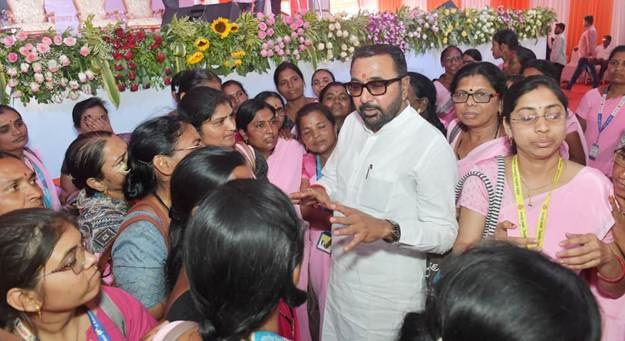
Addressing a diverse crowd of practitioners and rural citizens on February 26, Union Minister of State (Independent Charge) for Ayush, Shri Prataprao Jadhav, framed the Ayush systems—Ayurveda, Yoga, Naturopathy, Unani, Siddha, and Homoeopathy—not merely as alternative treatments, but as the “backbone of preventive healthcare.”
“Ayush is a movement for social transformation,” Jadhav stated. He urged a return to disciplined daily routines (Dinacharya) to combat the rising tide of non-communicable diseases (NCDs) like diabetes and hypertension.
The Minister highlighted the “Aaji Bai ka Batua” (Grandmother’s Medicine Pouch) concept—a metaphor for home-based, affordable botanical remedies. This “kitchen-pharmacy” approach is increasingly backed by modern science. For instance, the use of turmeric (Curcuma longa)—a staple in Indian households—has been extensively studied for its anti-inflammatory properties.
Expert Insight: “The integration of traditional knowledge with standardized protocols is essential,” says Dr. Anjali Nayak, a public health consultant not affiliated with the Ministry. “When we talk about ‘Aaji Bai ka Batua,’ we are essentially talking about low-cost, primary preventive interventions that can reduce the burden on our secondary and tertiary healthcare facilities.”
The Economic Engine: Healing the Soil to Heal the Soul
Perhaps the most innovative aspect of the 2026 Fair was the explicit link between medicinal farming and rural prosperity. The National Medicinal Plants Board (NMPB) transformed the event into a commercial hub, facilitating nine Letters of Intent (LoIs) between farmers and industry leaders.
One landmark agreement involved the Sevarpan Farmer Producer Organization and Veloce Herbals Pvt. Ltd., securing the procurement of 100 metric tonnes of turmeric.
Why This Matters for Public Health:
-
Quality Control: Direct linkages ensure that the raw herbs used in Ayush medicines meet stringent safety and efficacy standards.
-
Sustainability: Encouraging the cultivation of crops like Shatavari and Aloe vera provides farmers with stable pricing, reducing rural economic distress, which is a known social determinant of health.
-
Global Leadership: By standardizing these “raw materials,” India aims to become a primary global supplier for the multi-billion dollar botanical extract industry.
Evidence-Based Integration: Beyond Tradition
A common critique of traditional medicine is the perceived lack of rigorous clinical data. The Ministry of Ayush addressed this head-on at Shegaon by showcasing research achievements from its various Research Councils.
The pavilion featured interactive digital displays of peer-reviewed studies on Ayush Aahar (dietary principles). These guidelines emphasize region-specific, nutritionally balanced diets tailored to an individual’s constitution—a concept remarkably similar to the burgeoning field of “personalized nutrition” in Western medicine.
Free consultations were provided across all six Ayush systems. For many in underserved areas of Buldhana, this represented their first interaction with a qualified healthcare professional. Live Yoga therapy sessions also demonstrated the “restorative potential” of mind-body practices in managing chronic stress.
Challenges and the Road Ahead
While the Fair celebrated success, the path to full integration remains complex. Critics often point to the “bridge-gap” between Ayush practitioners and allopathic (Western) doctors.
“The challenge is ensuring that ‘integration’ doesn’t lead to ‘confusion,'” notes Dr. Nayak. “We need clear referral pathways. If a patient at an Arogya Fair has severely high blood pressure, they need to be stabilized with emergency medicine before transitioning to Ayurvedic lifestyle management. Coordination is key.”
Furthermore, while the NMPB promotes medicinal farming, ensuring that these crops do not replace essential food crops—a phenomenon known as “crop displacement”—remains a vital consideration for food security.
What This Means for You
For the average consumer, the National Arogya Fair suggests three actionable takeaways:
-
Preventive Ownership: Healthcare starts with routine. Simple shifts in sleep hygiene and diet, as advocated by Ayush, are scientifically proven to mitigate NCD risks.
-
Informed Supplementation: As the industry moves toward better “market linkages,” consumers can expect higher-quality, standardized herbal products with better traceability.
-
Holistic Consultation: Integrated health doesn’t mean choosing one system over the other. It means using the best of both—modern diagnostics paired with traditional wellness strategies.
As the Fair concluded on February 28, the message from Shegaon was clear: the future of Indian healthcare may well be rooted in its past, but its success will be measured by its ability to meet the rigorous scientific and economic standards of the future.
Medical Disclaimer: This article is for informational purposes only and should not be considered medical advice. Always consult with qualified healthcare professionals before making any health-related decisions or changes to your treatment plan. The information presented here is based on current research and expert opinions, which may evolve as new evidence emerges.
References and Sources
-
Ministry of Ayush. (2026, Feb 27). Ministry of Ayush showcases integrated healthcare and rural empowerment at National Arogya Fair 2026. PIB Delhi.