 0
0
 0
0
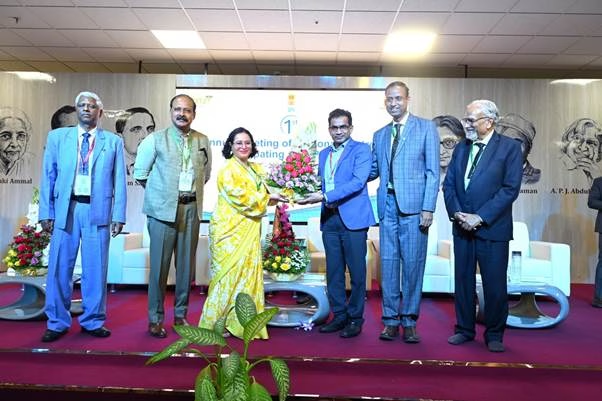
VISAKHAPATNAM — In a landmark move to fortify the safety net for millions of patients, the Indian Pharmacopoeia Commission (IPC) and the Andhra Pradesh MedTech Zone (AMTZ) concluded a historic two-day national summit today. The meeting, held February 27–28, 2026, marks the first-ever unified annual gathering of regional centers dedicated to monitoring the safety of medicines and medical devices across the country.
The summit’s centerpiece was the launch of the ADR PvPI 2.0 mobile application, a sophisticated digital tool designed to transform how adverse drug reactions (ADRs) are reported in real-time. By bridging the gap between clinical observation and regulatory action, health officials aim to transition India from a culture of “safety awareness” to one of “measured performance.”
A New Era for Patient Safety
India, often referred to as the “pharmacy of the world,” is home to a massive pharmaceutical industry and a rapidly growing medical technology sector. However, the systems used to track side effects (Pharmacovigilance) and medical device failures (Materiovigilance) have historically faced hurdles, including underreporting and fragmented data.
“We must move beyond merely knowing that reporting is important,” said Dr. V. Kalaiselvan, Secretary-cum-Scientific Director of the IPC, during the inaugural session. “Our goal now is a performance-oriented framework where we can measure outcomes and ensure that every reported incident leads to a safer healthcare environment.”
Strengthening the Infrastructure
The meet brought together a “who’s who” of Indian healthcare, including senior leadership from the All India Institutes of Medical Sciences (AIIMS) and the World Health Organization (WHO) Country Office for India. The collaboration between the IPC (the nation’s drug standards body) and AMTZ (one of the world’s largest medical device manufacturing hubs) signals a high-level commitment to integrating safety protocols directly into the manufacturing and clinical ecosystems.
Key objectives of the summit included:
-
Harmonization: Aligning the efforts of Adverse Drug Reaction Monitoring Centres (AMCs) and Medical Device Monitoring Centres (MDMCs).
-
Technology Integration: Leveraging the new ADR PvPI 2.0 app to simplify reporting for both healthcare providers and the public.
-
Expanding Reach: Moving safety monitoring beyond major city hospitals into district-level healthcare facilities.
Addressing the “Silent” Challenge: Underreporting
One of the most significant hurdles in global healthcare is the “underreporting” of adverse events. Medical experts estimate that only a fraction of side effects are actually reported to regulatory bodies, often due to complex paperwork or a lack of time among frontline staff.
Dr. Jitendra Sharma, Managing Director and Founder CEO of AMTZ, emphasized that medical device safety—Materiovigilance—requires a specialized focus. Unlike drugs, which are metabolized by the body, medical devices (such as stents, pacemakers, or even surgical gloves) can fail due to mechanical issues or material biocompatibility.
“Institutional collaboration is the only way to ensure that as India innovates in medical technology, our safety oversight keeps pace,” Dr. Sharma noted.
Digital Transformation: The ADR PvPI 2.0 App
The launch of the ADR PvPI 2.0 application is expected to be a game-changer for the Pharmacovigilance Programme of India (PvPI). The app allows healthcare professionals and, crucially, patients themselves to report suspected side effects directly from their smartphones.
How it works:
-
Ease of Entry: A simplified interface reduces the time required to log an event.
-
Real-Time Data Capture: Information is sent instantly to the IPC database for analysis.
-
Standardization: The app uses standardized medical terminology, ensuring that data from a rural clinic in Andhra Pradesh is compatible with data from a tertiary hospital in Delhi.
Statistical context provided during the meet suggested that digital-first reporting strategies in other nations have increased reporting rates by as much as 30% to 40% within the first two years of implementation.
Expert Perspectives
While not a participant in the Visakhapatnam meet, independent public health analysts view this as a critical step.
“The integration of Materiovigilance with Pharmacovigilance is vital,” says Dr. Arati Rao, a clinical research consultant (not affiliated with the IPC). “In modern medicine, patients often receive a combination of drugs and implants. Having a unified reporting culture means we can see the full picture of patient health rather than looking at medicines and devices in silos.”
However, experts also cautioned that technology is only half the battle. “An app is a tool, not a solution,” says Prof. Y. K. Gupta, a veteran of India’s pharmacovigilance efforts. The summit addressed this by dedicating the second day to “Working Groups” focused on training staff and developing standardized frameworks to analyze preventable adverse events.
What This Means for You
For the average consumer, these developments translate to a more transparent and responsive healthcare system.
-
Confidence in Quality: Increased monitoring means that “signals”—patterns of unexpected side effects—are caught faster, leading to quicker recalls or updated warning labels.
-
Empowerment: The new mobile app gives patients a direct voice in the regulatory process.
-
Safer Devices: As India manufactures more of its own medical hardware, the Materiovigilance Programme (MvPI) ensures these devices meet rigorous safety standards throughout their lifecycle.
Challenges and Limitations
Despite the optimism, the working groups acknowledged several “documentation gaps.” Collecting data is one thing; analyzing it to determine “causality” (whether the drug actually caused the reaction) requires highly trained personnel. The IPC has recommended significant “capacity building”—essentially a massive training push—to ensure that the surge in data from the new app can be effectively processed.
Furthermore, expanding these programs to rural districts remains a logistical challenge. The summit concluded with a pledge to integrate technology-enabled monitoring mechanisms that don’t just rely on high-speed internet but can function in the varied infrastructure of rural India.
References
-
Press Information Bureau (PIB) Delhi. (2026). National Meet on Strengthening Pharmacovigilance and Materiovigilance in India at Visakhapatnam. [Post ID: 2110280].
Medical Disclaimer: This article is for informational purposes only and should not be considered medical advice. Always consult with qualified healthcare professionals before making any health-related decisions or changes to your treatment plan. The information presented here is based on current research and expert opinions, which may evolve as new evidence emerges.