 0
0
 0
0
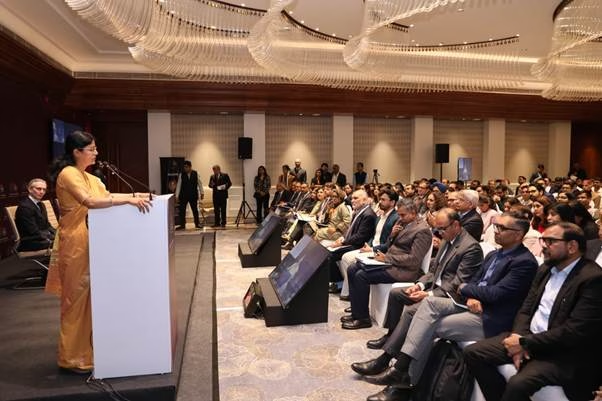
NEW DELHI — At the high-level India AI Impact Summit 2026 held at Bharat Mandapam this week, government leaders and global healthcare titans converged to outline a future where Artificial Intelligence (AI) is no longer a futuristic luxury, but a foundational tool for public health.
The session, titled “Innovation to Impact: AI as a Public Health Game-Changer,” featured Union Minister of State for Health and Family Welfare, Smt. Anupriya Patel, who articulated a vision of “All-Inclusive Intelligence.” The summit highlighted how AI is currently being deployed to bridge the rural-urban healthcare divide, predict disease outbreaks before they jump from animals to humans, and significantly boost tuberculosis (TB) detection rates across the subcontinent.
A Paradigm Shift: “All-Inclusive” Intelligence
Addressing an audience of policymakers and tech experts, Minister Patel emphasized that India’s approach to AI deviates from global trends of mere “precision medicine.” Instead, the focus is on equity.
“AI for India is not merely Artificial Intelligence, but All-Inclusive Intelligence,” Patel stated, citing Prime Minister Narendra Modi’s vision. She argued that the success of technology in a nation of 1.4 billion must be measured by its ability to touch the lives of the most vulnerable and reduce longstanding health inequities.
Key Breakthroughs in Disease Surveillance
One of the most significant developments discussed was the Media Disease Surveillance System. This AI-enabled platform monitors potential health threats in 13 different languages in real-time. By analyzing patterns across regional reports and data streams, the system generates alerts that allow health authorities to respond to outbreaks weeks faster than traditional manual reporting.
Furthermore, under the One Health Mission, the Indian Council of Medical Research (ICMR) has deployed genomic surveillance tools. These algorithms are designed to predict zoonotic spillover—the moment a virus moves from animals to humans—offering a “pre-emptive strike” capability against future pandemics.
Tangible Results: The Fight Against Tuberculosis
While high-level policy often feels abstract, the summit provided concrete statistics on how AI is saving lives today, particularly in India’s rigorous campaign to eliminate Tuberculosis.
-
Enhanced Detection: The deployment of AI-enabled handheld X-ray machines and Computer-Aided Detection (CA-TB) tools has resulted in a 16% increase in case detection. These portable units allow health workers to screen individuals in remote villages who might otherwise never visit a hospital.
-
Improved Outcomes: AI models that predict which patients are at high risk for “adverse treatment outcomes” (such as drug resistance or treatment dropout) have contributed to a 27% decline in negative results.
The Human Element: Augmentation, Not Replacement
A recurring theme throughout the summit was the role of the clinician. Minister Patel was firm in her stance: AI is a tool for augmentation, not a replacement for doctors.
“Medicine is not only a science; it is also an art,” Patel remarked. “Healthcare thrives on human touch, empathy, and compassion—qualities that cannot be replicated by machines.”
By automating “high-intensity, routine tasks”—such as scanning thousands of X-rays or sorting through patient data—AI allows physicians to dedicate more time to complex clinical decision-making and patient interaction. To support this transition, the National Board of Examinations in Medical Sciences has launched a nationwide AI training program to ensure the next generation of doctors is “AI-literate.”
Global Perspectives: Scaling Solutions
Roy Jakobs, CEO of Royal Philips, joined the discussion to provide a global industry perspective. He noted that the pressures facing health systems worldwide—workforce shortages and rising costs—make AI integration a necessity.
“AI will have its greatest impact in the field of healthcare,” Jakobs predicted. He specifically praised the Ayushman Bharat Digital Mission (ABDM), noting that India’s digital infrastructure provides the “clean, interoperable data” that AI requires to function effectively. He further observed that innovations built to solve India’s unique challenges (scale and diversity) are now being exported globally as resilient, “frugal” healthcare solutions.
Challenges and Ethical Safeguards
Despite the optimism, Prof. V. K. Paul, Member (Health) at NITI Aayog, injected a note of caution regarding the “black box” nature of some algorithms. He called for:
-
Robust Regulatory Frameworks: To ensure patient data remains private.
-
Continuous Validation: To prevent “algorithmic bias” where a tool might work for one demographic but not another.
-
Transparency: AI systems must be “explainable” so that a doctor understands why a machine flagged a specific risk.
What This Means for You
For the average citizen, the “AI revolution” in public health will likely manifest in three ways:
-
Faster Diagnostics: Expect quicker turnaround times for screenings at local primary health centers.
-
Preventive Alerts: Public health responses to local viral outbreaks may become more surgical and rapid.
-
Personalized Follow-ups: AI-driven health apps and government portals may provide more tailored reminders for medication adherence based on individual risk profiles.
As India moves toward its “Viksit Bharat” (Developed India) 2047 goal, the synergy between human empathy and machine intelligence appears to be the cornerstone of its national health strategy.
Reference Section
Primary Sources:
-
Press Information Bureau (PIB) Delhi: “Union Minister Smt. Anupriya Patel participates in India AI Impact Summit 2026.” Posted Feb 17, 2026.
Medical Disclaimer: This article is for informational purposes only and should not be considered medical advice. Always consult with qualified healthcare professionals before making any health-related decisions or changes to your treatment plan. The information presented here is based on current research and expert opinions, which may evolve as new evidence emerges.