 0
0
 0
0
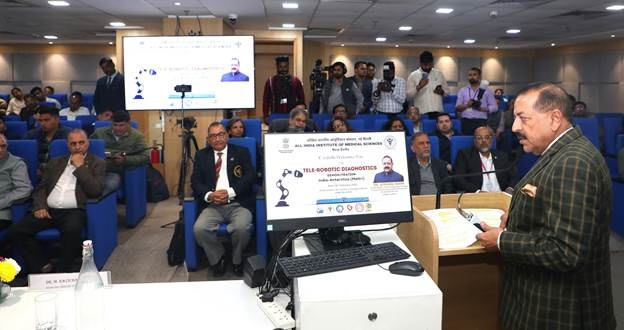
NEW DELHI — In a landmark demonstration of “frontier medicine,” a radiologist at the All India Institute of Medical Sciences (AIIMS) in New Delhi successfully performed a live ultrasound scan on a volunteer located over 12,000 kilometers away at the Maitri Research Station in Antarctica.
The event, held on February 16, 2026, was overseen by Union Minister Dr. Jitendra Singh and marks a significant leap in tele-robotics and Artificial Intelligence (AI) integration. The technology, indigenously developed through a collaboration between AIIMS, IIT Delhi, and the National Centre for Polar and Ocean Research (NCPOR), aims to provide specialist diagnostic care to the most inaccessible corners of the globe—and eventually, the most remote villages in India.
“This is not just about a machine; it is about the convergence of AI, robotics, and real-time medical expertise to break geographical barriers,” said Dr. Jitendra Singh during the demonstration. “We are witnessing a new era where a specialist in a metropolitan hospital can touch a patient in the frozen desert of Antarctica.”
The Technology: Six Degrees of Freedom
At the heart of this breakthrough is a robotic arm equipped with an ultrasound probe. Unlike standard telemedicine, which often relies on video consultation, this system uses Tele-Robotic Ultrasonography (TUS).
The system allows a doctor in Delhi to manipulate a joystick or a haptic device that mimics their hand movements. The robotic arm in Antarctica responds with six degrees of freedom, replicating the precise tilting and sliding of a probe required to capture high-quality diagnostic images.
Key Technical Features:
-
Low Latency: The system operates with a delay of less than one second, crucial for real-time adjustments during a scan.
-
Force-Sensing Safety: Built-in sensors ensure the robot does not apply excessive pressure to the patient, mimicking the “tactile feel” a radiologist relies on.
-
Diagnostic Versatility: The system can perform FAST (Focused Assessment with Sonography for Trauma) scans, abdominal evaluations, and cardiac assessments.
Solving the “Evacuation Dilemma”
For the scientists and researchers stationed at Maitri, healthcare is a logistical nightmare. Antarctica’s extreme weather often makes airlifting patients impossible for weeks at a time. Even when possible, a single medical evacuation can cost hundreds of thousands of dollars.
Dr. M. Ravichandran, Secretary of the Ministry of Earth Sciences, noted that this innovation could drastically reduce unnecessary evacuations. By providing a definitive diagnosis on-site via tele-robotics, medical teams can decide whether a patient can be treated locally or truly requires the risks of a long-distance flight.
“In remote environments, information is as valuable as medicine,” says Dr. Arvinder Singh, a senior radiologist not involved in the study. “If you can rule out internal bleeding or an organ rupture using a tele-robotic FAST scan, you save lives and resources simultaneously.”
From the South Pole to Rural India
While the Antarctica demonstration captures the imagination, the broader implications lie in India’s domestic healthcare challenges. The “rural-urban divide” remains a persistent hurdle, with the majority of specialists concentrated in Tier-1 cities.
Dr. Jitendra Singh emphasized that this “Whole-of-Government” approach—combining the engineering prowess of IIT with the clinical expertise of AIIMS—is designed for scalability. The goal is to deploy these robust, affordable robotic units in:
-
Border Areas: Providing immediate trauma care to soldiers in high-altitude zones.
-
Disaster Zones: Offering diagnostic support when hospitals are inaccessible.
-
Rural Health Centers: Allowing a single specialist in a city to “visit” multiple village clinics in one day.
Challenges and Limitations
Despite the successful demonstration, experts caution that widespread adoption faces hurdles.
“The primary challenge for tele-robotics in rural India isn’t just the robot; it’s the ‘pipe’—the high-speed, stable internet connection required to maintain low latency,” says Dr. Sameer Varma, a health technology consultant.
Furthermore, while the robot replicates movement, it cannot yet replace the physical presence of a healthcare provider to manage patient anxiety or handle complications that arise during a physical examination. There is also the matter of cost-effectiveness; while cheaper than an Antarctic evacuation, the initial investment for a rural clinic remains high compared to traditional diagnostic tools.
The Road Ahead: AI Integration
The next phase of the project involves deeper AI integration. Future iterations of the TUS system are expected to include AI “auto-navigation” features, where the software helps the robotic arm find the optimal window to view an organ, even if the remote operator faces a minor lag in connection.
As India strengthens its Arctic policy and deep-ocean missions, these medical innovations are proving that “frontier science” has very practical, life-saving applications for the general public.
“We are moving toward a future,” Dr. Singh concluded, “where quality healthcare is a right determined by technology, not by your PIN code.”
Reference Section
Official Sources:
-
Press Information Bureau (PIB) India: “Tele-Robotics to add new dimension to healthcare with value addition through AI: Dr Jitendra Singh” (Posted 16 Feb 2026).
Medical Disclaimer: This article is for informational purposes only and should not be considered medical advice. Always consult with qualified healthcare professionals before making any health-related decisions or changes to your treatment plan. The information presented here is based on current research and expert opinions, which may evolve as new evidence emerges.