 0
0
 0
0
January 10, 2026
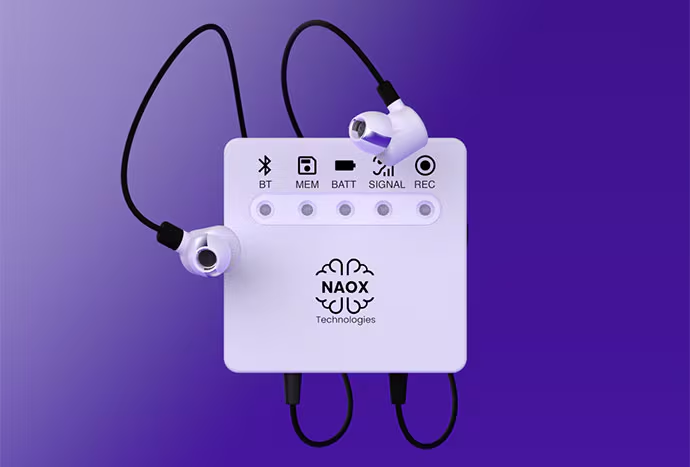
SILVER SPRING, MD — The U.S. Food and Drug Administration (FDA) has granted 510(k) clearance to Naox Link (NX01), the first-of-its-kind in-ear electroencephalography (EEG) system. Developed by Paris-based Naox Technologies, the device is authorized to acquire, record, and transmit brain electrical activity via noninvasive electrodes tucked inside the ear canal. This regulatory milestone transitions EEG—a diagnostic cornerstone for nearly a century—from a complex, gel-heavy hospital procedure to a discreet, earbud-like experience for patients at home.
The clearance covers use in both adults and children aged 6 years and older, provided the data is interpreted by a licensed healthcare professional. While the device does not offer automated diagnoses, its ability to capture long-duration, real-world data is expected to transform how clinicians manage epilepsy, sleep disorders, and neurodegenerative risks.
Redefining the “Gold Standard”
For decades, the “gold standard” for monitoring brain waves has involved a “cap” of 20 or more electrodes glued to the scalp with conductive gel. While highly accurate, this traditional setup is cumbersome, often limits patients to short 30-minute sessions, and can be intimidating for pediatric patients.
“EEG has traditionally been constrained by clinical settings that fail to reflect patients’ real lives,” said Hugo Dinh, co-founder and CEO of Naox Technologies, in a statement following the clearance.
The Naox Link addresses these barriers by integrating soft, biocompatible dry electrodes into wired earbuds. By moving the recording site to the ear canal, the system allows for ambulatory monitoring—meaning patients can go about their daily routines or sleep in their own beds while their brain activity is recorded.
Evidence from the Ear Canal
The FDA’s decision was bolstered by clinical data comparing in-ear signals to traditional scalp-based EEG.
-
Signal Quality: A study published in the journal Sensors confirmed that the Naox Link provides viable signal quality for brain activity monitoring.
-
Sleep and Wakefulness: Research in Frontiers in Neuroscience involving 30 healthy adults demonstrated that in-ear recordings were comparable to conventional EEG during both wakefulness and sleep.
-
Validation: The technology was tested against the T7 and T8 electrode positions—the areas of the scalp closest to the ears—showing strong correlation in detecting alpha waves and sleep stages.
However, the transition to the ear is not without trade-offs. The Frontiers study noted that while signal quality is high, in-ear EEG is more susceptible to motion-related artifacts—electrical “noise” caused by jaw movements or head shifts—compared to traditional scalp electrodes.
Clinical Impact: Epilepsy and Beyond
The primary benefit of the Naox Link is its capacity for longitudinal monitoring. In epilepsy care, many seizures are infrequent or occur only during sleep, making them easy to miss during a brief office visit.
“A comfortable in-ear system that works overnight and at home opens an entirely new window into brain function,” noted Dr. Gilles Huberfeld, a scientific advisor to Naox. “Capturing the brain’s long-term dynamics is a prerequisite for being one step ahead of neurological disease.”
Beyond epilepsy, the device is being utilized in research for:
-
Sleep Medicine: Facilitating more natural sleep staging without the “first-night effect” often seen in sleep labs.
-
Alzheimer’s Research: Detecting early “epileptiform” activity in patients at risk for neurodegenerative diseases.
-
Pediatrics: Offering a less invasive way to monitor children with focal epilepsies.
Looking Ahead: 2026 and the “Naox Wave”
Currently, the Naox Link is available to a select group of neurology and sleep centers in the United States. Naox Technologies has announced plans for broader clinical availability in late 2026.
Furthermore, the company is leveraging this medical-grade technology to develop Naox Wave, a consumer-focused platform. While the Link remains a prescription medical device, the Wave platform aims to integrate brain-sensing technology into everyday wireless earbuds for general wellness tracking.
Expert Perspective and Limitations
Independent experts urge a balanced view of the new technology. While the convenience is undeniable, the Naox Link provides a single-channel EEG. This is significantly less spatial data than a full 20-electrode clinical cap, which can pinpoint exactly where in the brain a seizure originates.
“In-ear EEG is a fantastic screening and monitoring tool, but it’s a complement to, not a replacement for, full-scalp EEG,” says Dr. Sarah Thompson, a clinical neurologist not involved with Naox. “For complex diagnostic questions where we need to map the entire brain’s surface, the traditional cap will still be necessary. However, for a patient needing 48 hours of monitoring to see if a medication is working, this is a game-changer.”
Reference Section
- https://www.medscape.com/viewarticle/fda-clears-first-ear-eeg-device-2026a10000op
Medical Disclaimer: This article is for informational purposes only and should not be considered medical advice. Always consult with qualified healthcare professionals before making any health-related decisions or changes to your treatment plan. The information presented here is based on current research and expert opinions, which may evolve as new evidence emerges.