 0
0
 0
0
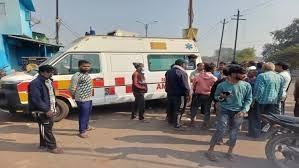
DHANBAD, JHARKHAND – A silent but deadly toxic gas leak emanating from a closed coal mine in the Kenduadih area of Dhanbad has claimed two lives and left nearly two dozen hospitalized, sparking a major public health emergency in India’s coal capital.
The incident, which began late Wednesday, December 3, 2025, has forced the urgent evacuation of over 1,000 residents from the densely populated neighborhoods of Rajput Basti and Masjid Mohalla. As authorities scramble to contain the leak from the mine—shuttered for over 15 years—health officials are warning of the insidious dangers posed by “afterdamp,” a lethal cocktail of gases produced by underground mine fires.
The “Silent Killer” Strikes
Local authorities have confirmed the deaths of two women, Priyanka Devi and Lalita Devi. Residents reported that the victims collapsed suddenly after complaining of severe breathlessness and nausea.
“The patient presented with symptoms of acute chemical asphyxiation, including foaming at the mouth and respiratory failure,” stated a senior medical officer at the local district hospital, speaking on condition of anonymity. “These clinical signs are consistent with high-level exposure to a mixture of carbon monoxide and other irritant gases.”
Reports indicate that nearly 20 others have been hospitalized with symptoms ranging from severe eye irritation and headaches to vomiting and dizziness. The leak has affected an estimated 10,000 residents across a 400-foot radius, turning entire neighborhoods into hazardous zones.
Medical Analysis: Understanding the Toxicity
While official post-mortem reports are pending, experts suspect the primary culprit is Carbon Monoxide (CO), often referred to in mining safety as “whitedamp.”
“Carbon monoxide is terrifying because it is the ultimate stealth killer—colorless, odorless, and tasteless,” explains Dr. Rajesh Kumar, a pulmonologist and occupational health specialist not involved in the incident. “When inhaled, CO binds to hemoglobin in the blood 200 to 250 times more effectively than oxygen. It essentially starves the body’s vital organs of oxygen within minutes.”
However, the reports of “severe eye irritation” suggest a more complex chemical profile. “Pure carbon monoxide does not irritate the eyes,” Dr. Kumar notes. “The presence of eye and throat irritation suggests the gas plume likely contains a mixture known as ‘afterdamp’ or ‘firedamp,’ which can include sulfur dioxide ($SO_2$), hydrogen sulfide ($H_2S$), and particulate matter from the underground combustion. This combination creates a dual threat: chemical asphyxiation from the CO and severe respiratory inflammation from the irritants.”
A Community on the Edge
The leak has reignited long-standing tensions in the Jharia coalfield region, where underground fires have raged for decades. On Thursday morning, panicked residents blocked the Dhanbad-Ranchi highway, burning tires and accusing Bharat Coking Coal Limited (BCCL) of negligence.
“We have been living on a ticking time bomb,” said Pradeep Kumar Thakur, a local resident who witnessed the tragedy. “They marked the area as unsafe years ago but gave us nowhere to go. Now, the ground beneath us is spewing poison.”
Dhanbad Deputy Commissioner Aditya Ranjan has ordered a high-level probe into the incident and directed the immediate establishment of tent cities to house displaced families. “Our priority is saving lives. We are moving people out of the danger zone immediately,” Ranjan told the press.
BCCL officials have stated that the gas was likely “trapped under pressure” in the abandoned mine galleries and began escaping through surface cracks. General Manager G.C. Saha admitted that a permanent solution would require the complete evacuation of the fire-affected zone—a logistical challenge that has stalled for years.
Public Health Implications
The immediate danger is acute toxicity, but the long-term health implications for the 10,000 exposed residents are concerning.
-
Neurological Damage: Survivors of acute CO poisoning are at risk for delayed neurological sequelae, which can include memory loss, cognitive decline, and motor dysfunction weeks after the initial exposure.
-
Respiratory Distress: For vulnerable populations—children, the elderly, and those with pre-existing conditions like asthma or COPD—inhaling mine fire particulates can trigger severe exacerbations and permanent lung damage.
-
Chronic Exposure: Residents living on the periphery of the leak zone face the risk of chronic low-level CO exposure, which is often misdiagnosed as chronic fatigue or flu but can lead to long-term cardiac strain.
What Residents Should Do
Health authorities are advising all residents in the Kenduadih, Rajput Basti, and Officer Colony areas to evacuate immediately if they experience:
-
Persistent headaches or dizziness
-
Nausea or vomiting
-
Shortness of breath
-
Confusion or weakness
“Do not rely on your sense of smell to detect danger,” warns the National Institute of Occupational Health (NIOH) guidelines. “By the time you smell smoke or sulfur, carbon monoxide levels may already be lethal.”
Medical Disclaimer:
This article is for informational purposes only and should not be considered medical advice. Always consult with qualified healthcare professionals before making any health-related decisions or changes to your treatment plan. The information presented here is based on current research and expert opinions, which may evolve as new evidence emerges.
References:
-
Primary Incident Report: Nagaland Tribune. (2025, Dec 4). “Toxic gas leak from closed coal mine in Dhanbad kills two, mass evacuation underway.”