 0
0
 0
0
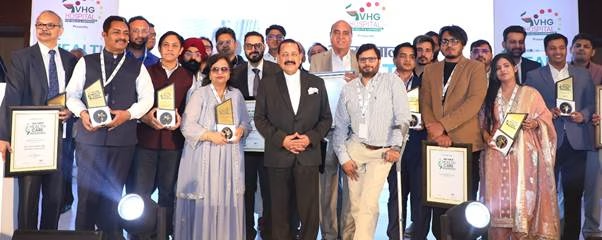
NEW DELHI — In a move to bolster the future of India’s healthcare infrastructure, Union Minister Dr. Jitendra Singh presented awards to 26 young medical professionals on March 5, 2026. The ceremony, held in the national capital, recognized rising stars across diverse specialties—including oncology, endocrinology, and emergency medicine—highlighting a strategic shift toward encouraging medical excellence during the “prime” of a physician’s career.
The event comes at a pivotal moment as the global healthcare sector grapples with the rapid integration of Artificial Intelligence (AI) and a shifting disease burden that combines traditional infectious threats with a surge in lifestyle-related chronic conditions.
A Strategic Shift: Recognizing Early-Career Excellence
Dr. Jitendra Singh, who serves as the Minister of State for Science & Technology and is himself a renowned endocrinologist, emphasized that honoring doctors early in their professional journey provides a unique motivational “boost” that lifetime achievement awards cannot replicate.
“Recognizing talent early not only boosts confidence but also inspires young medical professionals to continue contributing to society with greater commitment,” Dr. Singh stated during the conclave. He noted that while senior professionals deserve accolades for their legacy, the formative years are when a “nudge” toward excellence can most effectively shape the trajectory of national healthcare delivery.
The 26 awardees represent the vanguard of Indian medicine, selected for their contributions to:
-
Oncology: Implementing precision medicine in cancer care.
-
Paediatrics: Advancing neonatal survival rates.
-
Endocrinology: Managing the burgeoning diabetes epidemic in rural and urban sectors.
-
Emergency Medicine: Improving “Golden Hour” response times in trauma care.
The AI Frontier: Human Intuition vs. Machine Precision
A central theme of the Minister’s address was the “revolutionary transformation” of healthcare through technology. As AI tools increasingly handle diagnostic data and conventional learning patterns, Dr. Singh offered a nuanced perspective on the future of the stethoscope.
“The role of a doctor remains irreplaceable because experience and clinical intuition continue to play a crucial role in patient care,” he remarked. This sentiment aligns with current global medical discourse, which views AI as a “co-pilot” rather than a replacement.
According to a 2025 report by the World Health Organization (WHO), while AI can analyze radiological images with 95% accuracy, the human element—empathy, ethical judgment, and complex physical examination—remains the bedrock of patient outcomes.
“The challenge for the modern doctor is no longer just memorizing textbooks, but mastering the interface between technology and the patient’s bedside,” says Dr. Arvinder Soin, a leading transplant surgeon not involved in the awards ceremony. “Dr. Singh’s call for ‘continuous updating’ is the only way to stay relevant in this decade.”
From Syphilis to Specialization: The Evolution of Medicine
Dr. Singh reflected on the historical shift in medical education. Previously, mastering a few “sentinel” diseases like syphilis or tuberculosis provided a window into the entire field of medicine. Today, the sheer volume of medical data has forced a move toward hyper-specialization.
The Minister advised the young medicos to focus on specific niches. This “depth-over-breadth” approach is supported by data from the National Institutes of Health (NIH), which suggests that specialized centers of excellence consistently report lower complication rates and higher patient satisfaction in complex surgeries and chronic disease management.
The Post-COVID Landscape
The Minister also addressed the “Double Burden” of disease facing India today:
-
Communicable Diseases: The lingering vigilance required post-COVID-19.
-
Non-Communicable Diseases (NCDs): The rising tide of hypertension, heart disease, and mental health disorders.
Statistics from the Indian Council of Medical Research (ICMR) indicate that NCDs now account for nearly 66% of all deaths in India. Dr. Singh argued that this environment makes specialized knowledge and lifelong learning “non-negotiable” for the modern physician.
Implications for Public Health and Patients
For the general public, this emphasis on young, tech-savvy, and specialized doctors signals a shift toward more personalized care. As these awardees implement new technologies in their respective hospitals, patients can expect:
-
Faster Diagnoses: Through the integration of AI-assisted screening.
-
Precision Treatment: Especially in oncology and endocrinology, where treatments are increasingly tailored to genetic profiles.
-
Enhanced Access: As young doctors are often the early adopters of tele-health and remote monitoring tools.
However, some public health experts caution against over-specialization at the cost of primary care. “While we celebrate these 26 specialists, we must ensure the ‘family doctor’ model doesn’t disappear,” notes Dr. K. Srinath Reddy, former President of the Public Health Foundation of India. “The goal should be a specialized doctor who still understands the patient as a whole person, not just a collection of organ systems.”
Looking Ahead
The ceremony concluded with a vision of the future. Dr. Singh expressed confidence that these 26 professionals would eventually return to the stage decades from now to receive lifetime achievement honors. By incentivizing excellence at the start of the race, the government aims to ensure that the “prime” of these doctors’ careers is spent pushing the boundaries of what is possible in Indian medicine.
As AI continues to evolve, the message from the ministry is clear: the most successful doctors of tomorrow will be those who marry high-tech tools with the timeless art of clinical intuition.
Reference Section
-
Primary Source: Press Information Bureau (PIB) Delhi. “Union Minister Dr Jitendra Singh presents awards to 26 young medical professionals.” Posted 05 March 2026.
Medical Disclaimer: This article is for informational purposes only and should not be considered medical advice. Always consult with qualified healthcare professionals before making any health-related decisions or changes to your treatment plan. The information presented here is based on current research and expert opinions, which may evolve as new evidence emerges.