 0
0
 0
0
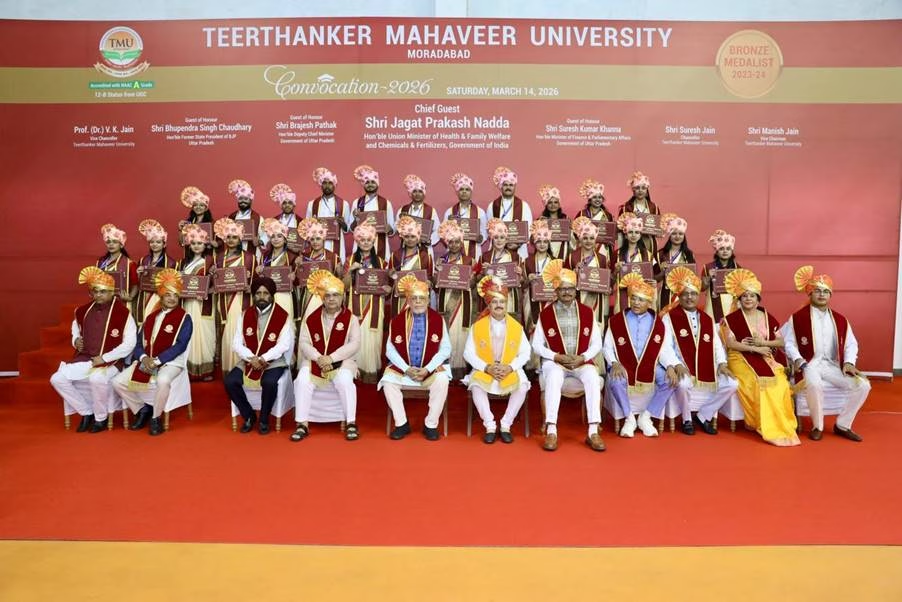
MORADABAD — Addressing over 6,000 graduates at the Teerthanker Mahaveer University (TMU) convocation on March 14, 2026, Union Minister for Health and Family Welfare Shri J.P. Nadda issued a clarion call for young professionals to lead India’s healthcare evolution. Amidst a backdrop of significant statistical gains in maternal health and infectious disease control, Nadda framed the current era, known as Amrit Kaal, as a pivotal window for graduates to bridge the gap between academic excellence and social responsibility in building a Viksit Bharat (Developed India) by 2047.
The ceremony, which saw 6,041 students receive degrees across various disciplines, served as a platform to highlight a decade of systemic shifts in India’s public health landscape—ranging from a massive expansion in medical education to a drastic reduction in the financial burden on patients.
A Shift in Medical Education and Infrastructure
A cornerstone of the Minister’s address was the rapid expansion of India’s premier medical infrastructure. Nadda noted that the number of All India Institutes of Medical Sciences (AIIMS) has grown from six to 23 in just over a decade. This expansion is not merely about buildings; it represents a strategic decentralization of high-quality tertiary care and research opportunities.
At TMU specifically, the Minister commended the university’s alignment with national needs, noting that 60% of its 150 academic programs are dedicated to medical and allied health sectors.
“You are entering the professional world during a phase where the country moves toward a vision of total development,” Nadda stated. “This period presents both an opportunity and a responsibility to shape the nation’s future.”
Milestone Achievements in Public Health Indicators
The Minister provided a data-driven look at India’s progress, citing figures that suggest the country is outperforming global averages in several critical areas:
1. Maternal and Child Health
India has recorded a staggering 86% decline in the Maternal Mortality Ratio (MMR). To put this in perspective, the global average reduction during the same period stands at approximately 48%. Public health experts attribute this to improved institutional delivery rates and the strengthening of the National Health Mission (NHM) frameworks.
2. The Fight Against Tuberculosis (TB)
While TB remains a significant global challenge, Nadda highlighted that India’s incidence of the disease has declined by 21%. This outpacing of the global decline rate (12%, according to the World Health Organization) suggests that India’s “TB Mukt Bharat” (TB-Free India) initiative is gaining measurable traction through early detection and nutritional support.
3. Cancer Care and Timely Intervention
Citing data published in The Lancet, the Minister pointed out that roughly 90% of cancer patients in India now begin their treatment within 20 days of diagnosis. This metric is a vital indicator of improved diagnostic pathways and reduced “wait-time” lethality in oncology.
Reducing the ‘Financial Toxicity’ of Healthcare
One of the most significant hurdles in Indian healthcare has historically been Out-of-Pocket Expenditure (OOPE)—the money patients pay directly for services not covered by insurance.
Nadda reported a sharp decline in OOPE, falling from 62.6% to 39.4%. This shift is largely attributed to the Ayushman Bharat Pradhan Mantri Jan Arogya Yojana (PM-JAY). Currently the world’s largest government-funded health insurance scheme, it provides ₹5 lakh per family annually for secondary and tertiary care.
-
Reach: Over 71 crore beneficiaries.
-
Impact: Millions of families have been prevented from falling into poverty due to “catastrophic health expenditures.”
The “Gender Gap” in Academic Excellence
A striking feature of the 2024–25 academic session at TMU was the dominance of female graduates in the merit lists. Out of 156 medal recipients, 112 were girls. This trend was reflected across all categories:
-
Gold Medals: 40 girls vs. 14 boys
-
PhD Awards: 19 women out of 36 recipients
This surge in female representation in medical and doctoral programs signals a shift in the demographic makeup of India’s future healthcare workforce, promising a more diverse and inclusive medical community.
Challenges and the Path Ahead
While the statistics presented by the Union Health Minister are encouraging, independent health policy analysts suggest that challenges remain. “The expansion of infrastructure like AIIMS is vital,” says Dr. Arvinder Singh, a public health consultant not affiliated with the government. “However, the next decade must focus equally on the quality of care and the retention of skilled medical staff in rural areas to ensure these new facilities function at peak capacity.”
Furthermore, while the decline in OOPE is significant, critics often point out that the cost of outpatient medicines—which are not always covered by PM-JAY—remains a burden for the lowest income brackets.
A Call to Social Responsibility
In his closing remarks, Shri Nadda reminded the 6,041 graduates that their degrees were a “collective effort” of their families and society. He urged the new doctors, nurses, and researchers to carry a sense of “social debt,” emphasizing that true professional success in the Amrit Kaal is measured by the service one returns to the community.
Reference Section
- https://www.pib.gov.in/PressReleasePage.aspx?PRID=2240151®=3&lang=1
Medical Disclaimer: This article is for informational purposes only and should not be considered medical advice. Always consult with qualified healthcare professionals before making any health-related decisions or changes to your treatment plan. The information presented here is based on current research and expert opinions, which may evolve as new evidence emerges.