 1
1
 0
0
Read Time:5 Minute, 26 Second
Introduction
Diarrheal diseases are a major cause of morbidity and mortality, particularly in children under 5 years of age. Globally, diarrhea remains the third leading cause of death in children 1–59 months of age, despite being both preventable and treatable. In India, diarrhea contributes significantly to under-five mortality, prompting the need for comprehensive public health action.
Diarrhoea is defined as the passage of 3 or more loose or liquid stools per day (or more frequent passage than is normal for the individual). Frequent passing of formed stools is not diarrhoea, nor is the passing of loose, pasty stools by breastfed babies.
However, it is the recent change in the consistency and character of stools rather than the number of stools that is more important.
There are 3 clinical types of diarrhoea:
acute watery diarrhoea – lasts several hours or days and includes cholera
acute bloody diarrhoea – also called dysentery
persistent diarrhoea – lasts 14 days or longer.
Burden of Diarrheal Diseases
Globally, diarrheal diseases kill nearly 480,000 children under five annually . and an additional 50 851 children aged 5 to 9 years (WHO, 2022).
In India, diarrhea accounts for ~9% of under-five deaths.
Globally, there are nearly 1.7 billion cases of childhood diarrhoeal disease every year.
High incidence is linked with unsafe water, poor sanitation, low literacy, and malnutrition.
National Diarrheal Disease Control Programme (NDDCP)
The National Diarrheal Disease Control Program (NDDCP) was launched in 1978 by the Government of India under the Ministry of Health and Family Welfare, as part of broader child survival initiatives.
Objectives
Reduce morbidity and mortality due to diarrheal diseases, especially among children <5 years.
Promote early case management using ORS and Zinc supplementation.
Improve community awareness and hygiene practices.
Key Components of the Program
1. Case Management
Oral Rehydration Therapy (ORT) is the cornerstone.
The introduction of Low Osmolarity ORS (245 mOsm/L) as per WHO and GoI recommendation enhances efficacy and reduces stool volume.
Zinc supplementation (per WHO & MoHFW):
10 mg/day for infants <6 months
20 mg/day for children 6 months to 5 years
Duration: 14 days.
2. ORS-Zinc Corners
Established in health sub-centers, Anganwadi Centers, PHCs, and even in community settings during intensified campaigns like IDCF.
Provide:
ORS sachets
Zinc tablets
IEC materials
3. Intensified Diarrhea Control Fortnight (IDCF)
Launched in 2014, IDCF is observed annually to:
Mobilize community action.
Improve coverage of ORS and Zinc.
Involve frontline workers (ASHAs, ANMs, AWWs).
Activities include:
Household visits
ORS distribution
Demonstration of ORS preparation
Counseling on hand hygiene and safe drinking water
4. Surveillance and Reporting
Diarrheal cases are reported via HMIS and IDSP (Integrated Disease Surveillance Programme).
Outbreaks are monitored and investigated.
Weekly trends help identify seasonal peaks (often pre- and post-monsoon).
Etiology and Classification
Causative Agents:
Viruses: Rotavirus (most common), Norovirus
Bacteria: E. coli (ETEC), Vibrio cholerae, Shigella, Salmonella
Protozoa: Giardia lamblia, Entamoeba histolytica
Types of Diarrhea:
Acute watery diarrhea – most common, high risk of dehydration.
Dysentery – blood/mucus in stool, often bacterial (e.g., Shigella).
Persistent diarrhea – lasting >14 days.
Cholera – a public health emergency requiring immediate notification.
Rotavirus Vaccine: A Major Preventive Strategy
Introduced in India’s Universal Immunization Programme (UIP) in phased manner since 2016, now nationally scaled.
Vaccine: Live attenuated oral vaccine
Schedule: 3 doses at 6, 10, and 14 weeks
Impact: Substantial reduction in hospitalizations due to severe rotavirus diarrhea
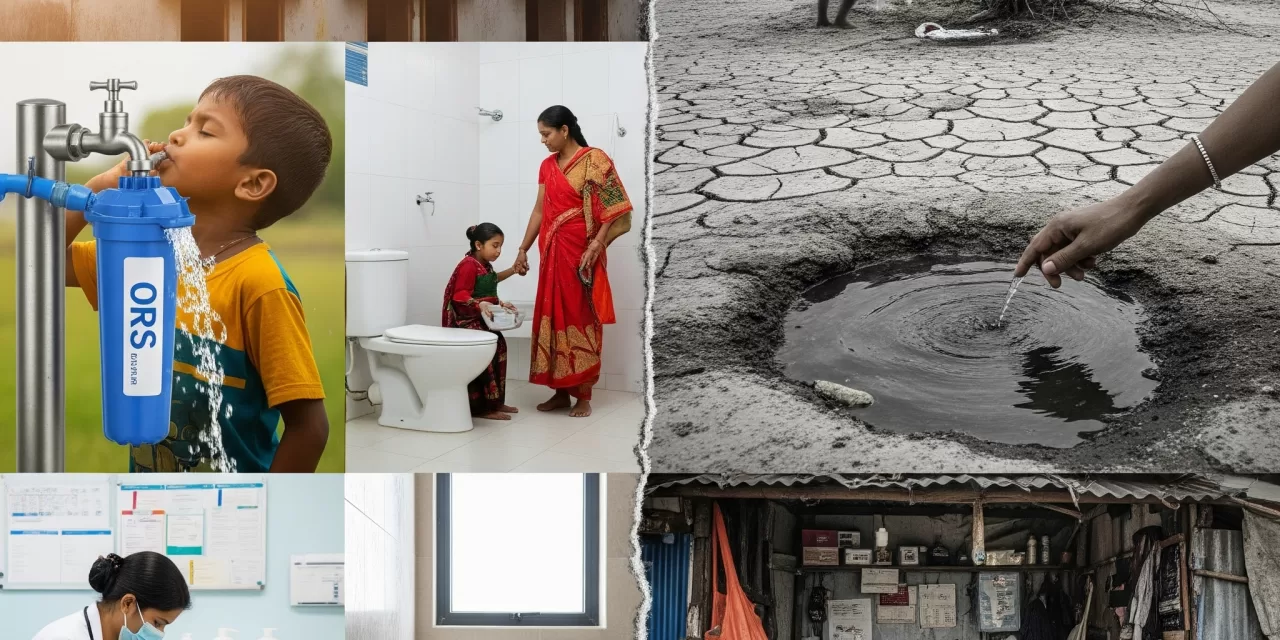
Water, Sanitation, and Hygiene (WASH) Interventions
Diarrheal disease control is incomplete without environmental health:
1. Safe Drinking Water
Chlorination, use of safe storage containers, and point-of-use treatment.
Promotion of boiling, filtration, and disinfection (e.g., chlorine tablets).
2. Sanitation
Swachh Bharat Mission led to improved toilet access and reduced open defecation.
Link with diarrheal reduction is well-documented.
3. Hand Hygiene
Use of soap and clean water before feeding, after defecation.
School-based interventions significantly reduce disease burden.
Information, Education, and Communication (IEC)
IEC is vital for behavioral change. Common messages include:
Prepare and use ORS correctly
Continue breastfeeding during diarrhea
Avoid antibiotics unless prescribed
Seek care for danger signs (sunken eyes, lethargy)
Delivery Methods:
Community health workers
Village Health and Nutrition Days
Media campaigns (radio, print, mobile vans)
Role of Health Workers
ASHA workers: Frontline in ORS-Zinc distribution, counseling, and surveillance.
ANMs & AWWs: Conduct health education, refer cases, maintain ORS stocks.
Medical Officers: Supervise IDCF, outbreak management, and training.
Recent Initiatives and Updates
As per Park’s 28th edition update:
Diarrhea control is integrated under Reproductive, Maternal, Newborn, Child and Adolescent Health (RMNCH+A) framework.
Greater focus on convergence with WASH programs.
Increased digitized reporting and supply chain strengthening.
Program Achievements
Significant reduction in diarrheal mortality among under-fives.
Improved community access to ORS and Zinc.
Enhanced community-level preparedness and outbreak control.
Challenges and Gaps
Gaps in supply chain: inconsistent availability of ORS and Zinc.
Inappropriate antibiotic use: resistance concerns.
Low literacy and cultural beliefs hinder ORT uptake in some regions.
Underreporting of diarrheal deaths, especially in rural areas.
Summary of Prevention and treatment
Key measures to prevent diarrhoea include:
access to safe drinking-water
use of improved sanitation
hand washing with soap
exclusive breastfeeding for the first 6 months of life
good personal and food hygiene
health education about how infections spread
rotavirus vaccination.
Key measures to treat diarrhoea include the following.
Rehydration with oral rehydration salts (ORS) solution. ORS is a mixture of clean water, salt and sugar. It costs a few cents per treatment. ORS is absorbed in the small intestine and replaces the water and electrolytes lost in the faeces.
Zinc supplements reduce the duration of a diarrhoea episode by 25% and are associated with a 30% reduction in stool volume.
Rehydration with intravenous fluids in case of severe dehydration or shock.
Nutrient-rich foods. The vicious circle of malnutrition and diarrhoea can be broken by continuing to give nutrient-rich foods – including breast milk – during an episode, and by giving a nutritious diet – including exclusive breastfeeding for the first 6 months of life – to children when they are well.
Consulting a health professional, in particular for management of persistent diarrhoea or when there is blood in stool or if there are signs of dehydration.
Conclusion
The National Diarrheal Disease Control Programme reflects India’s commitment to child health and public health equity. Through a multipronged strategy—emphasizing prevention, early treatment, and community participation—India has made measurable progress. Sustained focus, strong IEC, and effective WASH integration are key to achieving the SDG target of ending preventable under-five deaths.


Happy
0 %

Sad
0 %

Excited
0 %

Sleepy
0 %

Angry
0 %

Surprise
0 %