 0
0
 0
0
The Zomato founder’s new experimental device targets cerebral circulation, sparking both curiosity and scientific skepticism in the wellness community.
December 8, 2025
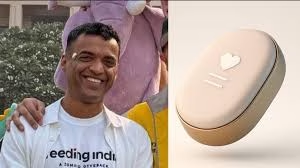
NEW DELHI — Deepinder Goyal, the founder and CEO of Zomato and its parent company Eternal, has officially teased his latest venture into the health technology sector: a wearable device named “Temple.” Designed to monitor cerebral blood flow in real-time, the device marks a significant pivot from food logistics to the complex world of neuroscience and longevity. The announcement, made via social media on Sunday, follows months of speculation surrounding a small golden sensor Goyal was spotted wearing on his temple, confirming his ambitions to commercialize “brain flow” as a new metric for personal health.
From Hypothesis to Hardware
The genesis of Temple lies not in market research, but in what Goyal describes as the “Gravity Ageing Hypothesis”—an unconventional theory he has been exploring through his biology research initiative, Continue Research.
Goyal posits that the constant force of gravity, combined with prolonged upright posture, gradually reduces blood flow to the brain. He hypothesizes that this reduction acts as a primary driver of the aging process and cognitive decline. While the scientific community has long understood the effects of gravity on circulation—such as pooling of blood in the legs—Goyal’s direct correlation between daily gravitational stress on the brain and the rate of human aging is a novel, albeit unproven, proposition.
“While conducting research on the Gravity Ageing Hypothesis, we had to make an experimental device to calculate Brain Flow accurately, real-time, and continuously,” Goyal explained in a statement. He revealed he has been beta-testing the device personally for over a year.
The Science: Promise and Skepticism
The concept of monitoring Cerebral Blood Flow (CBF) is well-established in clinical medicine. CBF is a critical vital sign used to assess conditions like stroke, traumatic brain injury, and dementia.
“Cerebral blood flow is indeed a vital biomarker,” explains Dr. Elena Vance, a neurologist and researcher in cerebrovascular health (not involved in the Temple project). “We know that reduced perfusion is linked to cognitive impairment and neurodegenerative diseases like Alzheimer’s. However, measuring this continuously in a non-invasive, ambulatory setting is an immense engineering challenge.”
Currently, precise CBF measurement typically requires hospital-grade equipment such as fMRI scans, PET scans, or Transcranial Doppler (TCD) ultrasound. While emerging research, such as recent studies from the University of California San Diego, has demonstrated the feasibility of wearable ultrasound patches for this purpose, consumer-grade applications remain rare.
This gap between clinical diagnostics and consumer wellness is where Temple aims to land. However, medical experts urge caution regarding the “Gravity Ageing” theory itself. Critics have noted that the body possesses robust autoregulatory mechanisms specifically designed to maintain constant brain blood flow despite changes in posture.
“The brain is exceptionally good at protecting its blood supply,” notes Dr. Vance. “While monitoring it is valuable, the idea that standing up is a primary accelerator of aging due to gravity is a hypothesis that would require rigorous, peer-reviewed clinical trials to substantiate.”
A New Metric for Wellness?
Despite the skepticism surrounding the gravity theory, Goyal maintains that the device holds independent value. “Brain Flow is already well accepted as a biomarker for aging, longevity, as well as cognition,” Goyal stated. “So this device is useful and relevant even if the Gravity Aging Hypothesis turns out to be wrong.”
If Temple can deliver accurate, continuous data, it could pioneer a new category in the wearables market. Current devices largely focus on cardiovascular metrics (heart rate, HRV) and metabolic health (glucose). A “brain-first” wearable could theoretically help users optimize their cognitive performance by identifying activities, foods, or postures that enhance cerebral circulation.
Market Position and Integrity
Goyal has been careful to distinguish Temple from his primary business interests. He describes Temple as a “small, cute company” distinct from the massive operations of Eternal. Addressing online speculation, he firmly denied that his “Gravity Ageing” theory was a fabricated narrative designed to drive sales.
“We did not ‘cook up’ the Gravity Aging Hypothesis to sell Temple,” Goyal asserted. “Not my game to lose the trust our customers have in me over a marketing gimmick.”
Implications for Public Health
For the health-conscious consumer, Temple represents the growing trend of “quantified self”—the desire to track every biological process to optimize longevity. However, the introduction of complex neurological metrics into the consumer space raises important questions:
-
Actionability: Will users know how to safely interpret fluctuations in brain blood flow?
-
Anxiety: Could constant monitoring of brain health create unnecessary “cyberchondria”?
-
Regulation: As a device making health claims, Temple will likely face scrutiny from medical device regulators before a full commercial release.
As the device moves from a “teaser” phase to a potential launch, the burden of proof will rest on Temple to demonstrate not just engineering prowess, but clinical validity. Until then, it remains a fascinating experiment at the intersection of tech billionaire curiosity and serious medical science.
Medical Disclaimer: This article is for informational purposes only and should not be considered medical advice. Always consult with qualified healthcare professionals before making any health-related decisions or changes to your treatment plan. The information presented here is based on current research and expert opinions, which may evolve as new evidence emerges.
References
-
Primary Source: Goyal, D. (2025). Announcement regarding Temple and Gravity Ageing Hypothesis. Social Media/Press Release via Lokmat Times & Economic Times.
-
News Report: IANS. (2025, December 7). Deepinder Goyal unveils teaser of ‘Temple’, a brain-flow device. Lokmat Times.