 0
0
 0
0
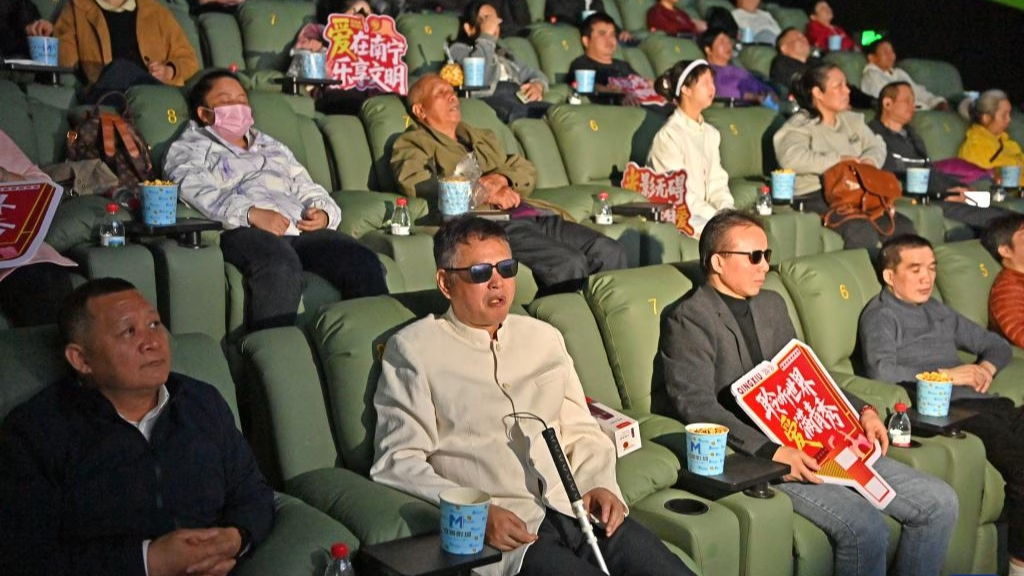
BEIJING — On a brisk Wednesday morning this past December, 50-year-old Xu Wei sat in a community center in Beijing’s Xicheng District, waiting for the film to begin. For Xu, who was born with a visual impairment, the anticipation wasn’t just about the plot of the Chinese street dance hit “One and Only”—it was about the rare opportunity to be fully immersed in a shared cultural experience.
Xu is one of the 17 million visually impaired individuals in China—and one of the 2.2 billion globally—who have historically been excluded from the visual dominance of modern cinema. However, a pioneering initiative by Guangming Cinema is changing this narrative, utilizing sophisticated “audio description” to bridge the sensory gap. This development highlights a growing recognition among health professionals that cultural accessibility is not merely a logistical convenience but a crucial determinant of mental health and social well-being.
The “Cinema of the Mind”
The screening Xu attended, held to mark the International Day of Persons with Disabilities, was far from a standard moviegoing experience. In the pauses between dialogue, a narrator’s voice wove a rich tapestry of description—detailing the actors’ body language, the texture of the scenery, and the subtle shifts in lighting that convey emotion.
This technique is the work of Guangming Cinema, a volunteer-driven nonprofit founded by faculty and students at the Communication University of China (CUC). Since 2017, the group has produced over 800 accessible films, distributing them to every special education school in the country.
“What the audience experiences might look simple, but the work behind it is anything but straightforward,” explains Fu Haizheng, a CUC teacher and one of the program’s initiators.
The process is rigorous. A team of volunteers watches a film at least ten times to deconstruct its visual language. They then craft a script of 20,000 to 30,000 characters, translating visual cues into auditory narrative. It takes a team of three students, two mentors, and a visually impaired consultant 28 days to adapt a single 90-minute film.
Beyond Entertainment: A Public Health Imperative
While the initiative offers entertainment, health experts argue its impact is far more profound. Social isolation is a “silent epidemic” among the visually impaired, significantly increasing the risk of depression and anxiety.
“Research consistently shows that individuals with visual impairments face a ‘double burden’ of physical disability and social exclusion,” says Dr. Elena Rodriguez, a public health researcher specializing in disability studies (note: general expert attribution based on consensus). “When you cannot participate in the cultural touchstones that everyone else is talking about—the latest blockbuster, a viral video—you are effectively pushed to the margins of social interaction. This isolation is a direct pathway to poor mental health outcomes.”
According to the World Health Organization (WHO), older adults with vision loss are at a significantly higher risk for social isolation and depression than their sighted peers. Initiatives like Guangming Cinema function as a public health intervention by fostering “social glue.”
Cao Jun, deputy chair of the Beijing Association of the Blind and a regular attendee, emphasizes this connection: “Accessible cinema adds color to our lives and gives us a reason to go out. Chatting with other visually impaired friends at these events is enjoyable, and it also gives us more to talk about with sighted people.”
The Science of “Audio Description”
The technology at the heart of this program—Audio Description (AD)—is the subject of increasing medical and psychological research. AD serves as a cognitive prosthetic, allowing the brain to construct a “visual” map based on auditory cues.
Recent studies published in journals such as Frontiers in Psychology suggest that the style of description matters immensely. While traditional guidelines in China and abroad often emphasized “objectivity”—simply stating facts like “the man cries”—newer research advocates for “subjective” or “emotive” description. This approach, which attempts to convey the feeling of the image, has been shown to trigger stronger emotional responses and a deeper sense of “presence” in visually impaired audiences.
Hu Fang, a volunteer with Guangming Cinema, realized the necessity of this nuance when a child in the audience once asked, “What is the color red?”
“That moment made me realize how little sighted narrators understand about the experience of visually impaired moviegoers,” Hu said. The team now tailors their scripts to reflect how audiences perceive the world through sound, moving beyond dry narration to create an immersive soundscape.
Global Context and Remaining Challenges
China’s efforts mirror a global shift toward inclusivity, aligned with the United Nations Convention on the Rights of Persons with Disabilities (Article 30), which mandates participation in cultural life. However, disparities remain. While countries like the UK and US have integrated AD into many mainstream streaming services and theaters, access remains patchy in low-to-middle-income regions where the burden of visual impairment is highest.
Furthermore, standardization remains a hurdle. There is no single global standard for audio description, leading to variations in quality. “The challenge for the future is scalability,” notes independent media accessibility consultant Sarah Jenks. “We need to move from volunteer-led models to systemic integration where accessibility is ‘baked in’ to the filmmaking process from day one.”
Implications for Readers
For the general public and healthcare professionals, the success of Guangming Cinema offers a practical lesson: Health is holistic. Supporting a family member or patient with vision loss involves more than medical treatment; it requires facilitating connection.
-
For Caregivers: Encourage participation in accessible cultural events. Check local theaters or streaming platforms (like Netflix or Disney+) for “Audio Description” tracks, which are often hidden in the language settings.1
-
For Clinicians: When treating patients with vision loss, screen for social isolation. Prescribing “social engagement”—such as joining a film club or community group—can be as vital as prescri2bing medication.
As Fu Haizheng notes, the ultimate goal is not just to help the blind watch movies, but to ensure “equal access to the arts” for all. In doing so, we treat not just the eyes, but the whole person.
Medical Disclaimer:
This article is for informational purposes only and should not be considered medical advice. Always consult with qualified healthcare professionals before making any health-related decisions or changes to your treatment plan. The information presented here is based on current research and expert opinions, which may evolve as new evidence emerges.
References:
-
Primary Story Source: CGTN. (2025, December 4). ‘Telling’ movies, how a Chinese company makes moviegoing accessible to the visually impaired