 0
0
 0
0
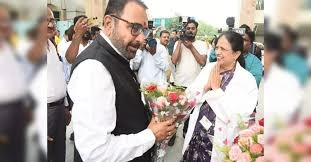
MUMBAI — In a significant move to modernize traditional medicine and foster integrative healthcare, Union Minister of State for Ayush (IC), Shri Prataprao Jadhav, is set to inaugurate the newly renovated Regional Research Institute of Unani Medicine (RRIUM) at the J.J. Hospital campus this weekend. The event, scheduled for February 14, 2026, marks the center’s transformation into a high-tech hub for evidence-based research, coinciding with the national Unani Day 2026 celebrations.
The inauguration will kick off a two-day National Conference titled “Innovation and Evidence in Unani Practice.” The gathering aims to unite traditional practitioners, modern medical researchers, and policymakers to bridge the gap between ancient healing wisdom and 21st-century clinical validation.
A ₹3.84 Crore Leap Toward Integrative Medicine
The renovation of the RRIUM Co-location Centre, completed at a cost of approximately ₹3.84 crore, represents more than just a facelift for a 40-year-old institution. By placing a state-of-the-art Unani research facility within the campus of J.J. Hospital—one of Mumbai’s premier modern medical institutions—the Ministry of Ayush is signaling a commitment to “cross-system” collaboration.
“The goal is not to replace modern medicine, but to complement it,” says Dr. N. Zaheer Ahmed, Director General of the Central Council for Research in Unani Medicine (CCRUM). “With this upgraded infrastructure, we can conduct rigorous, peer-reviewed clinical trials that meet global scientific standards, proving the efficacy of Unani treatments in a language the international medical community understands.”
The Science of Unani: Moving Beyond Tradition
Unani medicine, which traces its roots to ancient Greece and was refined by Persian and Arab scholars like Avicenna (Ibn Sina), operates on the principle of balancing the four “humors” or bodily fluids. While often viewed as “alternative,” the Indian government has increasingly invested in proving its clinical utility for chronic conditions where modern medicine sometimes struggles, such as skin disorders, liver diseases, and musculoskeletal issues.
Key Focus Areas of the National Conference:
-
Research Validation: Utilizing modern diagnostic tools to measure the physiological impact of Unani therapies.
-
Digital Health: The launch of new CCRUM web portals and mobile applications to make Unani research accessible to global practitioners.
-
Pharmaceutical Innovation: Showcasing new standardized formulations that ensure consistent dosage and safety.
“For the general public, this means safer, more reliable options,” explains Dr. M.A. Qasmi, Advisor (Unani) to the Ministry of Ayush. “When a traditional remedy is backed by a double-blind, placebo-controlled trial conducted in a facility like the one at J.J. Hospital, the patient can have the same confidence in it as they do in any other prescription.”
Why Unani Day Matters in 2026
Unani Day is celebrated annually on February 11 to honor the birth anniversary of Hakim Ajmal Khan (1868–1927), a visionary who founded the Ayurvedic and Unani Tibbia College in Delhi. Khan was a staunch advocate for the scientific modernization of traditional systems, a vision that the 2026 celebrations aim to fulfill.
The World Health Organization (WHO) has noted that approximately 80% of the world’s population uses some form of traditional medicine. In India, the “integrative” model—where a patient might receive conventional emergency care while using Unani therapies for long-term recovery—is becoming a blueprint for public health.
Perspectives from the Medical Community
While the expansion of Unani research is met with enthusiasm by many, some in the mainstream medical community urge a cautious, data-first approach.
“Integration is a noble goal, but it must be predicated on safety data,” says Dr. Anil Deshpande, a Mumbai-based consultant who is not affiliated with the CCRUM. “The renovation of this research center is a positive step because it provides the controlled environment needed to study potential herb-drug interactions. We need to know exactly how a Unani formulation for inflammation might interact with a patient’s existing blood-pressure medication.”
What This Means for You
For the health-conscious consumer, the developments in Mumbai suggest three major shifts in the healthcare landscape:
-
Standardization: Renovated centers mean better quality control. Readers can expect Unani medicines to become more standardized in their potency and purity.
-
Accessibility: The launch of new mobile apps will allow users to find verified information on traditional remedies, reducing the risk of following “WhatsApp medicine” or unverified home cures.
-
Collaborative Care: Patients at major hospitals may soon find it easier to consult with both a general physician and a Unani specialist under one roof, ensuring a more holistic approach to chronic illness.
Looking Ahead
The National Conference will also see the exchange of several Memoranda of Understanding (MoUs) between Indian research bodies and international institutions, aiming to export India’s “Evidence-Based Traditional Medicine” model to the world.
As Shri Prataprao Jadhav presides over the ceremony on February 14, the focus will remain firmly on the future. With an investment of nearly ₹4 crore in Mumbai alone, the message is clear: the ancient art of Unani is entering a new era of scientific accountability.
Reference Section
Primary Sources:
-
Press Information Bureau (PIB) Delhi: “Union Ayush Minister Shri Prataprao Jadhav to inaugurate renovated Unani Research Centre at JJ Hospital.” Published Feb 13, 2026.
Medical Disclaimer: This article is for informational purposes only and should not be considered medical advice. Always consult with qualified healthcare professionals before making any health-related decisions or changes to your treatment plan. The information presented here is based on current research and expert opinions, which may evolve as new evidence emerges.